Course Overview
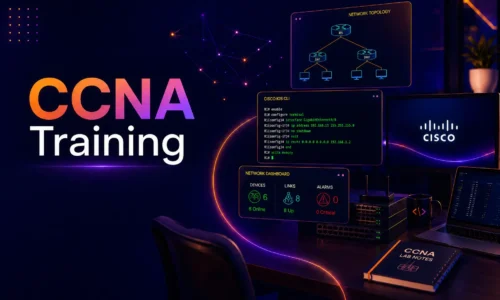
Looking to build a career in networking and develop strong skills in computer network infrastructure? Our CCNA Training in Nepal is designed for students, IT graduates, and aspiring network engineers who want to understand how modern networks are designed, configured, and managed.
This industry-focused training program covers networking fundamentals, OSI and TCP/IP models, IP addressing and subnetting, routing and switching concepts, Cisco router and switch configuration, VLANs, NAT, ACLs, network security basics, and troubleshooting techniques. Through hands-on labs and real-world network simulations, you will learn how to configure and manage small to medium-sized enterprise networks.
Whether you are a beginner or looking to strengthen your networking knowledge, this course provides a structured learning path to build job-ready technical skills. By the end of the training, you will have practical experience and the confidence to pursue roles such as Network Engineer, Network Administrator, IT Support Engineer, or Systems Engineer.
Instead of focusing only on theory, you will:
- Learn how computer networks function in real-world environments
- Configure routers, switches, and network devices through hands-on practice
- Understand IP addressing, routing, switching, and network security fundamentals
- Work with enterprise-level networking concepts used in modern organizations
Whether you want to start a career in networking, prepare for certification, or move into cybersecurity and system administration, this course provides a structured and practical learning path.
Why Choose CCNA Training from AITC Education
Practical Lab-Based Learning
Gain hands-on experience configuring and troubleshooting real networking environments
Industry-Relevant Networking Skills
Learn networking concepts and workflows used in companies, data centers, and enterprise environments
Certification-Focused Preparation
Build the knowledge and confidence required for the CCNA certification exam
Mentorship from Networking Professionals
Learn directly from experienced networking and infrastructure instructors
Career-Oriented Training
Develop technical skills that are in demand across IT support, networking, and cybersecurity roles
Flexible Learning Options
Available in both online and physical classroom formats
What You Will Be Able to Do After This Course
By the end of this training, you will be able to:
- Understand how computer networks and internet communication work
- Configure routers and switches using networking commands
- Work with IP addressing and subnetting
- Understand routing and switching concepts
- Implement basic network security practices
- Troubleshoot common network connectivity issues
- Configure VLANs and network segmentation
- Understand wireless networking fundamentals
- Prepare for the CCNA certification exam
- Work on real networking and infrastructure tasks
Tools and Technologies You Will Use
- Cisco Systems Networking Devices – Routers and switches
- Cisco Packet Tracer – Network simulation and lab practice
- IP Addressing & Subnetting Tools – Network planning and troubleshooting
- Networking Protocols – TCP/IP, DHCP, DNS, VLANs, NAT, and Routing Protocols
Additional tools include network troubleshooting utilities and command-line configuration environments.
Who This CCNA Course is For
- Beginners interested in networking and IT infrastructure
- Students planning careers in system administration or cybersecurity
- IT support professionals upgrading their technical skills
- Anyone preparing for the CCNA certification exam
- Technology enthusiasts wanting practical networking knowledge
No prior networking experience is required; the course starts from the fundamentals.
Career Opportunities After CCNA Training
After completing this course, you can work as:
- Network Support Technician
- Network Administrator
- IT Support Executive
- System Support Technician
- Junior Network Engineer
Opportunities are available in:
- IT companies and corporate offices
- Internet service providers (ISPs)
- Banks and enterprise organizations
- Data centers and infrastructure companies
- Cybersecurity and managed service providers
Portfolio Development Projects
During the course, you will work on:
- Router and switch configuration labs
- IP addressing and subnetting exercises
- Network troubleshooting scenarios
- VLAN and routing configuration projects
- Enterprise-style network simulation environments
These practical exercises help build technical confidence and industry-ready skills.
Certification
You will receive a Certificate of Completion after successfully finishing the course and completing all required practical sessions and projects.
Syllabus
- 9 Sections
- 31 Lessons
- 10 Weeks
- Networking Fundamentals4
- 1.1Introduction to networking
- 1.2Types of networks (LAN, WAN, MAN)
- 1.3OSI Model & TCP/IP Model
- 1.4Network devices overview
- IP Addressing & Subnetting4
- 2.1IPv4 addressing structure
- 2.2Subnetting techniques
- 2.3CIDR notation
- 2.4IPv6 basics
- Cisco Device Basics4
- 3.1Introduction to Cisco IOS
- 3.2Command Line Interface (CLI)
- 3.3Basic router and switch configuration
- 3.4Configuration modes
- Switching Concepts4
- 4.1MAC address learning
- 4.2VLAN configuration
- 4.3Trunking
- 4.4Inter-VLAN routing
- Routing Concepts4
- 5.1Static routing
- 5.2Dynamic routing basics
- 5.3Introduction to OSPF
- 5.4Routing table analysis
- Network Services3
- 6.1DHCP configuration
- 6.2DNS basics
- 6.3NAT (Network Address Translation)
- Network Security Basics3
- 7.1Access Control Lists (ACLs)
- 7.2Device security hardening
- 7.3Secure remote access (SSH)
- Wireless Networking Basics2
- 8.1Wireless standards overview
- 8.2Basic wireless configuration concepts
- Network Troubleshooting3
- 9.1Connectivity testing tools (ping, traceroute)
- 9.2Common network issues
- 9.3Debugging Cisco devices