Getting your salary in Nepal does not always mean receiving the full amount shown in your offer letter or pay slip. Income tax, Social Security Fund (SSF) contributions, and other deductions can affect how much you actually take home each month.
But how much salary tax do you really have to pay? The answer depends on your annual taxable income, the applicable tax slab, eligible deductions, and any rebates you may qualify for.
In this guide, we’ll explain how salary tax in Nepal works for FY 2083/84, including the current tax slabs, SSF deductions, TDS, and rebates. We’ll also work through a Rs. 60,000 monthly salary example so you can see how the calculation works step by step.
Nepal’s Salary Tax Slabs for FY 2083/84, Explained
Nepal uses a progressive tax system for employment income. This means your entire salary is not taxed at one rate. Instead, your annual taxable income is divided across different tax slabs, with each portion taxed at the rate assigned to that slab.
For FY 2083/84, the Inland Revenue Department (IRD) provides the applicable tax rates for natural persons based on annual taxable income. The Ministry of Finance’s Economic Bill 2083 and FY 2083/84 Budget Statement provide the underlying government framework for the current fiscal year.
Annual taxable income | Tax rate |
Up to Rs. 10,00,000 | 1% |
Rs. 10,00,001-15,00,000 | 10% |
Rs. 15,00,001-25,00,000 | 20% |
Rs. 25,00,001-40,00,000 | 27% |
Above Rs. 40,00,000 | 29% |
*The 1% rate in the first slab is Social Security Tax. Individuals contributing to a contribution-based Social Security Fund may be exempt from this 1% tax, subject to the applicable rules.
The tax rate for income above Rs. 40,00,000 is 29%.
The IRD published its FY 2083/84 tax-rate notice for natural persons on 22 Shrawan 2083. Check the latest IRD guidance when using these rates for your own tax calculation or filing.
How do the Salary Tax Slabs Work?
These are marginal tax slabs, so a higher rate does not automatically apply to your entire salary when you move into a higher band. For example, if your annual taxable income reaches Rs. 20,00,000, the calculation is divided across the applicable slabs rather than taxing the full Rs. 20 lakhs at 20%:
- The first Rs. 10,00,000 falls under the first slab.
- The next Rs. 5,00,000 falls under the 10% slab
- The remaining Rs. 5,00,000 falls under the 20% slab
This is why knowing your tax slab alone is not enough to calculate your final tax. You also need to consider which deductions, contributions, rebates, and other adjustments apply to your income.
Your salary tax is not calculated simply by applying a tax rate to your gross salary. The applicable tax rules determine how much of your employment income is taxable and which deductions or benefits can be considered. The next section looks at how SSF contributions fit into this calculation.
What Should You Remember About the FY 2083/84 Slab?
When calculating salary tax, use the rates applicable to FY 2083/84, rather than carrying forward the thresholds from a previous fiscal year. The IRD publishes tax rates and related notices by fiscal year, including separate guidance for tax deducted at source (TDS).
If you are checking your own payroll or preparing a tax calculation, treat this table as a guide and verify the applicable rate and any available tax benefits with the IRD before filing.
How SSF Deductions Affect Your Taxable Salary?
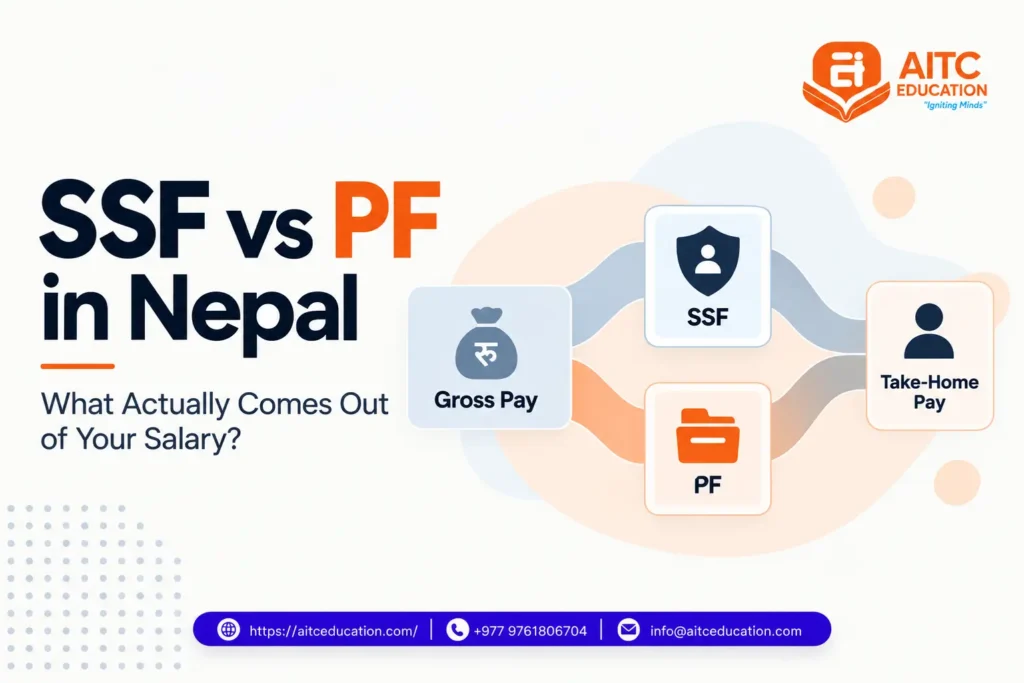
The Social Security Fund (SSF) deduction on your salary slip is separate from income tax. If you are covered by Nepal’s contribution-based SSF system, the total contribution is 31% of the applicable basic remuneration: 11% is contributed by the employee and 20% by the employer. The employer’s 20% contribution is additional and is not deducted from your salary.
SSF Contribution vs. the 1% Social Security Tax
These two are easy to confuse because both use the term “social security”, but they are different. Your SSF contribution is deposited into the Social Security Fund as part of the contribution-based social security system. The employee’s share is 11% of the applicable basic remuneration, while the employer adds another 20%.
The 1% Social Security Tax is a tax applied to the first band of employment income under Nepal’s income-tax rules. It is not the same as your SSF contribution. Importantly, the Inland Revenue Department states that individuals who contribute to a contribution-based Social Security Fund are exempt from this 1% Social Security Tax.
What This Means for Your Salary?
Your SSF deduction affects the amount you receive from your employer because the employee’s 11% contribution is deducted from the applicable basic remuneration. For example, if your monthly contribution-based basic remuneration is Rs. 60,000:
- Employee SSF contribution: Rs. 60,000 x 11% = Rs. 6,600
- Employer SSF contribution: Rs. 60,000 x 20% = Rs. 12,000
- Total monthly SSF contribution: Rs. 18,600
Only the employee’s Rs. 6,600 is deducted from the employee’s salary. The employer’s Rs. 12,000 is an additional contribution and does not reduce the employee’s monthly pay.
For tax purposes, do not confuse the 11% SSF deduction with the 1% Social Security Tax. The IRD’s current tax guidance specifically provides the exemption from the 1% Social Security Tax for eligible contribution-based SSF contributors.
Your actual salary-tax calculation can still vary depending on your salary structure, taxable allowances and benefits, applicable deductions, and other provisions of the current tax rules. For more details, see our guide to SSF deductions explained in full.
Worked Example: Tax on a Rs 60,000/Month Salary
To see how the calculation works, assume an employee earns Rs. 60,000 per month throughout FY 2083/84. For this simplified example, assume the entire Rs. 60,000 is contribution-based basic remuneration, with no bonuses, additional allowances, taxable benefits, or other adjustments.
Step 1: Calculate annual salary
The employee earns: Rs. 60,000 × 12 = Rs. 7,20,000 per year
So, the employee’s annual employment income is Rs. 7,20,000 under these assumptions.
Step 2: Calculate the employee’s SSF contribution
The employee’s SSF contribution is 11% of the applicable basic remuneration.
Rs. 60,000 × 11% = Rs. 6,600 per month
Over 12 months: Rs. 6,600 × 12 = Rs. 79,200 per year
The employer also contributes its own share to SSF. This employer contribution is separate and is not deducted from the employee’s Rs. 60,000 salary. The Social Security Fund’s contribution structure provides for a 20% employer contribution alongside the employee’s 11% contribution.
Step 3: Determine the salary tax
The employee’s annual employment income is Rs. 7,20,000, which falls within the first applicable band for FY 2083/84.
The first band includes a 1% Social Security Tax. However, the Inland Revenue Department provides an exemption from this 1% tax for individuals who contribute to a contribution-based Social Security Fund.
Therefore, under the assumptions in this example, the employee’s salary tax payable is Rs. 0.
Step 4: Estimate monthly take-home pay
Starting with the monthly salary: Rs. 60,000 − Rs. 6,600 SSF = Rs. 53,400
So, the estimated monthly amount received after the employee’s SSF contribution is Rs. 53,400.
This example is simplified. Your actual take-home pay may be different if your basic remuneration is lower than your gross salary, or if you receive allowances, bonuses, taxable benefits, or have other deductions. Your employer may also calculate and deduct TDS based on your actual annual taxable income and applicable tax provisions.
TDS, Rebates and Other Adjustments
TDS, or tax deducted at source, is an advance collection of income tax. When an employer pays salary or remuneration that is subject to tax, the applicable amount is deducted before the employee receives the payment and deposited with the tax authorities.
This means the TDS shown on your pay slip is not a separate tax on top of your annual income tax. It is generally a way of collecting the tax during the year. The Inland Revenue Department publishes separate TDS rates for each fiscal year, including FY 2083/84.
Your employer may calculate the expected annual tax and deduct the applicable amount periodically rather than waiting until the end of the fiscal year. The actual calculation can depend on your salary structure, taxable benefits, deductions, and other applicable adjustments.
Tax Rebates for Eligible Employees
Some employees may qualify for tax rebates under Nepal’s tax rules. For example, a resident individual whose only income is remuneration and who is a woman can receive a 10% rebate on the tax payable, subject to the applicable conditions.
This is a rebate on the calculated tax, not a 10% reduction in your salary or taxable income. For example, if an eligible employee’s calculated tax were Rs. 50,000, a 10% rebate would reduce that tax by Rs. 5,000, leaving Rs. 45,000 payable before any other applicable adjustments.
Not every employee qualifies for the same rebates or deductions, so your final tax calculation may differ from a simple salary-times-tax-rate calculation.
Why Your TDS May Look Different from Your Final Tax?
The amount deducted from your salary each month can depend on your employer’s estimate of your annual taxable income and the information available about your deductions and benefits. Changes in salary, bonuses, allowances, employment during only part of the year, or eligible tax rebates can affect the final calculation.
For this reason, the amount shown as TDS on a pay slip should be viewed as part of your overall tax calculation rather than as a separate additional charge. If you are checking your own tax liability, use the current FY 2083/84 rules and verify the applicable deductions and rebates with the IRD.
Conclusion
Understanding salary tax in Nepal becomes easier when you separate your gross salary, taxable income, tax slab, and payroll deductions. For FY 2083/84, your income is taxed progressively, while deductions such as SSF contributions and eligible rebates can affect your final tax and take-home pay.
If you are an employee, check your pay slip to see how much is being deducted for SSF and TDS, and make sure the calculation is based on the current fiscal year’s rules. The figures in this guide are intended to help you understand the calculation, but you should confirm the applicable rates and benefits with the Inland Revenue Department before filing or making tax decisions.
If you earn income through freelancing or other self-employed work, the tax treatment can be different from regular employment income. Read our guide to tax for self-employed/freelance income to understand how tax works for freelancers in Nepal.
Frequently Asked Questions
What is the tax rate for salary in Nepal?
For FY 2083/84, salary income is taxed progressively, with rates ranging from 1% to 29% depending on your annual taxable income. The 1% first-band charge is Social Security Tax, and eligible SSF contributors are exempt from it.
How much tax do I pay on a Rs. 60,000 salary in Nepal?
A Rs. 60,000 monthly salary equals Rs. 7,20,000 per year. Under the simplified example in this guide, an eligible SSF contributor does not pay salary income tax because the annual income falls within the first Rs. 10 lakh band and the 1% Social Security Tax does not apply.
How is tax calculated on salary in Nepal?
Salary tax is calculated based on your annual taxable income and the applicable progressive tax slabs. Your employer may then deduct TDS from your salary during the year, while eligible deductions and rebates can affect the final amount payable.
How much TDS is deducted on salary in Nepal?
There is no single TDS amount for every employee. The amount depends on your taxable salary, applicable tax rates, deductions, rebates, and other relevant details. Employers calculate and deduct TDS according to the current tax rules and deposit it with the Inland Revenue Department.
Is there a different tax slab for women or couples in Nepal?
No. For FY 2083/84, the applicable employment-income tax rates are based on annual taxable income rather than separate basic slabs for single individuals and couples. Eligible resident women whose only income is remuneration may also qualify for a 10% rebate on the calculated tax, subject to the applicable conditions.