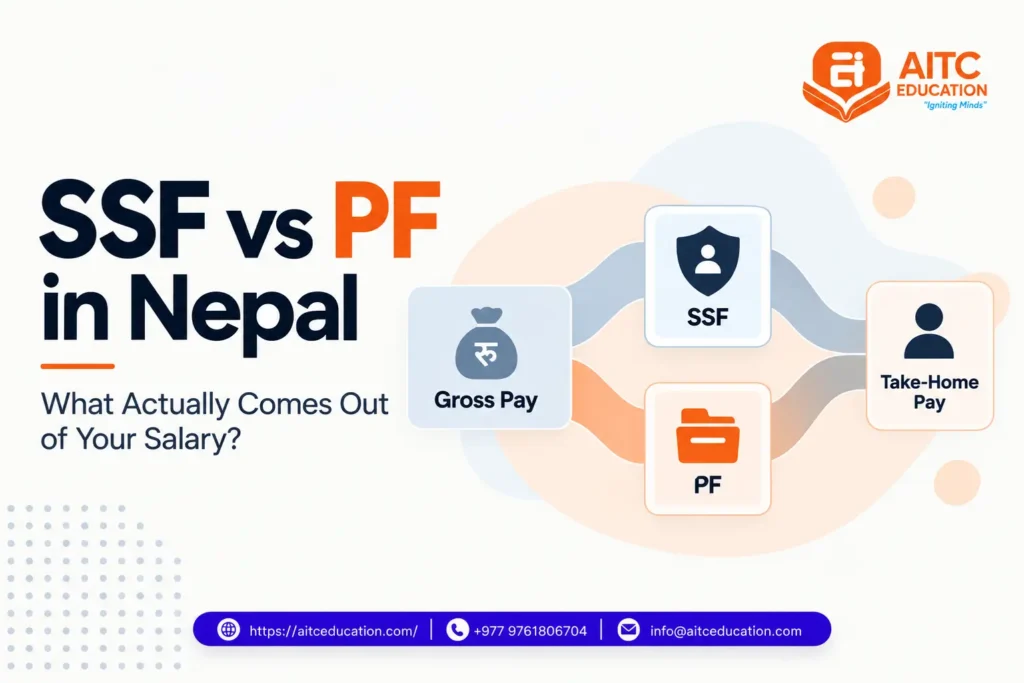
If you have recently noticed SSF or PF being deducted from your salary, you may be wondering what the deduction means and where your money is going. The confusion is especially common when an employer changes from a provident fund arrangement to the Social Security Fund.
SSF and PF both involve contributions from your salary, but they serve different purposes. PF mainly builds long-term savings, while SSF combines retirement-related savings with wider social-security benefits such as medical, maternity, accident, disability, and dependent-family protection.
The difference also affects your take-home pay, employer contribution, access to your funds, and the benefits you receive. In this guide, we’ll compare SSF and PF in Nepal, show what the deductions can look like on a Rs. 50,000 salary, and explain what happens to your existing PF balance if you move to SSF.
What is SSF in Nepal? Understanding the Social Security Fund
The Social Security Fund (SSF) is Nepal’s contribution-based social security system for eligible workers. It collects contributions from employers and employees and uses them to provide different forms of social protection, including old-age, medical, maternity, accident, disability, and dependent-family benefits.
What Does SSF Stand For?
SSF stands for Social Security Fund. It was established to provide contribution-based social protection to workers and their families.
The system is designed around regular contributions during employment. In return, contributors can receive benefits under different SSF schemes when they meet the relevant eligibility and claim conditions.
How Does SSF Work for Employees?
Under the current SSF contribution structure, the employee contributes 11%, and the employer contributes 20% of the applicable contribution base, making the combined contribution 31%. Only the employee’s contribution is deducted from their salary; the employer’s contribution is paid separately by the employer.
The contribution supports different social-security schemes, including medical and health care, maternity, accident and disability, dependent-family protection, and old-age protection, subject to the applicable rules and eligibility conditions.
What is PF in Nepal? Understanding Provident Fund
Provident Fund (PF) is a long-term savings arrangement that helps employees build funds for retirement or after leaving employment. In Nepal, the Employees Provident Fund (EPF), also known as Karmachari Sanchaya Kosh, manages provident-fund contributions for eligible employees and operates under the Employees Provident Fund Act, 2019.
Unlike SSF, which combines retirement protection with several social-security schemes, PF is primarily built around regular contributions, accumulated savings, and the returns earned on those savings.
How Does Provident Fund Work?
Under the regular PF contribution structure, 10% of the employee’s applicable salary is deducted, and the employer contributes an equal 10%. Both amounts are deposited into the employee’s provident fund account, where the accumulated funds can earn interest and profit according to the applicable EPF rules.
The accumulated amount, along with applicable interest and profit, is paid according to EPF rules when the employee retires or separates from employment.
SSF vs PF in Nepal: What Is the Difference?
The main difference between SSF and PF in Nepal is what the contribution is designed to provide. PF primarily builds an accumulated savings fund for employees, while SSF combines old-age protection with several social-security schemes.
Feature | SSF | PF |
Full form | Social Security Fund | Provident Fund |
Main purpose | Social security and old-age protection | Long-term savings and retirement fund |
Employee contribution | 11% of applicable contribution | 10% of applicable salary |
Employer contribution | 20% | 10% |
Total contribution | 31% | 20% |
Medical and health benefits | Available under applicable SSF scheme | EPF also provides certain medical-related services to members |
Maternity benefits | Available under applicable SSF scheme | EPF provides certain maternity-related services |
Accident/disability protection | Covered under applicable SSF schemes | EPF provides certain accident-related benefits |
Dependent-family protection | Available under applicable SSF scheme | Not the primary purpose of regular PF |
Retirement/old-age protection | Yes | Yes |
SSF combines old-age protection with medical, maternity, accident and disability, and dependent-family schemes. PF is primarily structured around accumulated savings, with employee and employer contributions earning applicable interest and profit.
How Are SSF and PF Contributions Calculated in Nepal?
SSF and PF contributions in Nepal are calculated as a percentage of an employee’s salary, with contributions from both the employee and employer. The Social Security Fund (SSF) requires an 11% employee contribution and a 20% employer contribution, while the regular Provident Fund (PF) structure generally requires 10% from each. The actual calculation depends on the applicable contribution rules and salary basis.
SSF Contribution on a Rs. 50,000 Salary
Under the current SSF contribution structure, the employee contributes 11%, and the employer contributes 20%.
Contribution | Rate | Amount |
Employee | 11% | Rs. 5,500 |
Employer | 20% | Rs. 10,000 |
Total | 31% | Rs. 15,500 |
So, Rs. 5,500 is deducted from the employee’s salary, while the employer adds Rs. 10,000 separately. The total Rs. 15,500 is contributed to SSF and allocated across the applicable social-security schemes.
PF Contribution on a Rs. 50,000 Salary
Under the regular PF contribution structure, the employee contributes 10%, and the employer contributes an equal 10%.
Contribution | Rate | Amount |
Employee | 10% | Rs. 5,000 |
Employer | 10% | Rs. 5,000 |
Total | 20% | Rs. 10,000 |
Here, Rs. 5,000 is deducted from the employee’s salary, while the employer adds another Rs. 5,000 to the PF account.
For the same Rs. 50,000 salary, the employee contribution is therefore Rs. 500 higher under SSF, while the total contribution from both employee and employer is Rs. 5,500 higher.
Want to see how these deductions affect your own take-home pay? Use our salary tax calculator to see the figures reflected on your pay slip.
What Are the Benefits of PF in Nepal?
PF helps employees build long-term savings through regular contributions from both the employee and employer. The accumulated balance can earn interest and profit according to applicable EPF rates and arrangements.
The main benefits are:
- Long-term savings: Employee and employer contributions build an accumulated fund over time.
- Employer contribution: The employer adds an amount equal to the employee’s regular 10% contribution.
- Interest and profit: The accumulated balance earns interest and profit according to applicable EPF rates and arrangements.
- Retirement financial support: The accumulated fund provides savings that can be accessed according to EPF rules after retirement or separation from employment.
- Additional member benefits: EPF also provides facilities such as healthcare reimbursement, accident compensation, and maternity and child-care benefits, subject to their respective conditions.
What Are the Limitations of PF?
PF is mainly structured around accumulated savings, so its main focus is building a fund through regular employee and employer contributions. Its social security benefits and facilities are provided separately under the applicable EPF rules and conditions. Access to PF funds and benefits also depends on the relevant EPF rules and eligibility requirements.
What Do You Get from SSF Besides Retirement Savings?
Depending on the applicable scheme and eligibility conditions, SSF can provide:
- Medical and health protection: Benefits related to medical treatment and health care.
- Maternity protection: Benefits related to maternity and childbirth.
- Accident and disability protection: Support for covered accidents or disability.
- Dependent-family protection: Benefits for eligible family members in situations covered by the scheme.
- Old-age protection: Benefits provided under the applicable old-age security scheme.
What Are the Limitations of SSF?
SSF provides broader social-security coverage, but access to individual benefits depends on the relevant contribution and eligibility conditions. Not every contribution is available as a freely withdrawable cash balance, because contributions are allocated across different social-security schemes.
What Happens to Your PF Balance When You Move to SSF?
Your existing PF balance does not simply disappear when your employer moves to SSF. Your old PF balance and future SSF contributions are treated separately.
If your employer is moving from PF to SSF, check with your employer and the Employees Provident Fund about the process for settling your existing PF account. The applicable process depends on the relevant EPF rules and requirements.
Can I Stay on PF Instead of SSF?
If your employer is covered by the Social Security Fund system and moves your employment to SSF, your future employment-based contributions will generally be made through the SSF system rather than regular PF.
Your situation may differ if your employer is not required to participate in SSF or if a specific transition arrangement applies. If your employer is moving from PF to SSF, ask your HR or payroll team how the change applies to your employment and what will happen to your existing PF balance.
Can I Contribute to Both SSF and PF?
If your employer is covered by SSF and makes contributions through the SSF system, your mandatory employment-based contributions are made under SSF rather than regular PF.
However, having an SSF account does not necessarily prevent you from having a separate PF balance from previous employment or another eligible arrangement. Your existing PF account and new SSF contributions should therefore be treated separately when your employer changes from PF to SSF.
Can I Withdraw All My Money from SSF?
You cannot generally withdraw your entire SSF contribution whenever you want. Access to SSF funds depends on the scheme, your employment status, contribution history, and the applicable withdrawal or retirement rules.
For example, SSF’s retirement provisions distinguish between pension and retirement benefits. Contributors who meet the applicable requirements may receive retirement benefits through the relevant scheme. SSF also has a process for claiming retirement amounts after employment ends.
In some situations, the SSF withdrawal process allows a contributor to withdraw the full eligible amount. However, withdrawing the full amount can result in the SSF account being closed, depending on the applicable scheme and process.
SSF should not be treated like a regular savings account where you can withdraw the full balance at any time. The amount you can claim and when you can claim it depend on the specific scheme and applicable conditions.
SSF or PF: Which is Better?
There is no single answer for every employee. SSF and PF serve different purposes, so the most relevant differences are their contribution structure, benefits, and access to funds.
If you value… | SSF | PF |
Retirement/old-age protection | Yes | Yes |
Employee contribution | 11% | 10% |
Employer contribution | 20% | 10% |
Medical/health benefits | Available under SSF schemes | Certain EPF member benefits |
Maternity benefits | Available under SSF schemes | Certain EPF member benefits |
Accident/disability benefits | Available under SSF schemes | Certain EPF member benefits |
Dependent-family protection | Available under SSF schemes | Not the primary purpose |
Main structure | Social-security schemes + old-age protection | Accumulated savings |
SSF combines old-age protection with medical, maternity, accident, disability, and dependent-family schemes, subject to their respective conditions. PF is primarily structured around accumulated savings, with employee and employer contributions deposited into the account and interest and profit added according to EPF arrangements.
Conclusion
SSF and PF both involve regular contributions from your salary, but they work differently. PF primarily builds accumulated savings, while SSF combines old-age protection with broader social-security benefits.
If your employer moves from PF to SSF, your existing PF balance and future SSF contributions should be considered separately. To see how these deductions affect your own take-home pay, use our salary tax calculator.
Frequently Asked Questions
What is the difference between SSF and PF in Nepal?
PF primarily focuses on building long-term savings through employee and employer contributions. SSF combines old-age protection with additional social security schemes such as medical, maternity, accident, disability, and dependent-family protection.
How much is deducted for SSF in Nepal?
The employee contribution under the current SSF structure is 11% of the applicable contribution base. The employer contributes an additional 20%.
How much is deducted for PF in Nepal?
Under the regular PF contribution structure, 10% of the employee’s applicable salary is deducted, and the employer contributes an equal 10%.
Can I stay on PF instead of SSF in Nepal?
If your employer is covered by SSF and has moved employees to the SSF system, you generally cannot choose to continue regular PF contributions through the same employment. The treatment can depend on the applicable employment and transition arrangements.
Can I withdraw all my money from SSF?
You cannot generally withdraw your entire SSF contribution whenever you want. Withdrawal and retirement benefits depend on the applicable SSF scheme, contribution history, employment status, and eligibility conditions.
What happens to my PF balance when my employer moves to SSF?
Your existing PF balance does not simply disappear when your employer moves to SSF. The existing balance and your future SSF contributions are treated separately, and the process for claiming your PF balance depends on the applicable EPF rules and requirements.