Choosing between freelancing and a full-time job can feel very different when you are building a career in Nepal. A regular job may offer a predictable salary and employee benefits, while freelancing can give you more control over your work, clients, and schedule.
But the choice is not simply about earning more or working fewer hours. Your income stability, SSF and PF benefits, leave, taxes, career growth, and ability to find consistent work can all affect which arrangement suits you.
In this guide, we’ll compare freelancing vs a job in Nepal across income, job security, benefits, taxes, and lifestyle. If you are still figuring out how freelancing works day to day, you can also explore our guide before comparing the two paths.
The Core Trade-off: Flexibility vs. Stability
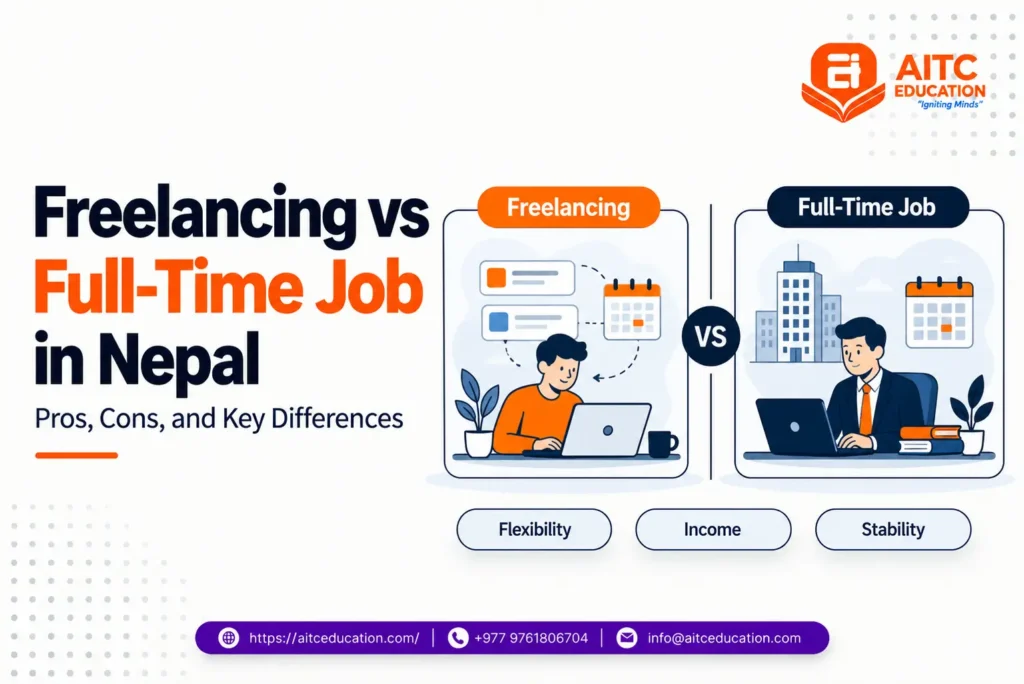
The biggest difference between freelancing and a full-time job is how much control and predictability you have over your work. Freelancing usually gives you more control over your schedule, clients, and projects, while full-time employment generally provides a more structured routine and predictable monthly income.
As a freelancer, you can often choose which projects to accept, decide when to work, and work with multiple clients. That flexibility can be useful if you prefer to manage your own workload or want to build an independent career. However, you also have to find clients, manage deadlines, and deal with periods when work may be limited.
A full-time job usually comes with a defined role, working schedule, and regular salary. You may have less control over your daily work, but the structure can make it easier to plan your monthly finances and build a routine. Depending on the employer and employment arrangement, you may also receive benefits such as paid leave, SSF or PF contributions, and other forms of employee support.
This trade-off is not simply about choosing between freedom and security. It is about deciding which combination of income consistency, control, benefits, and career structure fits your current situation.
Income Potential: Freelancing vs. a Nepali Salary
Income is one of the biggest factors when comparing freelancing with a full-time job in Nepal. Freelancers may have access to international clients and foreign-currency rates, while salaried employees are typically paid according to the salary agreed with their employer.
Freelance rates can vary widely based on skill, experience, type of work, client, and project. A beginner may start with smaller projects while building a portfolio and client base, while an experienced freelancer with specialized skills may charge higher rates.
What Can You Realistically Earn?
Freelance rates vary widely by skill, experience, client, and type of work. As a broad marketplace benchmark, Upwork reports typical rates of $10–$25 per hour for beginners and $25–$60 per hour for intermediate freelancers. These are freelance rates, not guaranteed monthly earnings, and they are not specific to Nepal.
Full-time salaries in Nepal also vary significantly by role, experience, and employer, so there is no single salary range that represents every full-time job in Nepal.
The two figures are not directly comparable. A freelance hourly rate only applies to billable work, while a full-time salary is paid for an agreed employment arrangement. Freelancers may also have unpaid time between projects, client acquisition and administration costs, platform or payment fees, and taxes that affect their actual take-home income.
Freelance Income Is Not the Same as Take-Home Income
A freelance rate can also make the comparison look simpler than it really is. If you charge an international client in USD, for example, the amount converted to NPR is not necessarily what you keep.
You may have to account for platform fees, payment or currency-conversion costs, taxes, unpaid time spent finding clients and communicating with them, and periods without paid work. This means a freelancer earning more from individual projects does not automatically have a higher or more consistent take-home income than a salaried employee.
Factor | Freelancing | Full-time job |
Income | Can vary by project, client, and workload | Usually a regular monthly salary |
Earning potential | Can increase with skills, rates, and client base | Often tied to salary, raises, and promotions |
Foreign-currency income | Possible when working with international clients | Depends on the employer and role |
Unpaid time | Finding clients, pitching, admin, and some communication may be unpaid | Usually part of an employer-managed work structure |
Income gaps | Possible between projects or clients | Generally less affected by individual projects |
Benefits You Give Up (or Gain): SSF, PF, Insurance, and Leave
Salary is only one part of what you receive from a full-time job. Depending on your employment arrangement, formal employment can also come with benefits and protections such as Social Security Fund (SSF) coverage, Provident Fund (PF) contributions, gratuity, paid leave, and insurance.
For workers enrolled in Nepal’s contribution-based social security system, contributions are made by both the employee and employer. The standard contribution is 11% of the employee’s basic salary from the worker and 20% from the employer, with the combined contribution supporting schemes covering areas such as medical and maternity protection, accidents and disability, dependent family protection, and old-age security.
What Happens to SSF and PF?
These contributions are not simply part of your monthly spendable salary. They can provide longer-term financial and social protection, which is why they should be considered when comparing a full-time salary with freelance income.
If you move into freelancing, you no longer have an employer making contributions on your behalf through an employment arrangement. However, Nepal’s social security framework includes provisions for self-employed people, so freelancers should check whether and how they can participate rather than assuming they are automatically excluded.
If you are weighing the employee benefits you’d give up when leaving formal employment, our guide to SSF and PF explains how these systems work and what comes out of your salary.
Leave and Insurance
A full-time employment arrangement may also provide paid leave and insurance-related benefits, depending on the applicable law and your employer’s policy. The Nepal Labor Act sets out statutory provisions on leave, provident fund, gratuity, and other employment benefits. Freelancers generally need to make their own arrangements for time off and related financial protection.
For example, taking a week away from freelance work may mean losing potential billable income unless you have enough savings or ongoing arrangements to cover the gap. An employee with applicable paid leave may be able to take time off without the same direct effect on their regular salary.
This does not make one arrangement automatically better. It means the value of a job includes more than its monthly salary, while a freelancer needs to factor these protections and costs into their overall financial planning.
Can You Do Both? Freelancing Alongside a Full-Time Job
You may be able to freelance while working a full-time job, especially if you want to build experience or a client base without giving up your regular salary. However, check your employment contract and workplace policies first, as some employers may restrict outside work or activities that create a conflict of interest.
You should also keep your freelance work separate from your main job. Avoid using your employer’s time, equipment, confidential information, or resources for client work, and make sure your freelance projects do not interfere with your employment responsibilities.
Time is another practical consideration. Taking on more freelance projects than you can manage can affect both your freelance work and your full-time job, so a smaller, manageable workload is usually easier to balance.
Which Factors Matter Most to You?
There is no single answer to whether freelancing or full-time employment is the better fit. Use the factors below to identify which work arrangement aligns more closely with your current priorities.
If you prioritize | You may want to consider |
Predictable monthly income | Full-time employment |
Greater control over your schedule | Freelancing |
Employee benefits such as SSF, PF, and paid leave | Full-time employment |
Working with multiple clients | Freelancing |
A structured career path within an organization | Full-time employment |
Building an independent client base | Freelancing |
Less responsibility for finding your next source of income | Full-time employment |
More control over which projects you accept | Freelancing |
Your priorities may also change over time. You might prefer the structure of employment while building your skills, then move toward freelancing later, or combine a full-time job with freelance work if your employment arrangement allows it.
Conclusion
The choice between freelancing and a full-time job in Nepal depends on what you need from your work right now. Freelancing can offer greater control over your schedule, clients, and earning opportunities, while full-time employment can provide more predictable income, structured career growth, and employee benefits.
Before deciding, consider your priorities: Do you need a stable monthly income? How important are SSF, PF, paid leave, and insurance to you? Are you comfortable finding clients and managing variable income? Do you want more control over your schedule or a structured work environment?
You also do not necessarily have to make the choice immediately. If your employment arrangement allows it, freelancing alongside a full-time job can help you build skills and clients while maintaining your regular income. If you decide to explore freelancing, start with our guide on how freelancing works day to day to understand the process, rates, clients, and payment options in Nepal.