Every business nowadays is fighting for visibility on search engines like Google & Bing, and this is exactly where SEO (Search Engine Optimization) becomes powerful.
Whether it’s a small blog, an e-commerce store, or a global brand, ranking on search engines can directly determine success or failure.
This growing demand has made SEO one of the most promising skills in the digital marketing industry.
If you are someone looking to enter the digital marketing field, following a proper SEO career roadmap can turn your interest into a high-demand skill and open doors to freelancing, remote jobs, and full-time career opportunities worldwide.
What is Search Engine Optimization (SEO)?
Search Engine Optimization (SEO) is the process of improving the visibility of a website on search engines by optimizing its technical setup and content quality so users can find relevant information more easily through search queries.
While SEO is commonly used for websites, it is not limited to websites only. It is also relevant for e-commerce stores, local business listings, social media content, and even mobile apps to improve their visibility in search results.
Even small improvements in digital content can lead to massive increases in traffic and the gain of leads without spending money on ads.
That’s why many beginners are now choosing SEO as a long-term career path. This is where a clear SEO career roadmap becomes essential.
Instead of learning randomly, a structured roadmap helps you move step-by-step, from understanding the basics of search engines to becoming a skilled SEO professional.
Why Choose a Career in SEO?
A career in SEO is one of the most practical and high-demand choices as businesses continue shifting online, and the need for skilled SEO professionals is rapidly increasing.
Key reasons to choose SEO as a career:
- High demand in the digital marketing industry: Every business needs visibility on Google, making SEO professionals essential.
- Wide range of career opportunities: You can work as an SEO executive, content strategist, freelancer, or consultant.
- Freelancing and remote work opportunities: SEO allows you to work with international clients from anywhere.
- Low entry barrier for beginners: You don’t need a technical or educational degree to start learning SEO.
- Continuous learning and growth: SEO keeps evolving, so your skills always stay relevant.
- Strong income growth with experience: As you gain expertise, your earning potential increases significantly.
- Future-proof digital skill: With increasing AI integration and data-driven marketing, SEO is becoming more advanced, creating long-term career stability and global opportunities.
In short, SEO is not just a skill; it is a long-term digital career path with global opportunities and strong future scope.
Essential Skills Required to Start an SEO Career
To build a successful career in SEO, beginners need both technical and analytical skills. Some of the key skills include:
- Keyword research and analysis
- Basic understanding of website structure
- Content writing and optimization
- Analytical thinking and data interpretation
- Familiarity with SEO tools like Google Analytics and Search Console
- Understanding user search behavior
These skills form the foundation of all SEO career roadmaps and help beginners grow into professional SEO experts.
Step‑by‑Step SEO Career Roadmap for Beginners
A structured roadmap helps beginners learn SEO in the right order and avoid confusion. Instead of learning random tactics, a process-based guide ensures gradual skill development, hands‑on practice, and long‑term growth.
Step 1: Learn SEO Fundamentals
The first step in your SEO career roadmap is understanding core concepts such as on‑page SEO, off‑page SEO, and technical SEO.
Beginners should also learn about organic search results, SERPs, ranking factors, and Google guidelines. Strong fundamentals make advanced SEO techniques easier to understand.
Step 2: Master Keyword Research and Search Intent
Keyword research is the backbone of SEO. Beginners must learn how to identify relevant keywords, analyze search volume and competition, and understand user intent.
Step 3: Understand On‑Page SEO Techniques
On-page SEO includes optimizing content, headings, meta tags, URLs, and images. It ensures that your website content is search-engine friendly and user-friendly.
For beginners, mastering on‑page SEO is crucial because it directly impacts rankings and user experience.
Step 4: Learn Technical SEO Basics
Technical SEO ensures that search engines can crawl and index your website properly. Beginners should learn fundamentals such as site speed, mobile friendliness, XML sitemaps, robots.txt, canonical tags, and website architecture.
Step 5: Explore Off‑Page SEO and Link Building
Off‑page SEO helps improve website authority and trust. Link building, brand mentions, and social signals are key elements.
Beginners should focus on earning high‑quality backlinks through content marketing, guest posting, and outreach, avoiding spammy techniques that harm rankings.
Step 6: Practice SEO Using Real Projects
Theory alone is not enough to build a successful SEO career. Practicing SEO on blogs, personal websites, or internships helps beginners understand how strategies work in real scenarios.
Step 7: Stay Updated With Algorithm Changes
Beginners must stay updated with Google algorithm updates, SEO trends, and best practices. Sometimes, your website may lose rankings or traffic if you stay passive during Google algorithm updates.
Free vs. Paid SEO Tools You Must Learn
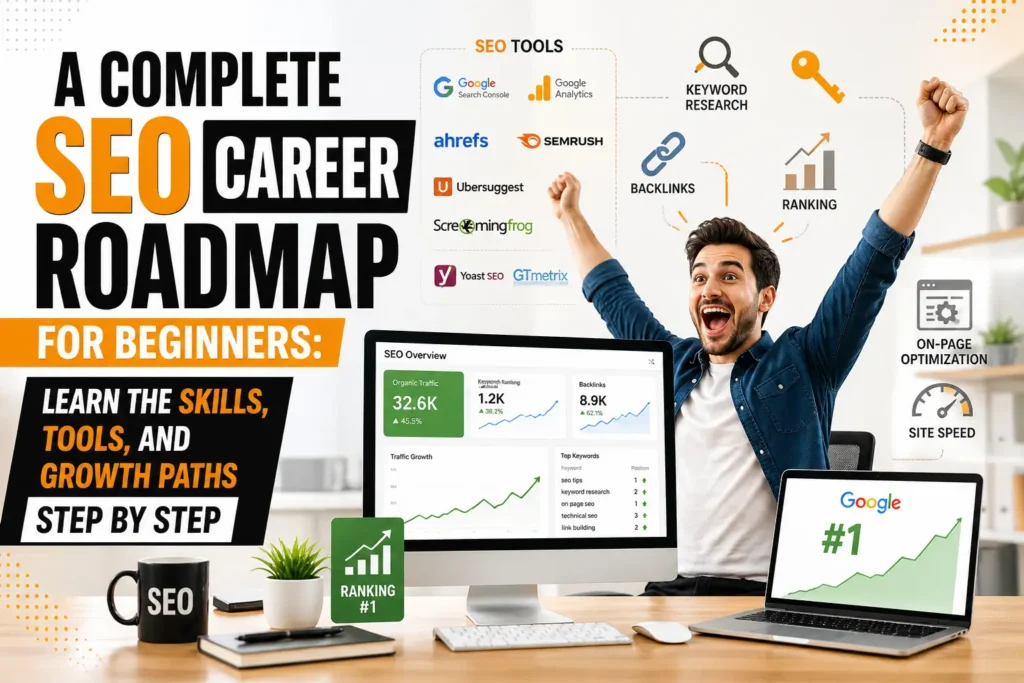
SEO tools simplify research, measurement, and optimization. Learning the right tools is a critical step in every SEO career for beginners.
Free SEO tools are ideal for beginners, while paid tools offer advanced features. A balanced mix of free and paid tools helps beginners follow SEO career roadmaps without a high initial investment.
Category | Free SEO Tools | What Free Tools Do | Limitations of Free Tools | Paid SEO Tools | What Paid Tools Do (Advanced Features) |
Keyword Research | Google Keyword Planner, Ubersuggest (Free for basic use) | Basic keyword ideas, search volume, CPC data | Limited keyword suggestions, restricted data access | Ahrefs, SEMrush | In-depth keyword analysis, keyword difficulty, competitor keywords, trends |
Website Analytics | Google Analytics | Tracks website traffic, user behavior, sessions | Complex for beginners, limited SEO-specific insights | SEMrush, Matomo (Paid plans) | Advanced audience insights, conversion tracking, SEO-focused reports |
Search Performance | Google Search Console | Shows website clicks, impressions, indexing issues | Limited competitor data, no deep keyword insights | Ahrefs, SEMrush | Keyword ranking tracking, competitor analysis, SERP insights |
SEO Audit | Screaming Frog (Free version) | Basic site audit, broken links, crawl issues | Crawl limit (500 URLs), limited reporting | Ahrefs Site Audit, SEMrush Audit | Full website audit, technical SEO fixes, automated reports |
Content Optimization | Yoast SEO (Free), Grammarly | Basic content readability, keyword usage suggestions | Limited optimization insights, no competitor data | Surfer SEO, Clearscope | Data-driven content optimization, NLP keywords, content scoring |
Backlink Analysis | Ubersuggest (Free), Google Search Console | Basic backlink overview | Limited backlink database and analysis | Ahrefs, Majestic | Detailed backlink profile, anchor text analysis, link-building opportunities |
Rank Tracking | SERP Robot (Free), Google Search Console | Basic keyword position tracking | Limited keyword tracking, no automation | SEMrush, Ahrefs | Daily rank tracking, location-based tracking, competitor comparison |
Technical SEO | Google PageSpeed Insights | Website speed and performance suggestions | Limited technical depth | GTmetrix (Pro), SEMrush | Advanced performance reports, Core Web Vitals tracking |
Career Opportunities After Following an SEO Career Roadmap
Once you complete SEO training and gain practical experience, multiple career paths open up, such as:
- SEO Executive
- SEO Specialist
- Content Marketing Strategist
- Digital Marketing Expert
- Freelance SEO Consultant
- E-commerce SEO Manager
With experience, you can even work remotely or build your own digital marketing agency.
Common Mistakes Beginners Make in SEO
Many beginners struggle due to avoidable mistakes such as:
- Ignoring keyword research
- Overusing keywords (keyword stuffing)
- Ignoring search Intent
- Not optimizing for mobile users
- Focusing only on backlinks without content quality
- Not tracking SEO performance
- Expecting Quick Results
- Not Creating Quality Content
Avoiding these common mistakes helps beginners build a strong foundation and grow successfully in SEO.
Where to Learn SEO (Best Platforms & Resources for Beginners)
After understanding the complete SEO career roadmap, the next important question is: where should you actually learn SEO? Choosing the right learning source can save time and help you build practical skills faster.
There are many reliable platforms, both free and paid, where beginners can start learning SEO from scratch and gradually move to an advanced level.
Category | Free SEO Learning Platforms | What You Get (Free) | Limitations | Paid SEO Learning Platforms | What You Get (Paid) |
Beginner Courses | Google Digital Garage, HubSpot Academy | Basic SEO concepts, beginner-friendly lessons, certificates (some) | Limited depth, mostly introductory content | Udemy, Coursera | Structured courses from beginner to advanced with detailed modules |
Advanced Learning | Google Search Central Docs, SEO Blogs (Moz, Ahrefs) | In-depth articles, latest SEO updates, real examples | No structured path, self-learning required | Ahrefs Academy, SEMrush Academy | Advanced strategies, step-by-step learning, real-world case studies |
Video Learning | YouTube (SEO tutorials) | Free video tutorials, practical demonstrations | Unstructured, quality varies, no certification | Skillshare, LinkedIn Learning | High-quality, organized video lessons with expert instructors |
Certifications | HubSpot (Free Certification), Google Courses | Basic certification to showcase skills | Less industry weight compared to premium certifications | Coursera, Simplilearn | Recognized certifications, career-focused learning paths |
Practical Learning | Blogging, personal projects | Hands-on experience, real skill development | Requires self-discipline and guidance | Paid Bootcamps, Institutes | Mentorship, guided projects, internships, career support |
On the other hand, you can also learn SEO by joining a professional training institute that offers a complete digital marketing or specialized SEO course.
Institutes like AITC Education provide structured training programs, including a 45-day SEO training class designed especially for beginners.
These programs focus on practical learning, where you get to work on real SEO projects used in websites and businesses, helping you gain hands-on experience. You will also learn industry-standard tools used by SEO professionals in Nepal and globally, which is essential for building job-ready skills.
For beginners following an SEO career roadmap, such guided training can accelerate learning and provide a clear direction toward a successful career.
Real Challenges in Building an SEO Career
Like any digital profession, SEO also comes with its own set of challenges. Understanding them early helps beginners prepare better and grow faster.
Here are some common challenges in SEO career:
- Frequent algorithm updates: Google regularly changes ranking factors, which can affect website performance.
- Slow results compared to paid marketing: SEO takes time, and results are not instant.
- High competition in ranking keywords: Competing with established websites can be difficult for beginners.
- Constant need for learning: SEO is always evolving, so continuous learning is required.
- Balancing technical and creative skills: SEO requires both analytical thinking and content creativity.
- Pressure to deliver measurable results: Clients and companies expect consistent traffic and ranking improvements.
Despite these challenges, SEO remains one of the most rewarding digital careers when practiced with consistency and strategy.
How to Overcome these Challenges?
The best way to overcome these challenges is by:
- Stay updated with algorithm changes
- Focus on long-term results, not quick success
- Practice continuously on real projects
- Balance technical and content skills
- Use SEO tools effectively
- Keep learning new digital marketing skills
Conclusion
Building a successful career in SEO is not about learning everything at once, it’s about following a clear and practical path.
This is one of the best opportunities in the digital marketing industry today.
One of the most powerful aspects of SEO is that it rewards consistency and learning. Unlike many other fields, you don’t necessarily need a formal degree to succeed.
What truly matters is your ability to experiment, analyze results, and adapt to changing search engine algorithms. By using both free and paid tools wisely, you can strengthen your strategies and gain a competitive edge in the industry.
If you stay updated, keep practicing, and follow a proper SEO career roadmap, you can turn this skill into a stable and high-growth career in the digital world.
Frequently Asked Questions
Is SEO a good career for beginners?
Yes, SEO is beginner‑friendly and offers strong career growth with the right learning approach.
Do I need coding skills to start SEO?
Basic HTML knowledge is helpful, but advanced coding is not mandatory.
How long does it take to learn SEO?
Beginners can learn SEO basics in 3–6 months with consistent practice.
Can I learn SEO without joining a course?
Yes, many beginners learn SEO through free resources, blogs, and real projects.
What is the starting salary in SEO?
Entry-level SEO professionals can earn a modest salary, which increases significantly with experience.