

Accounting vs bookkeeping is one of the first questions many commerce students and business owners ask, but the answer depends on what you want to achieve. Are you choosing a career that matches your skills and long-term goals, or deciding whether your business needs someone to record transactions or provide financial advice?
This guide explains the key differences between bookkeeping and accounting, including daily responsibilities, qualifications, salaries in Nepal, career opportunities, and when each role is the right choice. Whether you’re planning your future after +2 or looking to hire the right financial professional, you’ll find practical answers to help you make an informed decision.
Accounting vs Bookkeeping — The Core Difference in One Sentence
Bookkeeping | Accounting |
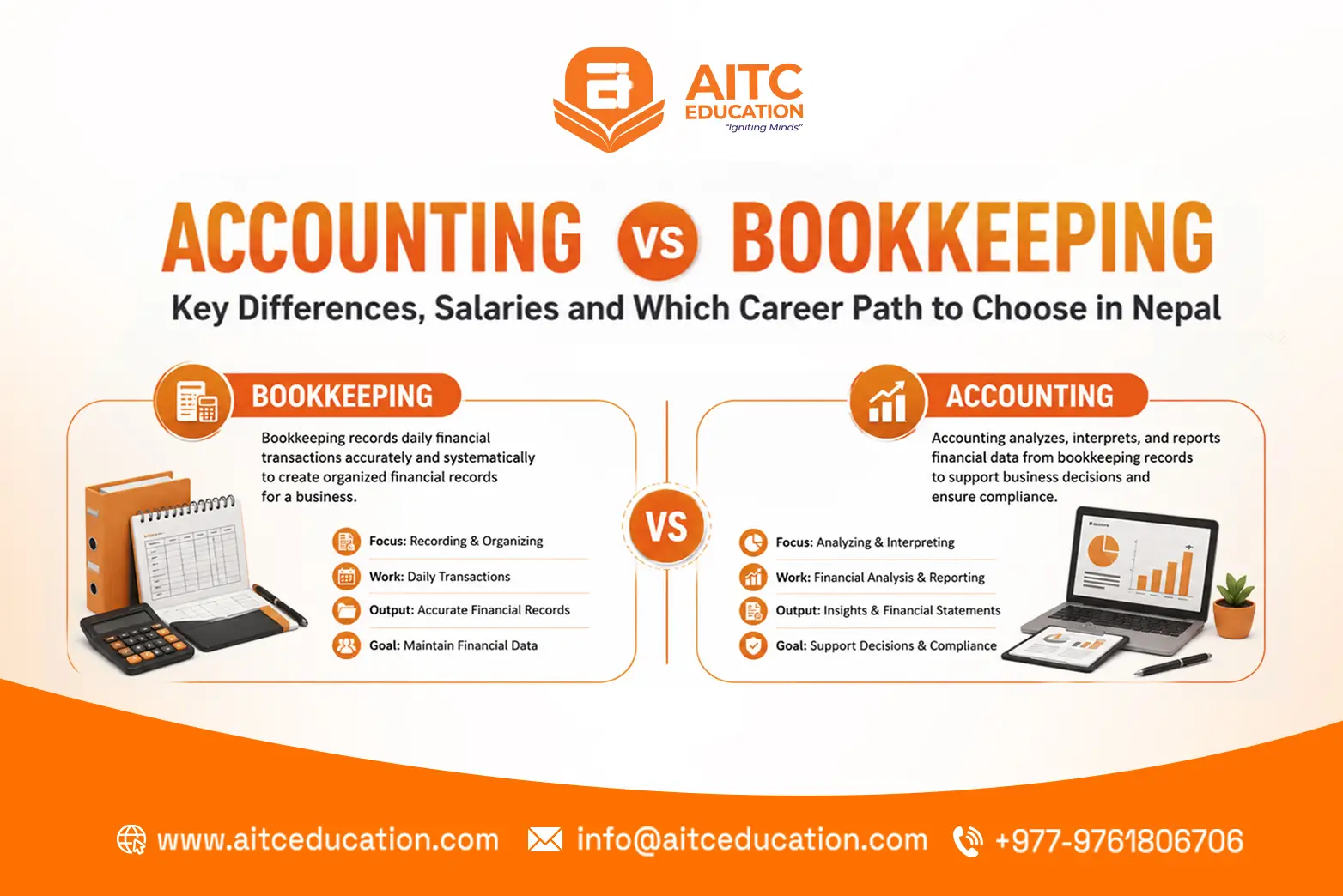
Bookkeeping records daily financial transactions accurately and systematically to create organized financial records for a business. | Accounting analyzes, interprets, and reports financial data from bookkeeping records to support business decisions and ensure compliance. |
Side-by-side Comparison — Bookkeeping vs Accounting
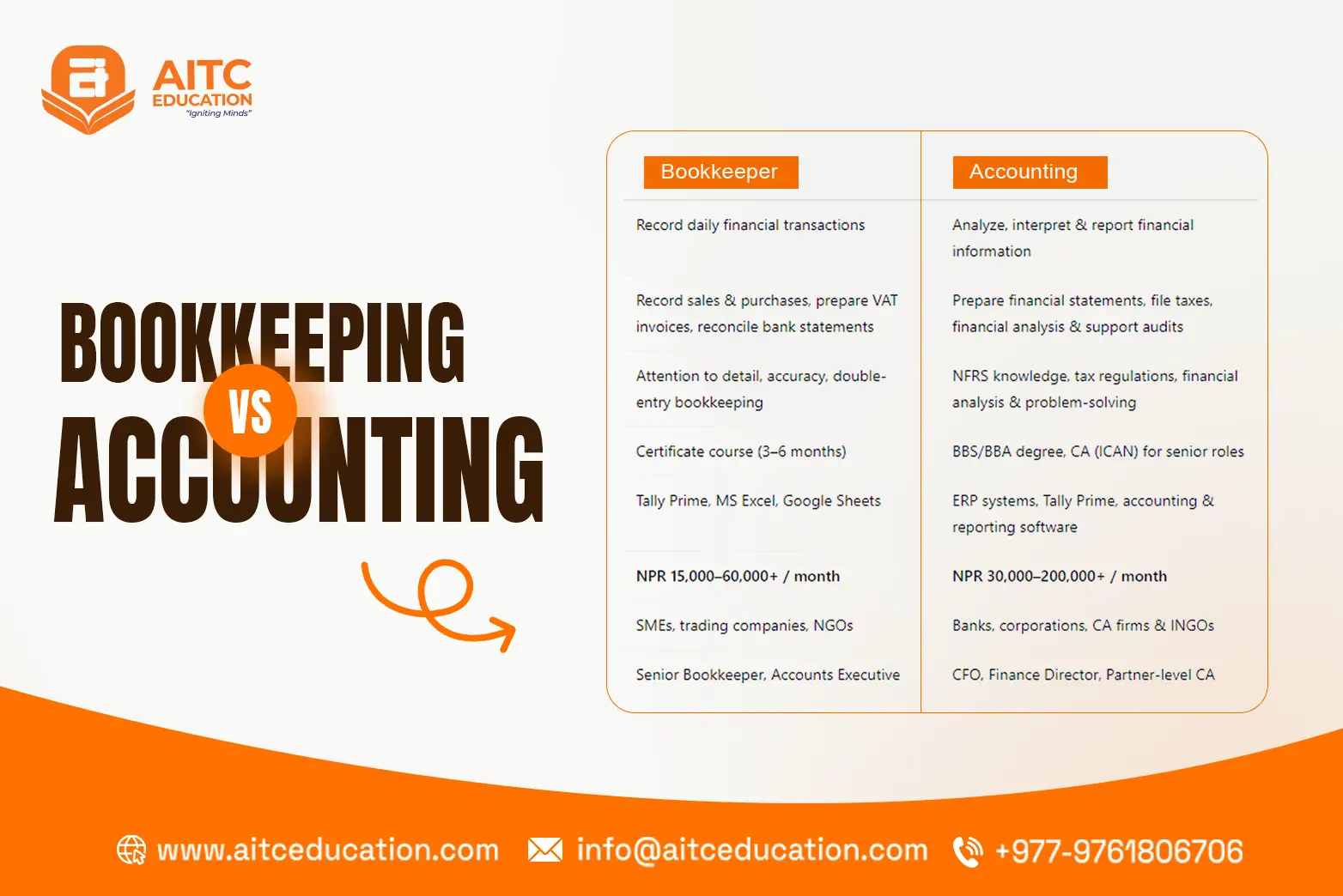
The difference between accounting and bookkeeping in Nepal is that bookkeeping focuses on recording financial transactions, while accounting uses those records to prepare reports, ensure compliance, and support business decisions.
Dimension | Bookkeeper | Accountant |
Primary Task | Record daily financial transactions | Analyze, interpret, and report financial information |
Typical Daily Activities | Record sales and purchases, prepare VAT invoices, reconcile bank statements | Prepare financial statements, file taxes, conduct financial analysis, and support audits |
Key Skills Required | Attention to detail, accuracy, double-entry knowledge | NFRS knowledge, tax regulations, financial analysis, problem-solving |
Qualifications Needed | Certificate course (3 to 6 months) | BBS/BBA degree, CA (ICAN) for senior roles |
Software Tools | Tally Prime, MS Excel, Google Sheets | ERP systems, Tally Prime, accounting software, reporting tools |
Average Nepal Salary (NPR/Month) | NPR 15,000 to 60,000+ | NPR 30,000 to 200,000+ |
Who Typically Hires Them | SMEs, trading companies, NGOs | Banks, corporations, CA firms, INGOs |
Career Ceiling | Senior Bookkeeper, Accounts Executive | CFO, Finance Director, Partner-level CA |
Bookkeeping builds the financial records that businesses rely on every day, while accounting transforms those records into meaningful insights for compliance and decision-making. For many students in Nepal, bookkeeping is also the first step toward a long-term accounting career.
What Does a Bookkeeper Actually Do?
Bookkeepers help businesses maintain accurate financial records by recording daily transactions and organizing financial documents. In Nepal, their work also supports compliance with the fiscal year (Shrawan to Ashadh), PAN and VAT requirements, and Internal Revenue Department (IRD) filing deadlines.
Daily Tasks of a Bookkeeper in Nepal
A bookkeeper’s daily responsibilities typically include:
- Recording sales and purchase transactions in Tally Prime
- Reconciling bank statements with the company’s financial records.
- Preparing VAT invoices and supporting VAT filing requirements.
- Maintaining payroll registers, including salaries, allowances, and deductions.
- Recording and monitoring petty cash transactions.
- Organizing receipts, invoices, and other financial documents for month-end reporting and IRD compliance.
- Updating ledgers and ensuring financial records are complete and accurate.
Key Skills and Tools a Bookkeeper Needs
A successful bookkeeper needs a solid understanding of the double-entry accounting system, strong attention to detail, and the ability to maintain accurate financial records. Since even small errors can affect financial reports, accuracy and consistency are essential.
Most employers in Nepal also expect practical knowledge of Tally Prime, MS Excel, and Google Sheets for recording transactions, reconciling accounts, and preparing reports. Learning these tools through a bookkeeping course Nepal can help beginners develop job-ready skills and transition more easily into entry-level accounting roles.
What Does an Accountant Actually Do?
While a bookkeeper focuses on recording financial transactions, an accountant uses those records to prepare reports, ensure legal compliance, and support business decisions. In Nepal, an accounting career often involves working with tax laws, financial reporting standards, and regulatory requirements in addition to day-to-day financial management.
What an Accountant Does (Daily and Monthly)
An accountant’s responsibilities go beyond maintaining financial records. They review financial information, ensure compliance with regulations, and provide insights that help businesses make informed financial decisions.
Daily and monthly responsibilities typically include:
- Preparing and filing TDS and VAT returns through the Inland Revenue Department (IRD) e-filing system.
- Preparing financial statements in accordance with Nepal Financial Reporting Standards (NFRS) where applicable.
- Supporting statutory audit requirements under the Companies Act, 2063.
- Ensuring compliance with the Bank and Financial Institutions Act (BAFIA) requirements when working in banks and financial institutions.
- Reviewing ledger balances, correcting accounting errors, and reconciling financial records.
- Preparing management reports, budgets, and cash flow statements to support business planning.
- Advising management on tax compliance, financial performance, and cost control.
Qualifications to Become an Accountant in Nepal
Most accountants build their careers gradually by combining practical skills with formal education.
- Start with an accounting training or certificate course. Learning Tally Prime, MS Excel, and accounting fundamentals helps you qualify for entry-level accounting and bookkeeping roles.
- Complete a BBS or BBA degree. A bachelor’s degree provides deeper knowledge of financial accounting, taxation, auditing, and business management, opening opportunities for accountant positions.
- Pursue CA through the Institute of Chartered Accountants of Nepal (ICAN) for senior roles. Professionals aiming for senior accountant, finance manager, or CFO positions often continue with the Chartered Accountancy pathway. From +2, reaching the CA level typically takes around 6 to 8 years, depending on examination progress and practical training.
This progression allows professionals to gain practical experience while continuing to develop the technical and analytical skills needed for higher-level accounting roles
Bookkeeping vs Accounting Salary in Nepal
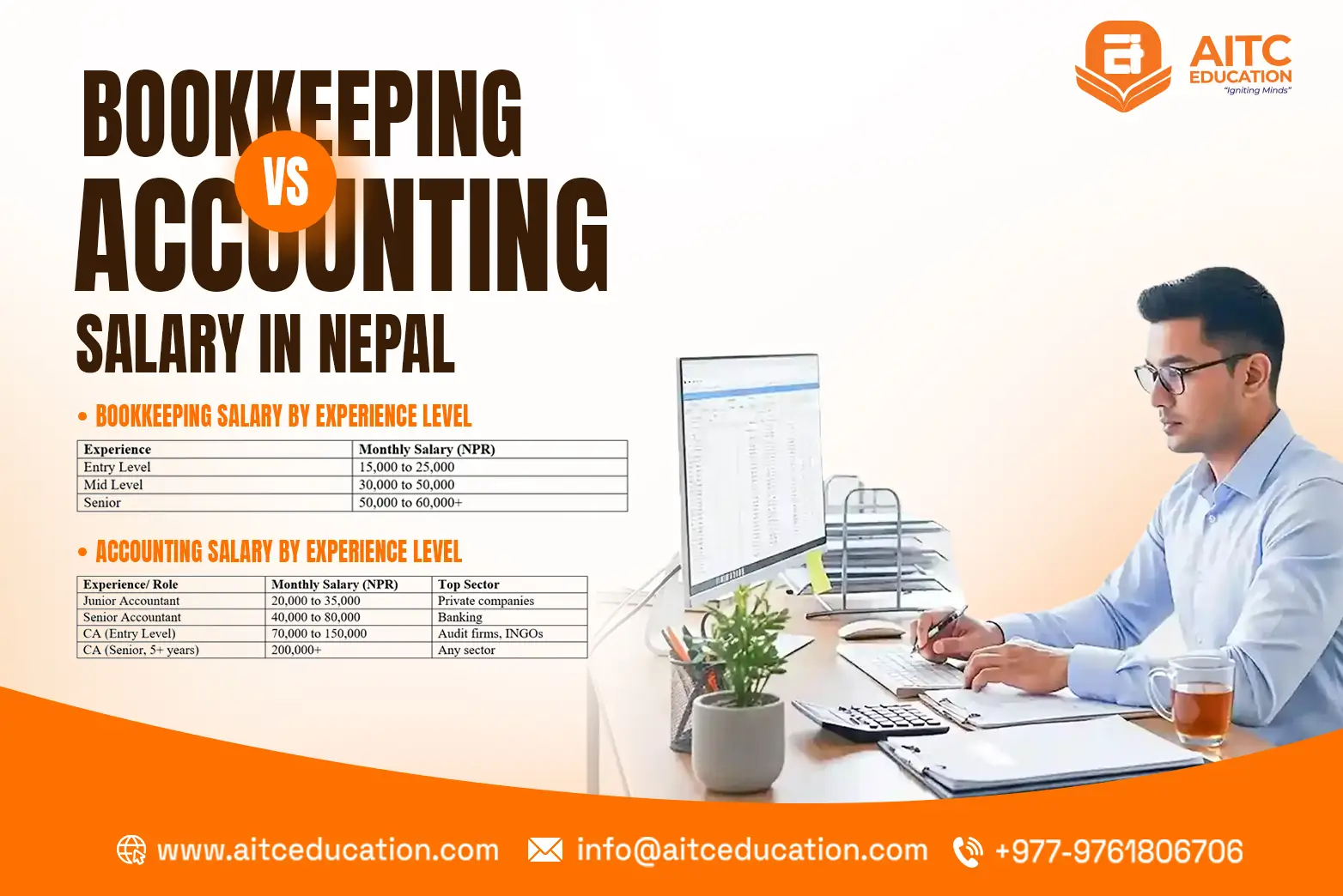
Salary varies depending on experience, qualifications, industry, and location. In general, bookkeeping offers a faster entry into the finance field, while accounting provides a higher long-term earning potential. The tables below summarize the typical salary ranges in Nepal.
Bookkeeping salary by experience level
Experience | Monthly Salary (NPR) |
Entry Level | 15,000 to 25,000 |
Mid Level | 30,000 to 50,000 |
Senior | 50,000 to 60,000+ |
Source: KumariJob (2026)
Accounting salary by experience level
Experience/ Role | Monthly Salary (NPR) | Top Sector |
Junior Accountant | 20,000 to 35,000 | Private companies |
Senior Accountant | 40,000 to 80,000 | Banking |
CA (Entry Level) | 70,000 to 150,000 | Audit firms, INGOs |
CA (Senior, 5+ years) | 200,000+ | Any sector |
Source: KumariJob (2026)
Accountants working in Kathmandu generally earn more than professionals in cities such as Pokhara and Biratnagar because of the higher concentration of banks, corporate offices, and multinational organizations. Government accounting positions usually offer lower salaries than those in the private sector, but they provide greater job stability and long-term employment benefits
Which Career Path Should You Choose? A Decision Guide for Nepali Students
Choosing between accounting and bookkeeping depends on your career goals, how quickly you want to start working, and the type of work you enjoy. The table below provides straightforward recommendations to help you decide.
Choose Bookkeeping if | Choose Accounting if |
You want to start earning within 3 months. | You are aiming for senior management or CFO-level roles. |
You enjoy practical, hands-on financial work more than business analysis. | You are willing to commit 4 to 7 years to the CA pathway. |
You plan to freelance or work for SMEs, trading firms, or small businesses in Nepal. | You prefer analytical work, financial reporting, and strategic decision-making. |
You have a commerce background but do not yet have a degree. | You want to work for banks, INGOs, multinational companies, or listed organizations. |
You want the flexibility to work with multiple clients or start your own bookkeeping services. | Your family can support a longer period of study before you enter the workforce. |
Which Career Path Should You Choose? A Decision Guide for Nepali Students
Choosing between accounting and bookkeeping depends on your career goals, how quickly you want to start working, and the type of work you enjoy. The table below provides straightforward recommendations to help you decide.
Choose Bookkeeping if | Choose Accounting if |
You want to start earning within 3 months. | You are aiming for senior management or CFO-level roles. |
You enjoy practical, hands-on financial work more than business analysis. | You are willing to commit 4 to 7 years to the CA pathway. |
You plan to freelance or work for SMEs, trading firms, or small businesses in Nepal. | You prefer analytical work, financial reporting, and strategic decision-making. |
You have a commerce background but do not yet have a degree. | You want to work for banks, INGOs, multinational companies, or listed organizations. |
You want the flexibility to work with multiple clients or start your own bookkeeping services. | Your family can support a longer period of study before you enter the workforce. |
Two student scenarios
- Rahul’s Career Path: Start Working Quickly:
Rahul is a first-year BBS student from Kathmandu who wants to earn an income as soon as possible. Instead of waiting until graduation, he completes an Advanced Accounting training program that covers Tally Prime and MS Excel.
Within a few months, he secures a job as an Accounts Assistant, earning around NPR 20,000 to 25,000 per month. After gaining three to four years of experience, he can progress to a mid-level accountant role with significantly higher earning potential. - Priya’s Career Path: Build a Long-Term Accounting Career:
Priya is a commerce student from Pokhara, aspiring to become a Chartered Accountant. Since her family can support her education, she chooses a long-term path by completing her BBS degree and preparing for the ICAN CA qualification. Although it takes several years, this route opens opportunities in audit firms, multinational companies, and senior finance positions with much higher salary potential.
Tally Prime in Nepal — Why It’s Essential for Both Roles
Whether you choose bookkeeping or accounting, Tally Prime is one of the most valuable software skills you can have. It is widely used by businesses across Nepal to manage financial records, making it a common requirement in job postings for accounts assistants, bookkeepers, and accountants.
If you are looking for a Tally course in Nepal, choose one that includes practical business scenarios instead of only software navigation. Learning Tally Prime alongside Excel and accounting fundamentals helps you perform day-to-day financial tasks confidently and prepares you for real workplace requirements.
With Tally Prime, professionals can:
- Prepare VAT returns and maintain VAT-compliant records.
- Process employee payroll and salary records.
- Manage inventory and stock movement efficiently.
- Perform bank reconciliation to match transactions and records.
- Generate financial and management reports for business decision-making.
AITC’s Advanced Accounting Training includes Tally Prime alongside Excel, Google Sheets, ERP basics, and AI tools for financial reporting.
View the full syllabus

Advanced Accounting Training
This 10-week advanced accounting course in Nepal takes you from bookkeeping to producing and defending financial statements — Tally Prime,…
For Business Owners — When to Hire a Bookkeeper vs an Accountant
As your business grows, your financial needs change. A bookkeeper helps you maintain accurate daily financial records, while an accountant or CA firm provides financial analysis, tax planning, compliance, and strategic advice. The table below can help you decide which option best fits your business.
Hire a Bookkeeper when | Hire a CA Firm when |
You need daily transaction recording and bookkeeping. | You need assistance with bank loan applications and financial planning. |
Your business requires VAT invoice preparation and basic payroll management. | You need NFRS-compliant financial statements and expert financial reporting. |
Your annual turnover is below NPR 50 lakh. | Your business is subject to a statutory audit under the Companies Act, 2063. |
You are running a startup or a small business in its first one to two years. | You need tax planning, tax optimization, or complex regulatory advice. |
You have a limited accounting budget and need day-to-day record keeping. | Your annual turnover exceeds NPR 1 crore, or your financial operations have become more complex. |
For many SMEs, hiring a full-time bookkeeper is the most affordable option for managing daily accounts. Entry-level bookkeepers in Nepal typically earn around NPR 15,000 to 25,000 per month, making them a practical choice for small businesses.
As your business expands, engaging a CA firm becomes valuable for audit, compliance, tax planning, and financial reporting. In Nepal, entry-level CAs typically earn around NPR 70,000 to 150,000 per month, while experienced CAs can earn NPR 200,000 or more, depending on the industry and role. Many growing businesses use both, relying on a bookkeeper for daily operations while consulting a CA firm for statutory and strategic financial work.
Will AI Replace Bookkeepers and Accountants in Nepal?
AI is already changing how bookkeeping and accounting work, but it is not replacing these professions. Instead, it is taking over repetitive tasks so professionals can spend more time on analysis, compliance, and business decision-making.
Today, software can automate routine work such as data entry, bank reconciliation, invoice matching, and payroll calculations. These tools reduce manual effort and improve accuracy, allowing bookkeepers and accountants to complete everyday tasks more efficiently.
However, many responsibilities still require human judgement. Interpreting Nepal’s tax regulations, preparing for audits, providing financial advice, ensuring compliance with IRD requirements, and handling ICAN-regulated work cannot be left entirely to AI. Businesses also rely on accountants to explain financial information and recommend the best course of action, something software cannot do on its own.
In Nepal, complete automation is still unlikely in the near future. Many SMEs continue to rely on cash transactions, paper invoices, and manual record-keeping, which require human verification before they can be processed digitally. Professionals who understand both traditional double-entry bookkeeping and modern accounting software such as Tally Prime and AI-powered reporting tools will remain in a stronger position as the industry continues to evolve.
Frequently Asked Questions
What is the difference between accounting and bookkeeping in Nepal?
In accounting vs bookkeeping, bookkeeping focuses on recording daily financial transactions, while accounting focuses on analyzing those records, preparing reports, and supporting business decisions.
Which is better for a career in Nepal, bookkeeping or accounting?
Bookkeeping is ideal if you want to start working quickly. Accounting is better if you are aiming for higher salaries and long-term career growth.
What is the salary of a bookkeeper in Nepal in 2026?
Based on available bookkeeping salary Nepal data, entry-level bookkeepers typically earn NPR 15,000 to 25,000 per month, while experienced professionals can earn NPR 50,000 to 70,000 per month.
Do I need a degree to become a bookkeeper in Nepal?
No. Practical skills, Tally Prime knowledge, and accounting training are often enough for entry-level bookkeeping jobs.
Is Tally required for bookkeeping jobs in Nepal?
Yes. Tally Prime is one of the most commonly required accounting software skills for bookkeeping roles in Nepal.
How long does it take to learn bookkeeping in Nepal?
Most bookkeeping training programs can be completed in 3 to 6 months, depending on the course.
Can a bookkeeper become an accountant in Nepal?
Yes. With additional education, practical experience, and accounting knowledge, a bookkeeper can progress into an accountant role.
What accounting courses does AITC Education offer in Nepal?
AITC Education offers Advanced Accounting Training, covering Tally Prime, MS Excel, Google Sheets, ERP basics, and AI tools for financial reporting.