Accounting helps businesses, organizations, and governments record transactions, control costs, manage taxes, prepare reports, and make financial decisions.
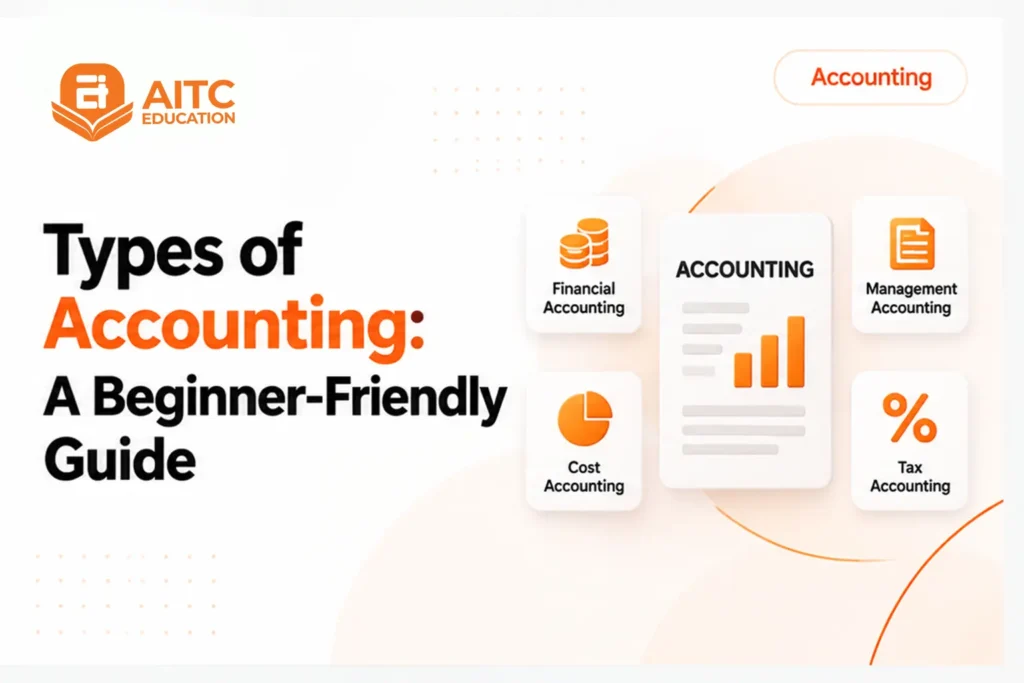
There is no fixed number of accounting types; classifications vary by textbook and purpose. This guide covers eight broad areas: financial, management, cost, tax, forensic, government, and fund accounting, plus auditing.
If you are considering an accounting career in Nepal, understanding these areas can help you find a path that matches your interests. Some lead to common entry-level roles, while others require specialized knowledge or experience.
8 Types of Accounting and What Each One Does?
The types of accounting covered are financial, management, cost, tax, forensic, government, and fund accounting, plus auditing. Some focus on preparing financial reports or managing taxes, while others help organizations plan, control costs, or investigate financial records. Here is what each area involves and where it may lead as a career in Nepal.
1. Financial Accounting: Reporting Under Nepal’s NFRS/NAS
Financial accounting focuses on recording, organizing, and reporting a business’s financial transactions. Its main purpose is to produce financial statements that show how a business is performing and what it owns and owes. These reports help business owners, investors, lenders, regulators, and other stakeholders understand the company’s financial position.
In Nepal, financial reporting follows accounting standards based on the Nepal Financial Reporting Standards (NFRS) and Nepal Accounting Standards (NAS), depending on the applicable requirements for the organization. These standards provide a framework for how financial information should be recognized, measured, presented, and disclosed.
A financial accountant may record transactions, maintain ledgers, prepare trial balances, make adjusting entries, and prepare financial statements. They may also handle accounts payable and receivable, bank reconciliations, and supporting documents needed for audits and regulatory reporting.
Financial accounting is one of the most relevant areas for people starting an accounting career because these skills are used across many organizations. Understanding bookkeeping and financial statements is a practical starting point before moving into more specialized areas.
Financial and tax accounting are practical starting points because the skills involved are useful across a wide range of accounting roles and businesses in Nepal. They can help you build a foundation in bookkeeping, financial reporting, VAT, TDS, and other day-to-day accounting work. Developing and learning the right accounting skills and tools can make this foundation more practical.
2. Management (Managerial) Accounting: What It Does and Where It Is Used
Management accounting uses financial and operational information to help managers make business decisions. Unlike financial accounting, which mainly focuses on reporting financial performance to external stakeholders, management accounting is designed to support internal decision-making.
Management accountants may analyze budgets, costs, sales figures, cash flow, and other business data to help managers plan and evaluate performance. For example, a company may use management accounting to decide whether to launch a product, reduce costs, set a budget, or adjust pricing.
Management accounting can involve budgeting, forecasting, cost analysis, performance measurement, and financial planning. It often requires accountants to interpret information and explain what the numbers mean rather than simply preparing financial records.
In Nepal, these skills can be useful in businesses where accounting teams are involved in budgeting, financial planning, cost control, and business analysis. Management accounting may also appear as part of a broader finance or accounting role rather than as a separate job title.
3. Cost Accounting: A Common Need in Manufacturing and Trading Businesses
Cost accounting focuses on identifying, recording, and analyzing the costs involved in producing goods or delivering services. It helps businesses understand where money is being spent and how much it costs to produce or sell something.
Cost accountants may track raw materials, direct labor, production overhead, transportation, and other operating costs. This information can help businesses calculate product costs, compare actual costs with budgets, identify overspending, and make better pricing and production decisions.
Cost accounting is particularly useful in manufacturing because production involves multiple inputs and stages. It can also be relevant to trading businesses that need to track purchase, transportation, storage, and other costs associated with getting products to customers.
For accounting professionals, cost accounting involves more analysis than simply recording transactions. It requires an understanding of how costs affect profitability and how financial information can support pricing, production, and cost-control decisions.
4. Tax Accounting: Managing Tax Records and Compliance in Nepal
Tax accounting focuses on maintaining financial records and calculations needed to meet a business’s tax obligations. It involves understanding how transactions affect taxes, keeping supporting documents, calculating tax-related amounts, and preparing information for required filings.
In Nepal, tax-related accounting work can involve Value Added Tax (VAT), Tax Deducted at Source (TDS), and income tax. Accountants may prepare tax-related information, maintain records, and use the Inland Revenue Department (IRD) systems for required submissions.
For example, an accountant may check transactions for VAT purposes, calculate TDS amounts, maintain supporting documents, and reconcile tax records with the company’s accounting records. The exact requirements depend on the type of tax and the taxpayer’s circumstances, so accountants need to work with current tax laws and IRD guidance.
For someone getting started with accounting in Nepal, basic knowledge of VAT, TDS, income tax, and IRD’s online systems can be useful alongside bookkeeping and financial reporting skills.
5. Auditing: A Specialized Accounting Career Path
Auditing involves examining financial records, transactions, and supporting documents to assess whether financial information is accurate and prepared according to applicable standards and requirements. Auditors provide an independent check that can help identify errors, inconsistencies, or issues in financial reporting.
Although auditing is often discussed alongside accounting rather than as a separate type of accounting, it is an important career area for accounting professionals. Auditors review evidence, test financial information, assess internal controls, and form conclusions based on their findings rather than simply preparing financial statements.
In Nepal, auditing is closely connected with the accounting profession and the regulatory framework overseen by the Institute of Chartered Accountants of Nepal (ICAN). Professional audit work can involve reviewing financial statements, checking supporting records, assessing compliance, and communicating findings to clients or other stakeholders.
A career in auditing can require stronger analytical skills and professional knowledge than basic bookkeeping. People interested in this path may work in audit firms, accounting and advisory firms, or internal audit and finance roles.
6. Forensic Accounting: What It Involves and Its Career Scope in Nepal
Forensic accounting combines accounting, financial analysis, and investigation to examine financial information for signs of fraud, misconduct, or other financial irregularities. Unlike routine accounting, the work focuses on finding and interpreting financial evidence that may be used in investigations, disputes, or legal proceedings.
Forensic accountants may examine transactions, trace funds, review financial records, identify unusual patterns, and estimate financial losses. Their work can support businesses, lawyers, investigators, regulators, and other organizations dealing with suspected financial wrongdoing or financial disputes.
In Nepal, forensic accounting is a more specialized area than general accounting. The skills can still be relevant where organizations need financial investigation, fraud examination, risk management, or support for financial disputes.
A career in forensic accounting can suit people who enjoy investigation and detailed financial analysis. Strong accounting knowledge, auditing, data analysis, internal controls, and an understanding of financial regulations can provide a useful foundation for this specialization.
For someone starting out, it generally makes more sense to build a foundation in accounting and auditing before specializing in forensic work.
7. Government Accounting: Accounting in Nepal’s Public Sector
Government accounting focuses on recording, classifying, and reporting the financial activities of government institutions. Instead of focusing mainly on business profitability, it helps track how public funds are collected, allocated, spent, and reported.
In Nepal, government accounting is used across the public sector to record government revenue and expenditure and maintain financial records for public funds. It supports budgeting, financial reporting, expenditure control, and accountability in the use of government resources.
Government accountants may work with budgets, expenditure records, revenue collections, financial statements, and other public sector financial documents. Their work also involves following government financial procedures and reporting requirements, which can differ from those used by private businesses.
This area can suit people interested in public sector finance and government institutions. Accounting knowledge, attention to detail, and an understanding of public financial procedures can be useful for these roles.
8. Fund Accounting: Managing Restricted and Purpose-Specific Funds
Fund accounting is a system used to track money according to its specific purpose or restrictions. Instead of looking only at an organization’s overall finances, it separates funds so that each pool of money can be monitored and reported based on how it is allowed to be used.
This type of accounting is commonly associated with nonprofit organizations, charities, government programs, and other organizations that manage restricted funds. For example, a nonprofit may receive a grant that can only be spent on a particular project. Fund accounting helps the organization track that money separately and show whether it was used for its intended purpose.
Fund accountants may maintain separate records for different funds, track income and expenses, prepare fund-specific reports, and check that spending follows the conditions attached to each fund.
In Nepal, these skills can be relevant to organizations such as NGOs and INGOs that manage project-based funding and need to report how funds are used. Fund accounting can be a useful specialization for accountants interested in nonprofit, development, or public sector finance.
Which Type of Accounting Is Best to Build a Career Around in Nepal?
There is no single best type of accounting for everyone. The right choice depends on your interests, qualifications, and the type of work you want to do. However, some areas may provide a more practical starting point for accounting careers in Nepal than others.
Financial and tax accounting are practical starting points because the skills involved are useful across a wide range of accounting roles and businesses in Nepal. They can help you build a foundation in bookkeeping, financial reporting, VAT, TDS, and other day-to-day accounting work.
Auditing can be a strong path for those who want a more specialized career, particularly if you plan to pursue a professional accounting qualification. Management and cost accounting can also be valuable as you move into roles involving budgeting, analysis, financial planning, and cost control.
Forensic accounting and fund accounting are more specialized choices. They can be useful in areas such as financial investigation, NGOs, INGOs, and project-based organizations, but they are less likely to be the first accounting specialization for a beginner.
If your priority is getting started in accounting in Nepal, build your core accounting skills first and then specialize based on the roles and industries that interest you. Learning how to become an accountant in Nepal can help you understand the education, skills, and experience involved in entering the profession. Your first job does not have to determine your entire accounting career.
If pay is part of your decision, compare accountant salaries in Nepal by role and experience, since specialization alone does not determine earnings.
Once you have a clearer idea of the work that interests you, focus on building practical skills alongside the basics. An advanced accounting training course can give you a structured way to practice financial reporting, tax work, and accounting tools before applying those skills in a role.

Advanced Accounting Training
This 10-week advanced accounting course in Nepal takes you from bookkeeping to producing and defending financial statements — Tally Prime,…
Conclusion
The eight areas of accounting serve different purposes, from preparing financial reports and managing taxes to controlling costs and investigating financial records.
If you are starting out in Nepal, financial and tax accounting can provide skills used across many roles. You can explore auditing, management accounting, or more specialized areas as you gain experience.
You do not need to choose a specialization immediately. Start with bookkeeping, financial reporting, and practical tax knowledge, then use the work you enjoy and the opportunities available to guide your next step.
Frequently Asked Questions
How many types of accounting are there?
There is no fixed number of types of accounting because different textbooks and organizations classify them differently. This guide covers eight broad areas commonly discussed in accounting and related financial work.
What are the 3 main types of accounting?
The three most commonly discussed types are financial accounting, management accounting, and cost accounting. Each serves a different purpose, from financial reporting to internal decision-making and cost analysis.
What is the difference between financial and management accounting?
Financial accounting prepares information about a company’s financial performance and position, mainly for external users. Management accounting uses financial and operational information to help managers plan, analyze performance, and make decisions.
Which type of accounting is best for a career in Nepal?
Financial and tax accounting are practical starting points because they provide skills used in many accounting roles. Auditing, management accounting, and other specialized areas can be considered as you gain experience and qualifications.
Is forensic accounting in demand in Nepal?
Forensic accounting is a specialized area rather than a common starting point for accountants in Nepal. It can be relevant to financial investigations, fraud examination, risk management, and financial disputes.