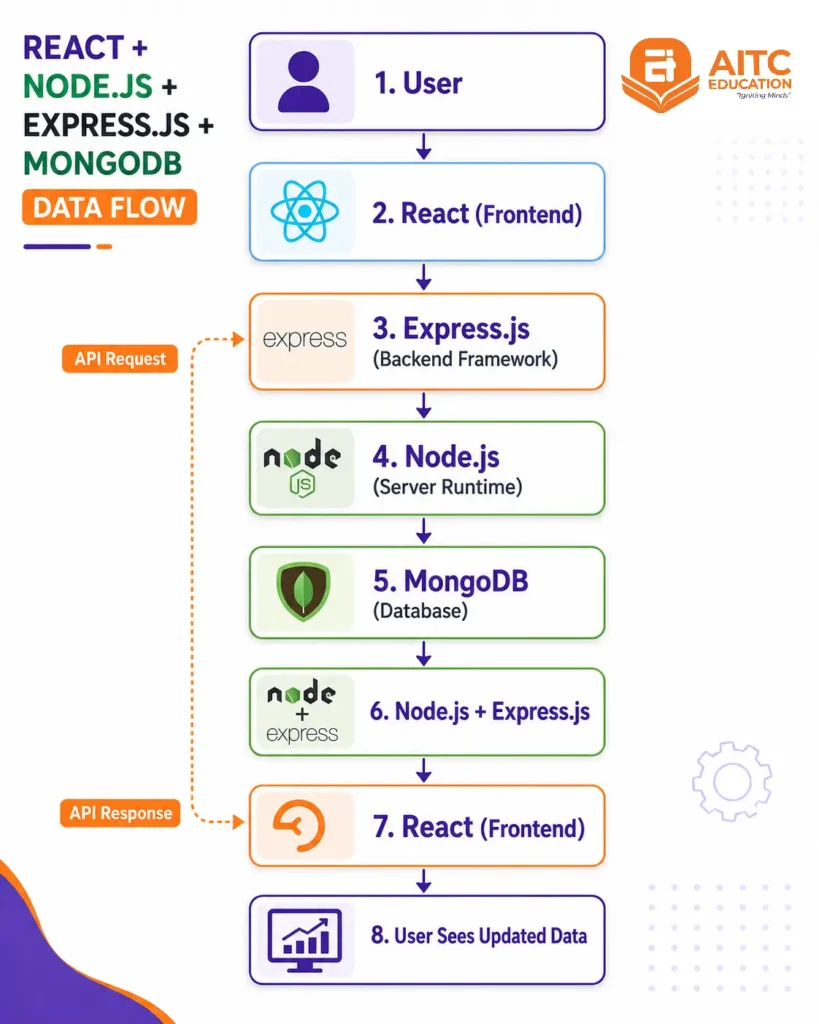
MERN Stack is a JavaScript-based technology stack used to build full-stack web applications. It combines four powerful technologies: MongoDB for database management, Express.js for backend development, React for frontend user interfaces, and Node.js for server-side execution. By using JavaScript across the entire development process, the MERN stack enables developers to create fast, scalable, and modern web applications efficiently.
Components of MERN Stack:
- MongoDB: A NoSQL database used to store application data.
- Express.js: A backend framework that simplifies API and server development.
- React: A frontend library for building interactive user interfaces.
- Node.js: A runtime environment that executes JavaScript on the server.
Common Uses:
- E-commerce websites
- Social media platforms
- Content management systems
- Business applications
- Real-time web applications
Example: Applications like online marketplaces, task management systems, and social networking platforms are commonly built using the MERN stack.
How Does the MERN Stack Work?
The MERN stack works by combining four JavaScript technologies that handle different parts of a web application. Together, they enable seamless communication between the user interface, server, and database.
Step 1: User Interacts with the Frontend
The user accesses the application through a web browser. The frontend, built with React, displays the interface and captures user actions such as logging in, submitting forms, or browsing content.
Step 2: React Sends Requests to the Backend
When the user performs an action, React sends an HTTP request to the backend server through an API.
Step 3: Express.js Processes the Request
The request reaches Express.js, a backend framework running on Node.js. Express handles routing, validates data, applies business logic, and determines how the request should be processed.
Step 4: Node.js Executes Server-Side Operations
Node.js provides the runtime environment that executes the backend code. It manages requests, communicates with the database, and handles server-side functionality.
Step 5: MongoDB Stores or Retrieves Data
If data needs to be saved, updated, or retrieved, the backend communicates with MongoDB. The database stores information such as user accounts, products, orders, or application content.
Step 6: Response is Sent Back to the User
MongoDB returns the requested data to the backend. Express and Node.js process the response and send it back to React, which updates the user interface accordingly.
MERN Stack Workflow