
Artificial intelligence (AI) is becoming a part of everyday life, behind tools such as recommendation systems, spam filters, and fraud-detection systems. Many of these technologies are powered by machine learning, one of the fastest-growing fields in modern technology.
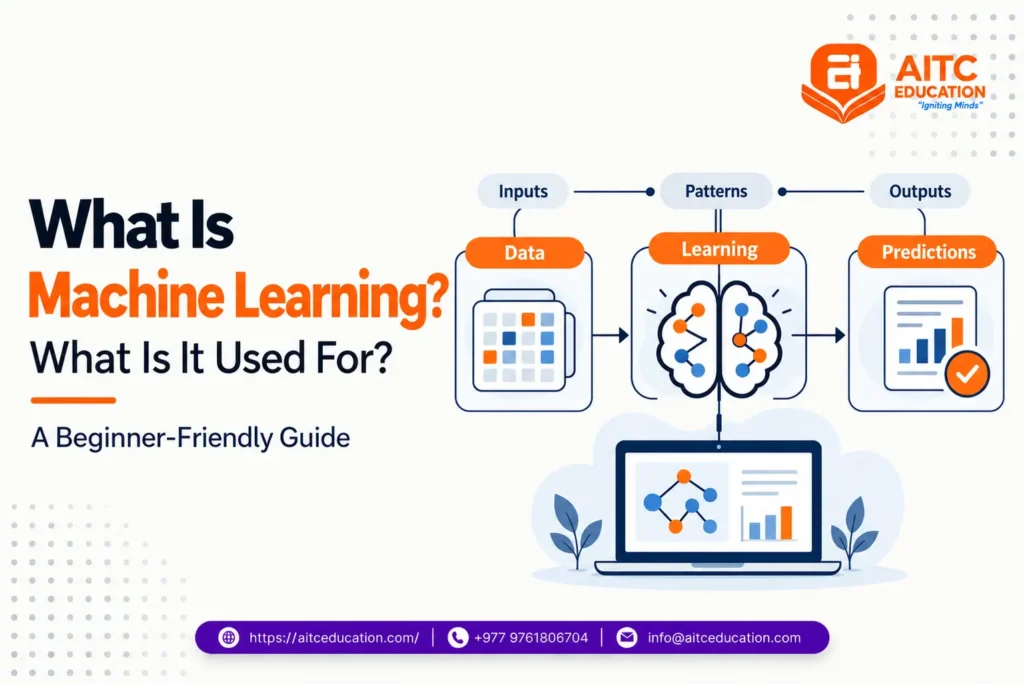
Machine learning enables computers to learn from data, identify patterns, and make predictions without being explicitly programmed for every task. This guide explains how machine learning works, its main types, real-world applications, career opportunities, and the skills beginners need to start learning machine learning.
What Is Machine Learning?
Machine learning is a branch of artificial intelligence (AI) that enables computers to learn from data instead of relying solely on fixed instructions. By identifying patterns and relationships in data, machine learning models can make predictions, solve problems, and improve their performance over time.
Unlike traditional software, which follows rules written by a programmer, machine learning systems learn from examples. They are trained using large datasets, allowing them to recognize patterns and apply what they have learned to new data without requiring separate instructions for every situation.
Machine learning powers many technologies people use every day. It helps streaming platforms recommend movies, enables banks to detect fraudulent transactions, improves online shopping recommendations, supports voice assistants, and helps businesses make faster, data-driven decisions.
As more organizations continue adopting AI-powered solutions, machine learning plays a central role in automation, predictive analytics, and intelligent decision-making across industries.
Traditional Programming vs Machine Learning
Traditional programming and machine learning both solve problems, but they do so in different ways. In traditional programming, a developer writes explicit rules that tell the computer what to do. In machine learning, the computer learns those rules on its own by analyzing data and identifying patterns.
Aspect | Traditional Programming | Machine Learning |
How it works | Developers write explicit rules and logic | The system learns rules by analyzing data |
Input | Input data and defined logic | Data and expected outcomes (examples) |
Output | A specific, predictable output | Patterns and predictions |
Best suited for | Tasks with clear, predictable rules | Problems where patterns are complex, changing, or hard to define manually |
Instructions | Every situation must be programmed | No need for explicit instructions for every case |
How Does Machine Learning Work?
Machine learning works by analyzing data to identify patterns that can be used to make predictions or decisions. Instead of following predefined rules, a machine learning model learns from examples and improves its accuracy as it processes more relevant data.
The process usually begins with collecting and preparing data. The model is then trained using this data, allowing it to recognize patterns and relationships based on the task it is designed to perform. After training, the model is tested with new data to evaluate its performance and identify areas for improvement.
Most machine learning projects follow a similar workflow:
- Collect Data: Gather relevant data from reliable sources.
- Prepare the Data: Clean, organize, and format the data so it can be used for training.
- Train the Model: Use the prepared data to help the model learn patterns and relationships.
- Evaluate the Performance: Test the model using new data to measure its accuracy and identify areas for improvement.
- Deploy and Monitor the Model: Integrate the trained model into real-world applications where it can make predictions or automate tasks, then continuously monitor its performance to ensure it remains accurate as it encounters new data.
Once a machine learning model has been trained, tested, and deployed, it can be used to solve a wide range of real-world problems. Today, machine learning powers applications across industries, from healthcare and finance to transportation and cybersecurity.
How Machine Learning Models Improve Over Time?
The final step, improving a deployed model, works differently depending on how the model is set up. A machine learning model does not automatically get better after deployment; how it improves depends on its training approach.
Some systems use static, or offline, training and stay unchanged until developers retrain them and release a new version. Others use dynamic, or online, training, which lets the model adapt more frequently as new data arrives.
Dynamic training can keep a model more current, but it also requires stronger validation, monitoring, and operational controls to prevent errors from reaching users. In both approaches, monitoring the incoming data is good practice, since changes in that data are often an early sign that performance may drift.
Application of Machine Learning
Machine learning is used across industries to analyze data, automate repetitive tasks, and make more accurate predictions. By identifying patterns in large datasets, it helps organizations improve efficiency, reduce manual effort, and make informed decisions.
1. Healthcare
Machine learning supports healthcare by analyzing large volumes of medical data to help doctors diagnose conditions more accurately and intervene earlier. By identifying patterns in scans, test results, and patient results that may be difficult to spot manually, it supports faster and informed clinical decisions. Machine learning also helps researchers accelerate drug discovery and strengthen preventative care.
2. Finance
Banks and financial institutions use machine learning to detect fraudulent transactions, assess credit risk, automate customer support, and identify unusual account activity. Because these models continuously learn from new transaction data, they can identify suspicious behavior more quickly and improve fraud detection accuracy over time.
3. E-commerce
Online retailers use machine learning to recommend products based on customer preferences, purchase history, and browsing behavior. It also helps forecast demand, optimize pricing, improve inventory management, and deliver a more personalized shopping experience. These insights enable businesses to reduce operational costs while increasing customer satisfaction and sales.
4. Marketing
Businesses use machine learning to better understand customer behavior, personalize marketing campaigns, and predict which leads are most likely to convert. By analyzing customer interactions and historical data, businesses can deliver more relevant content and improve the effectiveness of their marketing strategies.
5. Transportation
Machine learning plays an important role in navigation systems, route optimization, traffic prediction, and autonomous vehicle technology. Logistics companies also use it to improve delivery planning, reduce fuel consumption, and optimize fleet management.
6. Manufacturing
Manufacturers use machine learning to monitor equipment performance, predict maintenance requirements, detect product defects, and improve production efficiency. This reduces downtime, minimizes waste, and improves overall production efficiency. Predictive maintenance also helps organizations prevent costly equipment failures before they occur.
7. Cybersecurity
Machine learning strengthens cybersecurity by identifying unusual network activity, detecting malware, filtering spam, and responding to potential security threats more quickly than traditional rule-based systems. It also helps organizations detect emerging threats by continuously learning from new security data.
As cyberattacks become more sophisticated, machine learning enables security systems to respond faster and adapt to evolving attack patterns.
Types of Machine Learning
Machine learning models are trained in different ways depending on the problem they are designed to solve and the data available. The three main types of machine learning are supervised, unsupervised, and reinforcement learning. Each approach follows a different learning process and is suited to specific real-world applications.
1. Supervised Learning
Supervised learning is a type of machine learning in which a model is trained using labeled data. Each training example includes both the input and the correct output, allowing the model to learn the relationship between them and make accurate predictions on new data.
This approach is commonly used for prediction and classification tasks where the expected outcome is already known. Because the model learns from labeled examples, it can produce highly accurate predictions when similar data is introduced in the future.
Some of the most commonly used supervised machine learning algorithms include Linear Regression, Logistic Regression, Decision Trees, Random Forests, Support Vector Machines (SVM), and K-Nearest Neighbors (KNN). The choice of algorithm depends on the type of data and the problem being solved.
2. Unsupervised Learning
Unsupervised learning is a type of machine learning that works with unlabeled data. Instead of being given the correct answers, the model analyzes the data to identify patterns, similarities, or hidden relationships on its own.
It is often used to organize large datasets, group similar data points, and uncover insights that may not be immediately visible. Common applications include customer segmentation, recommendation systems, and market research.
Popular unsupervised machine learning algorithms include K-Means Clustering, Hierarchical Clustering, and Principal Component Analysis (PCA). These algorithms help discover patterns and organize data without requiring predefined labels.
3. Reinforcement Learning
Reinforcement learning is a type of machine learning in which a model learns through trial and error. It interacts with an environment, receives rewards for correct actions and penalties for incorrect ones, and gradually improves its decisions based on that feedback.
This approach is useful for problems where decisions need to be made continuously in changing environments. It is commonly used in robotics, autonomous vehicles, game-playing AI, and resource optimization.
Unlike supervised and unsupervised learning, reinforcement learning focuses on maximizing long-term rewards through continuous interaction. Popular reinforcement learning algorithms include Q-Learning, Deep Q-Networks (DQN), and Policy Gradient methods, which are commonly used in advanced AI systems.
AI vs. Machine Learning vs. Deep Learning vs. Generative AI
Artificial intelligence is the broad field of building intelligent systems, while machine learning and deep learning are techniques that enable those systems to learn from data. Generative AI is a newer application of AI built with deep learning that focuses on creating content such as text, images, videos, and code.
Technology | What It Is | Primary Purpose |
Artificial Intelligence (AI) | The broad field of creating systems that perform tasks requiring human intelligence. | Simulates human intelligence and decision-making, as in virtual assistants and robotics. |
Machine Learning (ML) | A subset of AI that learns patterns from data to make predictions or decisions. | Learn from data without explicit programming Learns from data without explicit programming, as in fraud detection and recommendation systems. |
Deep Learning (DL) | A subset of machine learning that uses multi-layered neural networks to process large amounts of data. | Solves complex tasks such as image and speech recognition, including facial recognition and speech-to-text. |
Generative AI | AI models that generate new content based on learned patterns. | Creates text, images, videos, and code, as in ChatGPT, Gemini, DALL·E |
Machine learning forms the foundation of many modern AI applications, while deep learning is designed to solve more complex problems using advanced neural networks. Generative AI builds on these technologies to create new content rather than simply analyzing existing data, making it one of the fastest-growing areas of artificial intelligence today.
Benefits and Limitations of Machine Learning
Machine learning offers significant advantages for businesses and organizations, but it also comes with challenges. Understanding both the benefits and limitations helps determine whether machine learning is the right solution for a particular problem and how it can be implemented effectively.
Benefits of Machine Learning
- Automates Repetitive Tasks: Machine learning can automate repetitive tasks that would otherwise require significant manual effort, helping organizations save time and improve efficiency.
- Improves Decision-Making: By analyzing large volumes of data, machine learning helps identify patterns and insights that support faster and more informed decisions.
- Increases Accuracy: As models learn from more data, they can improve prediction accuracy and deliver more reliable results over time, making them useful for tasks that require consistent decision-making at scale.
- Scales with Growing Data: Machine learning can efficiently process large datasets, making it well-suited for organizations that rely on data-driven operations.
- Delivers Personalized Experiences: Machine learning enables businesses to provide personalized recommendations, content, and services based on user preferences and behavior, improving customer satisfaction and engagement.
Limitations of Machine Learning
- Requires High-Quality Data: The quality of a machine learning model depends heavily on the data used for training. Incomplete or biased data can lead to inaccurate results.
- Can Be Expensive to Develop: Building machine learning solutions often requires skilled professionals, specialized tools, and computing resources.
- Can Be Difficult to Interpret: Some advanced models can be difficult to explain, making it challenging to understand how they reach certain decisions.
- Needs Continuous Monitoring: Models require regular updates and retraining to maintain accuracy as data and user behavior change.
- Raises Privacy and Ethical Concerns: Machine learning systems often rely on large amounts of data, making responsible data collection, privacy protection, and bias mitigation essential throughout the development process.
When is Machine Learning the Right Choice?
Machine learning is most effective when you have large amounts of data and need to identify patterns, make predictions, or automate decisions that would be difficult to define using traditional programming. It is particularly valuable when data changes over time, and the system needs to continuously improve its performance.
Machine learning is a good choice if your project involves predicting customer behavior, detecting fraud, recommending products, analyzing images, recognizing speech, or processing large volumes of data. It can also help automate repetitive tasks and generate insights that support better business decisions.
However, machine learning is not always necessary. If your problem follows clear and predictable rules, traditional programming is often simpler, faster, and more cost-effective. Before adopting machine learning, it is important to evaluate whether the available data, project requirements, and expected outcomes justify the additional complexity involved.
How to Start Learning Machine Learning?
Getting started with machine learning is easier when you follow a structured learning path. Begin by building a strong foundation in Python, mathematics, and data analysis before moving on to machine learning concepts and algorithms.
Once you’re comfortable with the basics, learn tools such as NumPy, Pandas, and scikit-learn. As your skills improve, you can explore advanced frameworks like TensorFlow and PyTorch, while building projects that strengthen your portfolio.
Hands-on practice is essential. Work with public datasets, solve real-world problems, and publish your projects on GitHub to demonstrate your skills to potential employers.
Industries in Nepal are creating more opportunities for Machine Learning Engineers, Data Scientists, and AI Engineers. Joining a structured training program, such as the Python Course at AITC Education, can help you build the programming foundation needed before moving into machine learning concepts, libraries, and frameworks.
Conclusion
Machine learning is transforming the way businesses solve problems, automate processes, and make data-driven decisions. From understanding how machine learning works to exploring its types, applications, and career opportunities, building a strong foundation can open doors to one of today’s fastest-growing technology fields.
Frequently Asked Questions
What is machine learning in simple words?
Machine learning is a branch of AI that enables computers to learn from data and make predictions without being explicitly programmed.
What are the three main types of machine learning?
The three main types are supervised learning, unsupervised learning, and reinforcement learning.
Is machine learning the same as artificial intelligence?
No. Machine learning is a subset of artificial intelligence that focuses on learning from data.
Which programming language is best fit for machine learning?
Python is the most widely used language because of its simplicity and extensive machine learning libraries.
What skills do I need to learn machine learning?
A basic understanding of Python, statistics, probability, linear algebra, and data analysis provides a strong foundation for learning machine learning.
Are there machine learning jobs in Nepal?
Yes. Demand for Machine Learning Engineers, Data Scientists, and AI Engineers is growing across Nepal’s tech industry.