Reviewed by: Data Science Trainer
Getting ready for a data science interview can feel intimidating when you are a fresher. You may have completed a course, built a few projects, or created a portfolio, but you may still wonder how to answer questions that seem designed for someone with professional experience.
The good news is that entry-level interviews are not only about how much work experience you have. Interviewers may want to see whether you understand core concepts, can solve problems logically, explain your approach clearly, and apply what you have to practical situations.
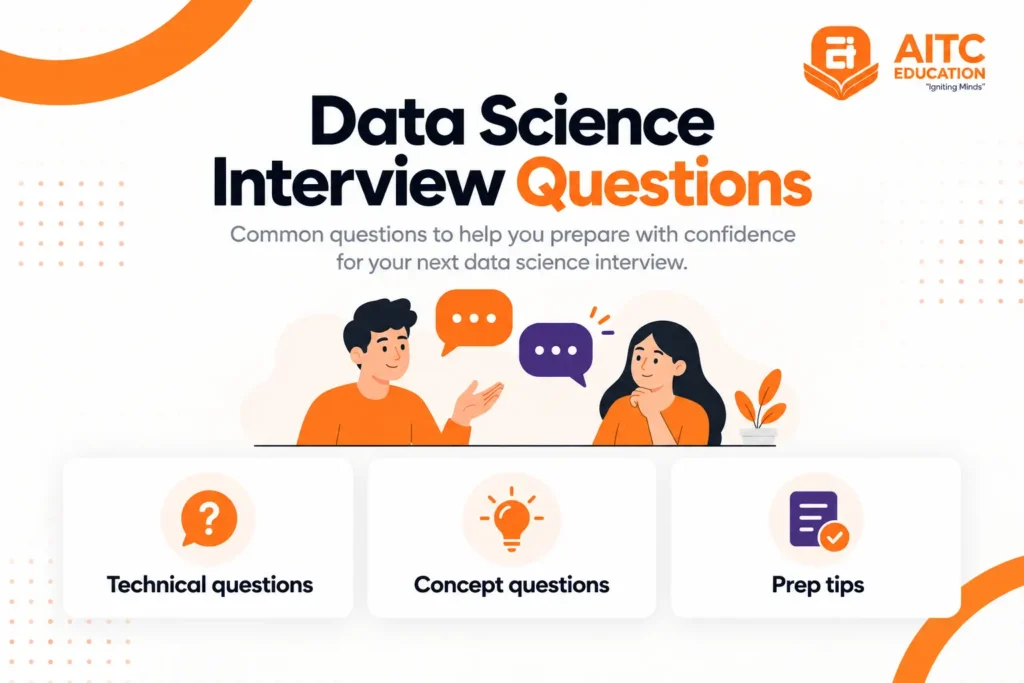
This guide covers common data science interview questions for freshers across Python, SQL, statistics, exploratory data analysis (EDA), and machine learning. It also covers scenario-based questions, project discussions, HR and behavioral questions, and common mistakes to avoid so you can prepare with more confidence.
How Did We Choose These Interview Questions?
We chose these questions based on our experience as an IT training institute, connecting common interview topics with the skills freshers learn and practice. The selection covers both the concepts you should understand and the decisions you should be able to explain from your own work.
For example, handling missing values gives you a decision to discuss: why did you fill or remove them? Building a model gives you questions about how you tested it, which metric you used, and what the results tell you. That is why this guide includes scenario and project questions alongside the fundamentals, with sample answers and an explanation of what each question tests.
These questions cover commonly asked topics, but there is no guarantee that an employer will ask this exact set. Your interview will depend on the role, the company, and the skills and projects you include on your resume.
What Interviewers Expect from a Fresher?
As a fresher, you are not expected to have years of professional experience. Interviewers know you are at the beginning of your career, so they are more likely to focus on your fundamentals, problem-solving approach, and ability to explain what you have learned.
1. A Clear Understanding of the Basics
You should be comfortable with the skills you mention on your resume, such as Python, SQL, statistics, or machine learning. You do not need to know everything, but you should be able to explain the concepts you have learned and how they are used. Understanding what a data science career in Nepal involves can also help you see which skills to focus on as you prepare for your first role.
2. The Ability to Think Through a Problem
You may be given a problem that you have not seen before. Rather than guessing the expected answer, explain how you would approach the problem and what you would check before making a decision.
3. The Ability to Explain Your Work
Your projects can demonstrate practical knowledge when you do not have professional experience. Be ready to explain what you built, why you made certain choices, what challenges you faced, and what you learned.
4. Honest Answers When You Don’t Know Something
You will not know the answer to every question, and that is normal for a fresher. If you are unsure, say so instead of making up an answer, and explain what you do know.
5. Communication Matters Too
A technically correct answer is not enough if you cannot explain it clearly. Keep your answers direct, use simple examples when helpful, and explain your reasoning instead of repeating memorized definitions.
The goal is to show that you have a solid foundation, can apply what you have learned, and are ready to grow into the role.
Python Questions Freshers Get Asked
Python is commonly used in data science for data cleaning, analysis, visualization, and machine learning. In a fresher interview, questions usually focus on Python basics and how you apply them when working with data.
1. What is a Python list, and how is it different from a tuple?
What they’re really testing: Whether you understand basic Python data structures and when to use each.
Sample answer:
“A list is an ordered collection that I can change after creating it, while a tuple is generally used when I want an ordered collection that should not be modified. I would use a list when I need flexibility and a tuple when the values should remain fixed.”
2. What is the difference between == and is in Python?
What they’re really testing: Whether you understand the difference between comparing values and objects.
Sample answer:
“== checks whether two objects have the same value, while is checks whether they refer to the same object. So, to compare values, I would normally use ==.”
3. What is a dictionary in Python?
What they’re really testing: Whether you understand key-value data structures and where they can be useful.
Sample answer:
“A dictionary stores data as key-value pairs. For example, I could use one to store customer information such as name, age, and location.”
customer = {
“name”: “Anita”,
“age”: 22,
“location”: “Kathmandu”
}
4. What is a function in Python?
What they’re really testing: Whether you understand how to create reusable pieces of code.
Sample answer:
“A function is a reusable block of code that performs a specific task. It lets me avoid writing the same code repeatedly.”
def calculate_average(numbers):
return sum(numbers) / len(numbers)
5. What is pandas, and why is it used in data science?
What they’re really testing: Whether you understand a main Python library used to work with datasets.
Sample answer:
“Pandas is a Python library used for working with structured data. I can use it to load, clean, filter, analyze, and transform datasets.”
import pandas as pd
data = pd.read_csv(“sales.csv”)
6. What is NumPy, and why is it used in data science?
What they’re really testing: Whether you understand the purpose of NumPy in numerical computing.
Sample answer:
“NumPy is a Python library mainly used for numerical operations and working with arrays. It makes it easier to perform calculations on numerical data.”
7. How do you handle missing values using pandas?
What they’re really testing: Whether you understand basic data-cleaning techniques.
Sample answer:
“First I would check how much data is missing and which columns are affected. Then I would decide whether to remove or fill the missing values based on the dataset.”
data.isnull().sum()
8. How do you find duplicate rows in pandas DataFrame?
What they’re really testing: Whether you know basic pandas operations for checking data quality.
Sample answer:
“I would first check whether duplicate rows exist and understand why they are duplicated. If they are genuine duplicates, I can remove them using pandas.”
data.duplicated().sum()
data = data.drop_duplicates()
SQL Questions Freshers Get Asked
SQL is an important skill for working with structured data, so interviewers may ask you to explain SQL concepts or write a query to solve a simple data problem. For a fresher, the focus is usually on whether you understand how to retrieve, filter, group, and combine data.
1. What is the difference between WHERE and HAVING in SQL?
What they’re really testing: Whether you understand when to filter individual rows and grouped results.
Sample answer:
“WHERE filters rows before they are grouped, while HAVING filters results after GROUP BY is applied. I would use WHERE for individual records and HAVING for aggregate results.”
SELECT customer_id, SUM(amount) AS total_spent
FROM sales
GROUP BY customer_id
HAVING SUM(amount) > 10000;
2. What is the difference between an INNER JOIN and a LEFT JOIN?
What they’re really testing: Whether you understand how SQL combines data from different tables.
Sample answer:
“An INNER JOIN returns only records with matching values in both tables. A LEFT JOIN keeps all records from the left table and adds matching records from the right table when they exist.”
SELECT customers.customer_id, orders.order_id
FROM customers
LEFT JOIN orders
ON customers.customer_id = orders.customer_id;
3. How does GROUP BY work in SQL?
What they’re really testing: Whether you can summarize data by categories using aggregate functions.
Sample answer:
“GROUP BY combines rows with the same value into groups, which lets me calculate things such as the total, average, or count for each group.”
SELECT product_id, SUM(sales) AS total_sales
FROM orders
GROUP BY product_id;
4. How would you find the second-highest salary from a table?
What they’re really testing: Whether you can combine filtering and SQL logic to solve a common data problem.
Sample answer:
“I could first find the highest salary and then find the highest salary below that value.”
SELECT MAX(salary) AS second_highest_salary
FROM employees
WHERE salary < (
SELECT MAX(salary)
FROM employees
);
5. What is a window function in SQL?
What they’re really testing: Whether you understand calculations across related rows without collapsing them into one row per group.
Sample answer:
“A window function performs a calculation across a set of related rows while keeping the individual rows in the result. For example, I could use RANK() to rank employees within each department.”
SELECT employee_id,
department,
salary,
RANK() OVER (
PARTITION BY department
ORDER BY salary DESC
) AS salary_rank
FROM employees;
6. How would you find duplicate records using SQL?
What they’re really testing: Whether you can use grouping and counting to identify possible data-quality problems.
Sample answer:
“I would group records by the columns that should uniquely identify a record and use COUNT to find groups that appear more than once.”
SELECT email, COUNT(*) AS count
FROM customers
GROUP BY email
HAVING COUNT(*) > 1;
7. If a SQL query gives you an unexpected result, how would you troubleshoot it?
What they’re really testing: Whether you can debug a data problem systematically.
Sample answer:
“I would break the query into smaller parts and check each step separately. I would look at the filters, joins, grouping, and calculations to find where the result starts to differ from what I expect.”
Statistics and EDA Questions Freshers Get Asked
Statistics helps data scientists understand patterns, variation, and relationships in data, while exploratory data analysis (EDA) helps them investigate a dataset before building a model.
1. What is the difference between mean and median, and when would you use each?
What they’re really testing: Whether you understand how central tendency measures behave when data contains extreme values.
Sample answer:
“The mean is the average of all the values, while the median is the middle value when the data is arranged in order. I would generally prefer the median when the data has strong outliers because extreme values can pull the mean away from the typical value.”
2. What are outliers, and how would you handle them?
What they’re really testing: Whether you can recognize unusual values and make a sensible decision instead of automatically removing them.
Sample answer:
“An outlier is a value that is unusually far from the other observations in a dataset. I would first investigate why it exists because it could be an error or a genuine observation, then decide whether to correct, remove, transform, or keep it.”
3. What is a normal distribution?
What they’re really testing: Whether you understand a common distribution and what it means for a dataset.
Sample answer:
“A normal distribution is a symmetric, bell-shaped distribution where most observations are around the mean, with fewer observations farther away. In a perfectly normal distribution, the mean, median, and mode are equal.”
4. What is the difference between correlation and causation?
What they’re really testing: Whether you understand that a relationship between two variables does not automatically mean one causes the other.
Sample answer:
“Correlation means two variables are related in some way, while causation means a change in one variable directly leads to a change in another. Correlation alone does not prove causation.”
5. What is exploratory data analysis, or EDA?
What they’re really testing: Whether you understand what happens before deeper analysis or machine learning.
Sample answer:
“EDA is the process of exploring and understanding a dataset before further analysis or modeling. I would look at the structure of the data, missing values, duplicates, distributions, outliers, and relationships between variables.”
data.info()
data.describe()
data.isnull().sum()
6. What would you check first when you receive a new dataset?
What they’re really testing: Whether you have a logical process for understanding unfamiliar data.
Sample answer:
“First, I would understand what the dataset represents and what each column means. Then I would check the number of rows and columns, data types, missing values, duplicates, unusual values, and important variable distributions.”
7. What is the difference between descriptive and inferential statistics?
What they’re really testing: Whether you understand the difference between summarizing existing data and drawing conclusions about a larger population.
Sample answer:
“Descriptive statistics summarize the data we have using measures such as the mean, median, or standard deviation. Inferential statistics use sample data to make estimates or draw conclusions about a larger population.”
Machine Learning Questions Freshers Get Asked
Machine learning questions in fresher interviews often focus on core concepts rather than advanced mathematics. Interviewers want to know whether you understand how models work, when to use them, and the common problems that can affect their performance.
1. What is the difference between supervised and unsupervised learning?
What they’re really testing: Whether you understand the two main categories of machine learning and when they are used.
Sample answer:
“Supervised learning uses labeled data, where the correct output is already known. For example, predicting house prices or classifying emails as spam or not spam. Unsupervised learning works with unlabeled data and is used to find patterns, groups, or relationships in the data, such as customer segmentation.”
2. What is overfitting?
What they’re really testing: Whether you understand that a model can perform well during training but fail on new data.
Sample answer:
“Overfitting happens when a model learns the training data too closely, including noise and small details that do not generalize well. As a result, the model performs very well on training data but poorly on unseen data.”
Common ways to reduce overfitting include collecting more data, simplifying the model, using regularization, or applying cross-validation.
3. Why do we split data into training and testing sets?
What they’re really testing: Whether you understand how models are evaluated fairly.
Sample answer:
“We split data into training and testing sets so that we can evaluate how well the model performs on data it has not seen before. If we test the model on the same data used for training, we may get an unrealistic idea of its performance.”
One common approach is an 80:20 split, where 80% of the data is used for training and 20% for testing.
4. What is the bias-variance tradeoff?
What they’re really testing: Whether you understand the balance between underfitting and overfitting.
Sample answer:
“Bias happens when a model is too simple and misses important patterns, while variance happens when a model learns the training data too closely. The goal is to find a balance where the model performs well on new data.”
5. What is the difference between logistic regression and a decision tree?
What they’re really testing: Whether you understand that different models have different strengths and use cases.
Sample answer:
“Logistic regression is commonly used for classification problems and works well when the relationship between variables is relatively simple. A decision tree makes decisions by splitting the data into branches and can capture more complex patterns.”
6. What evaluation metrics would you use for a classification model?
What they’re really testing: Whether you know that accuracy is not always enough.
Sample answer:
“For a classification problem, I would look at metrics such as accuracy, precision, recall, and F1-score. The choice depends on the problem. For example, in fraud detection, recall may be important because missing fraudulent cases can be costly.”
7. What is cross-validation?
What they’re really testing: Whether you understand a common method for evaluating model performance.
Sample answer:
“Cross-validation is a technique where the data is divided into multiple parts, and the model is trained and tested several times using different splits. This helps provide a more reliable estimate of how the model will perform on unseen data.”
8. Do freshers need to know deep learning or NLP?
What they’re really testing: Whether you understand the expectations for entry-level roles.
Sample answer:
“For most entry-level data science roles, a strong understanding of Python, SQL, statistics, EDA, and basic machine learning concepts is more important. Knowledge of deep learning or NLP can be helpful, but it is not always required unless the role specifically focuses on those areas.”
Scenario Questions Freshers May Face
Scenario questions test how you think when there is no single answer. Instead of looking for a perfect response, show the interviewer that you can approach an unfamiliar data problem logically.
1. How would you approach a new data science problem?
What they’re really testing: Whether you can think through a problem systematically instead of jumping straight into model building.
Sample answer:
“First, I would understand the problem and what we are trying to predict or solve. Then I would explore and prepare the data, choose an appropriate model, train and evaluate it, and improve it based on the results.”
2. What if your model has high accuracy but performs poorly on new data?
What they’re really testing: Whether you can recognize overfitting and think beyond a single performance metric.
Sample answer:
“I would check whether the model is overfitting by comparing its training and test performance. Then I would consider approaches such as simplifying the model, using regularization, or applying cross-validation.”
3. What if the dataset has many missing values?
What they’re really testing: Whether you understand that missing data should be investigated before choosing a solution.
Sample answer:
“I would first check how much data is missing and which columns are affected. Then I would decide whether to remove the affected data or fill the missing values based on the dataset and the reason for the missing data.”
A Simple Structure for Answering Scenario Questions
When you get a scenario you have not seen before, structure your answer around four steps:
- Understand the problem: What are we trying to solve or predict?
- Understand the data: What data is available, and what issues does it have?
- Choose an approach: Which method or model makes sense, and why?
- Evaluate the result: How will you know whether the solution works?
You do not need to know the perfect answer immediately. Showing a logical process is often more valuable than naming an advanced technique without explaining why you would use it.
“Walk Me Through a Project” When You Have No Professional Experience
If you are a fresher, your projects may be the strongest evidence of your practical skills. Building a few data science projects for beginners can give you practical experience and something concrete to discuss during an interview.
1. How would you explain a data science project?
What they’re really testing: Whether you understand your own work and can explain your decisions clearly.
Sample answer:
“I worked on a [project type] project using [tools]. The goal was to solve [problem]. I first [main step], then [main step], and evaluated the results using [metric or method]. One of the main things I learned was [learning].”
2. What if they ask why you chose a particular model?
What they’re really testing: Whether you understand your decisions rather than simply following a tutorial.
Sample answer:
“I chose the model based on the type of problem and the characteristics of the dataset. I also compared its performance with another model before deciding which one worked better for my project.”
3. What if they ask what you would improve in the project?
What they’re really testing: Whether you can evaluate your own work honestly.
Sample answer:
“I would explore more features and try additional models to see whether I could improve the results. I would also spend more time checking the data and tuning the model.”
A useful structure for explaining any project is:
- Problem: What were you trying to solve?
- Data: What data did you use?
- Approach: What tools and methods did you use?
- Result: What did you achieve?
- Learning: What did you learn or what would you improve?
You do not need a professional project to demonstrate practical experience. A well-explained personal, academic, or portfolio project can show how you apply what you have learned.
HR and Behavioral Questions, Done Honestly
Technical skills are only one part of a data science interview. HR and behavioral questions help interviewers understand how you communicate, handle challenges, and approach your career as a fresher.
1. Tell me about yourself.
What they’re really testing: Whether you can give a clear summary of your background and why you are interested in data science.
Sample answer:
“I have a background in computing and have been developing my skills in Python, SQL, statistics, and machine learning. I have also worked on projects to apply these skills to real datasets. I’m now looking for an entry-level opportunity where I can continue learning and contribute to a data-driven team.”
2. Why do you want to work in data science?
What they’re really testing: Whether you have a genuine reason for choosing the field.
Sample answer:
“I enjoy working with data to find patterns and solve problems. While learning data science, I found that I especially enjoy the process of exploring data, building solutions, and using the results to answer practical questions.”
3. What is your biggest weakness?
What they’re really testing: Whether you can recognize an area you need to improve without giving a rehearsed answer.
Sample answer:
“I sometimes spend too much time trying to make my work perfect. I’ve been working on this by setting clearer priorities and focusing first on completing the most important parts of a task.”
4. Tell me about a challenge you faced in a project.
What they’re really testing: How you handle problems and what you learn from them.
Sample answer:
“In one of my projects, I had difficulty dealing with missing and inconsistent data. I researched different ways to handle it, tested the approaches, and chose one based on the dataset. It taught me to understand the data first rather than immediately applying a solution.”
5. What are your salary expectations?
What they’re really testing: Whether your expectations are realistic and whether you understand that you are applying for an entry-level role.
Sample answer:
“I’m open to discussing a salary based on the role and the company’s range for an entry-level position. I’m also looking for an opportunity where I can learn and grow.”
Before the interview, it can also help to understand the typical data analyst salary in Nepal so you have a realistic expectation.
For behavioral questions, avoid memorizing long answers. Use your own experiences, keep your answers specific, and focus on what you did and what you learned.
Five Mistakes that End a Fresher’s Interview Early
Even strong technical preparation can be undermined by a few common mistakes. As a fresher, focus on showing what you know clearly rather than trying to appear more experienced than you are.
- Memorizing answers without understanding them: Interviewers may ask follow-up questions to see whether you actually understand a concept. Learn the idea well enough to explain it in your own words.
- Listing skills you cannot explain: Only include tools and technologies you are comfortable discussing. If Python, SQL, or machine learning is on your resume, be ready to answer basic questions about them.
- Jumping to advanced solutions too quickly: A complex technique does not automatically make an answer better. Start with the problem, explain your reasoning, and choose an approach that fits the situation.
- Pretending you know something you don’t: You will not know every answer as a fresher, and that is normal. Be honest about what you know and explain how you would approach finding the answer.
- Being unable to explain your own projects: Interviewers may ask about anything on your resume. Be ready to explain what you built, why you chose the approach, what challenges you faced, and what you learned.
The goal is not to prove that you know everything. It is to show that you have a solid foundation, can think through problems, communicate clearly, and are ready to learn.
Conclusion
Preparing for a data science interview as a fresher is less about knowing every advanced concept and more about having a strong foundation. Be comfortable with Python, SQL, statistics, EDA, and basic machine learning, and be ready to explain how you have applied these skills in your projects.
Practice answering questions aloud, especially scenario and project-based questions. When you do not know something, be honest, explain what you understand, and show how you would approach finding the answer.
Focus on demonstrating what you know, how you think, and your willingness to learn. AITC Education’s Data Science with Python Training in Nepal can help you build these skills through structured learning and practical projects.
Frequently Asked Questions
What are common data science interview questions for freshers?
Python, SQL, statistics, EDA, machine learning, projects, and behavioral questions are common areas.
How do I prepare for a data science interview with no professional experience?
Build strong fundamentals, practice common questions, and prepare to explain your projects clearly.
Do I need to know deep learning or NLP for an entry-level interview?
Not usually. Focus first on Python, SQL, statistics, EDA, and basic machine learning.
Is a data scientist role difficult to get as a fresher?
It can be competitive, but strong fundamentals, practical projects, and good interview preparation can improve your chances.
Can I use project work instead of professional experience?
Yes. Personal, academic, and portfolio projects can demonstrate your practical skills.