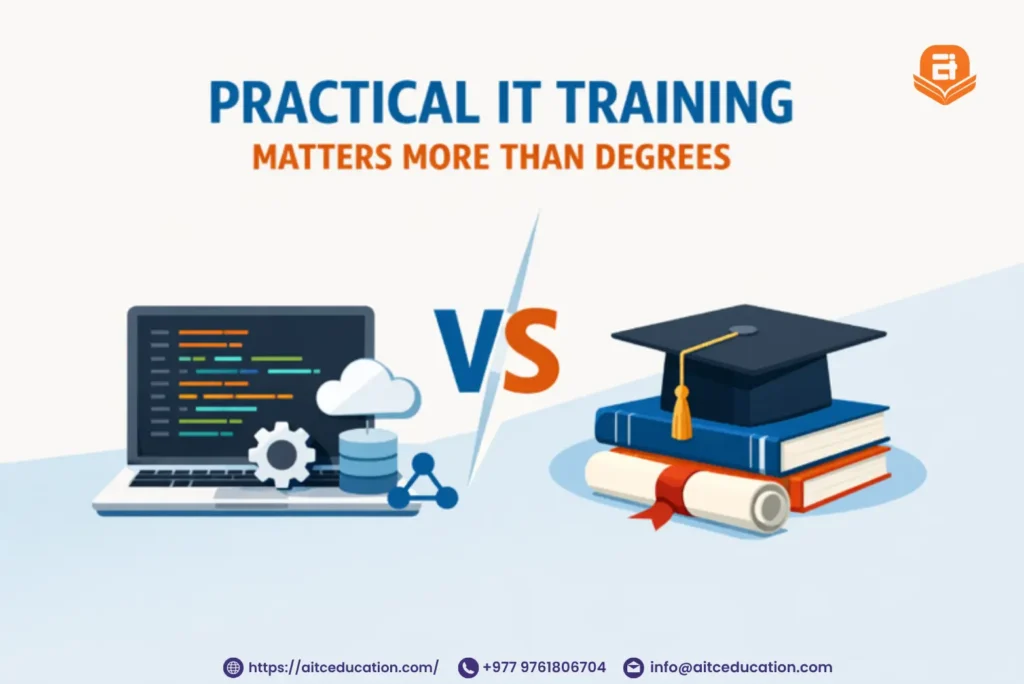
With technology changing rapidly, we still rely heavily on conventional, theory-based learning. But in today’s IT industry, theory alone is not enough to land jobs.
Real success depends on practical knowledge and the ability to apply skills directly to real-world problems. Even with a degree, it’s difficult to compete with those who have hands-on experience.
Ultimately, what truly makes you a professional is the combination of academic learning and practical IT training, because together they provide both theoretical understanding and real-world skills needed to succeed in the IT field.
Nowadays, IT training institutes in Nepal have brought a more practical, job-oriented approach to learning by offering hands-on training, internships, and placement support, making them more career-focused than traditional degree-only paths.
Marks Alone are Not Enough: Why is Practical IT Training Vital?
In IT sector, both academic and practical knowledge are important, but they are used in different ways. Academic knowledge comes from books and classrooms and gives you the answer to “Why,” while practical knowledge comes from doing real work like projects, internships, and training, and it teaches you the “How?”
A degree may build your base and open the door, but practical knowledge makes you job-ready and keeps you in competition by proving your ability.
Here are some reasons why practical IT training is considered more valuable than academic degrees in today’s industry.
1. Performance-Driven Field
IT is a field where your experience matters more than theoretical knowledge. A company will prefer someone who can build a working website or app rather than someone who can only explain programming theories.
2. Confidence Through Real Projects
When you build real projects like a website or a mobile app, you naturally gain confidence and build problem-solving skills. Completing your first project makes you confident and ready to take on real-world challenges instead of just learning theory.
3. Employers Value Portfolios Over Degrees
Most IT companies look at your skills and previous projects rather than just degree. Recruiter often ask for GitHub links or project samples instead of focusing only on a degree because your practical work proves your actual ability.
4. Technology Evolves Constantly
Degrees cover fundamentals that remain relatively stable over time, while tools and frameworks evolve quickly in real-world IT environment. In this dynamic environment, practical knowledge becomes more valuable than theoretical learning alone.
5. Better Prepared for Interviews & Workplaces
Practical training helps you answer real interview questions and complete tasks effectively. If you’ve built projects, you can confidently explain how you solved errors or designed a system which demonstrates both understanding and hands-on ability.
6. Adaptability to industry needs
As industries are evolving rapidly due to new technologies, changing consumer behavior, and updated tools and platforms, professionals need to adapt quickly.
IT training programs keep updating their curriculum to match these changes, focusing on practical, hands-on skills that align with current industry needs rather than outdated theory alone.
7. Global Opportunities
Practical skills are recognized globally allowing you to work remotely for international companies if you have strong hands-on IT expertise. In this competitive environment, real-world skills often carry more weight than a college degree when proving your capability.
How Educational Institutions Can Stay Relevant
Colleges must move beyond theory-based education and also focus on practical, job‑oriented learning to compete in this highly competitive job market. This means integrating live projects, hands-on lab work, workshops, and training with industry-relevant tools. .
Key Changes Needed in Today’s Education System
To prepare students for real‑world careers, education system needs to implement the following:
- Hands‑on training, workshops, and lab sessions
- Regularly updated and industry‑relevant curriculum
- Emphasis on skill development over marks
- Practical‑based evaluation methods
- Integration of live projects and mandatory internships
- Industry collaboration and partnerships
Colleges can partner with IT training institutes to deliver practical modules, bridge skill gaps, and ensure students gain job-ready experience aligned with current industry demands.
Role of IT Training Institutes in Bridging This Gap
IT training institutes act as a practical extension of traditional education by focusing on skill execution rather than theory. While colleges provide foundational knowledge, training institutes convert that knowledge into usable, job-ready skills through structured practice.
They focus on areas like web development, software development, UI/UX design, and digital technologies where students actively build projects instead of only studying concepts. This hands-on exposure helps learners understand real workflows used in companies.
Also, IT institutes in Nepal offer structured internship programs, mentorship from industry professionals, and portfolio development support. This creates a direct path from learning to employment, especially for entry-level IT roles.
Industry-Relevant Skill Development Approach
Modern IT training programs are designed based on current market demand. Instead of outdated syllabi, they focus on tools and technologies that companies actually use, such as modern frameworks, version control systems, and deployment practices.
This approach ensures that learners are not only aware of concepts but can also apply them in real development environments. It also reduces the gap between what students learn and what employers expect.
Learners can explore our structured IT courses to gain practical training and build industry-ready skills more effectively.
Conclusion
The most successful professionals combine both academic knowledge for the foundation and practical training as the bridge to real-world expertise. Only a degree is not sufficient to meet modern industry demands without practical knowledge and hands-on experience.
When individuals focus solely on earning a degree, they often struggle to handle real‑world field challenges, adapt to changing industry requirements, and apply theoretical concepts effectively in practical situations.
Therefore, relying solely on a degree is not enough; you must also focus on practical knowledge and real‑world experience to adapt and succeed in the industry.
Frequently Asked Questions
When is the best time to start practical training?
The best time to start practical training is during college, alongside academic studies through internships, projects, and skill-based courses, not after graduation.
What should colleges focus on to provide job‑oriented education?
Colleges should focus on live projects, internships, hands-on training, workshops, and industry‑relevant skills. Additionally, colleges need to improvise their outdated syllabi from time to time according to industry needs.
Can a degree guarantee a successful career?
No, a degree without practical experience often fails to meet modern industry expectations. Having both a degree and field knowledge matters more today.
Can practical knowledge solely help an individual succeed in industry?
Although practical knowledge alone can help individuals perform job‑related tasks efficiently, combining it with academic knowledge leads to long‑term career growth.
Where Can I Learn Practical Knowledge?
You can learn practical knowledge through internships, live projects, freelancing or part‑time jobs, college projects and labs, online platforms, and by joining IT training institutes.
Why Do Colleges Still Rely on Theoretical Knowledge Despite the Benefits of Practical Learning?
Colleges still rely on theoretical knowledge due to outdated curricula, limited resources and infrastructures, and traditional education systems, despite the growing need for practical skills.