A CV for a job in Nepal should clearly present your education, experience, skills, and other qualifications relevant to the position. But there is no single CV format in Nepal that works for every employer.
What you include and how you present it can vary by sector. Government applications may have different requirements from banks, NGOs, and private IT companies, while some employers may use the terms CV and bio-data differently.
If you are unsure what to include, where to put your qualifications, or which details to leave out, this guide explains the main sections of a Nepali CV, sector-specific expectations, common mistakes, and practical formatting tips.
What Should a CV in Nepal Include?
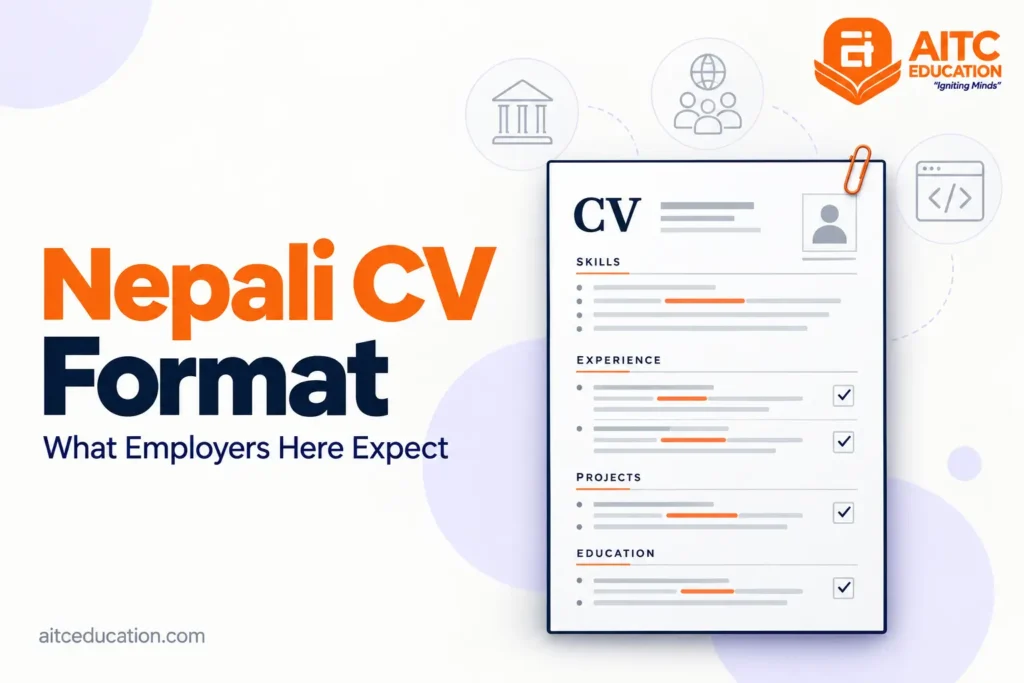
A CV in Nepal should usually include your contact details, professional summary or career objective, work experience, education, relevant skills, projects or practical training, certifications, languages, and references where appropriate.
1. Name and Contact Details
Start with your full name and the contact information an employer needs to reach you. Include:
- Phone number
- Professional email address
- Current location
- LinkedIn profile or relevant portfolio link
Use a professional email address and make sure your contact details are current. For jobs where your work can be shown online, such as IT, design, writing, or marketing, include a relevant portfolio or professional profile.
2. Professional Summary or Career Objective
A professional summary briefly describes your background, relevant strengths, and the type of role you are seeking. If you have little or no professional experience, a short career objective can introduce your career direction instead.
Keep this section specific to the job. Avoid generic statements such as wanting to “work in a challenging environment” or “contribute to the growth of the organization” unless you explain what you can bring to the particular role.
3. Work Experience
List your most recent relevant experience first. For each position, include your job title, organization, employment period, and a few bullet points describing your responsibilities and achievements.
Focus on experience that relates to the vacancy. Where possible, show results or outcomes rather than simply listing everything you were responsible for.
4. Education
Include your qualification, institution, and relevant dates. Education can take more prominence when you are a student or recent graduate with limited work experience.
If you have several years of relevant experience, you can place your work history before your education and keep older academic details brief.
5. Relevant Skills
List skills that directly relate to the position. These may include technical skills, software, tools, languages, or other job-specific abilities.
For example, an IT applicant might list programming languages, databases, or cloud platforms, while a marketing applicant might highlight SEO, analytics, advertising platforms, and content tools. Avoid filling the section with broad traits such as “hardworking” or “team player” without evidence elsewhere in the CV.
6. Projects, Internships, and Practical Training
Projects, internships, and practical training can demonstrate how you have applied your knowledge. Include the project or training name, what you worked on, the relevant tools or skills, and your contribution.
Choose examples that support the position you are applying for rather than listing every project you have completed.
7. Certifications and Languages
Include certifications that are relevant to the job, particularly those that demonstrate a specific technical, professional, or industry skill. List the certification name, issuing organization, and completion year where useful.
Languages can also be included when they are relevant to the position. State your level accurately rather than listing a language without indicating your proficiency.
8. References
References can be included when the employer or vacancy specifically requests them. Otherwise, you can leave them out and provide suitable referees later if requested.
If you include references, use people who can speak about your professional, academic, or practical experience and provide their name, position, organization, and contact details only with their permission.
How Long Should a CV Be in Nepal?
There is no fixed page limit for a CV in Nepal. The appropriate length depends on your experience, qualifications, and the requirements of the position.
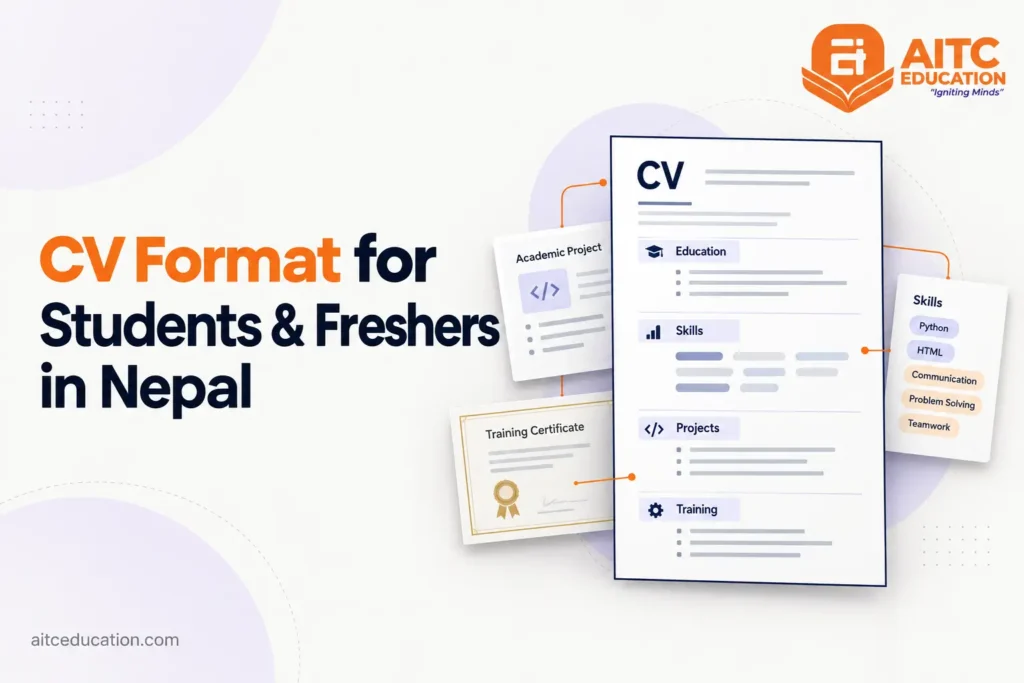
For students and freshers, a concise one-page CV may be enough to present relevant education, skills, projects, and training. Candidates with several years of experience may need more space to show their employment history and relevant achievements.
Focus on including information that supports your application rather than adding content just to make the CV longer. A well-organized CV should be easy to scan without leaving out important qualifications.
CV vs Bio-Data in Nepal: What’s the Difference?
The key difference between a CV and bio-data is the type of information each document presents. A CV focuses on your professional and academic qualifications, while bio-data may include additional personal information depending on the application.
CV | Bio-data |
Focuses on education, experience, skills, and qualifications | Can include broader personal and background information |
Usually tailored to the job | May follow a more formal or prescribed format |
Commonly used for private-sector and professional applications | May be requested for certain formal or government-related applications |
Usually keeps personal information limited to what is relevant | May request details such as date of birth, nationality, or other personal information |
When Should You Use a CV?
Use a CV when the vacancy asks for a CV or similar professional document. For most professional applications, focus on information that helps the employer assess your suitability for the role rather than adding personal details that are not relevant to the position.
When Might Bio-Data Be Required?
Some formal applications may specifically ask for bio-data and provide a format or list of required details. In that case, follow the employer’s or institution’s instructions rather than using a standard CV format.
Which CV Format Should You Use for Different Jobs in Nepal?
The right CV format can vary across sectors because employers may look for different qualifications, experience, and skills. The table below shows what to emphasize when preparing a CV for common job sectors in Nepal.
Sector | What to Emphasize | General Format |
Government | Required qualifications, relevant experience, and information specified in the vacancy | Formal and requirement-focused |
Banking | Education, relevant experience, financial knowledge, technical skills, and certificates | Clean and professional |
NGO/INGO | Project experience, relevant sector knowledge, communication, reporting, and language skills | Experience and skills-focused |
Private IT/Tech | Technical skills, projects, tools, experience, and portfolio | Skills-focused and concise |
1. Government Jobs
Government vacancies often have specific eligibility criteria and documentation requirements. Your CV should clearly present the qualifications and experience relevant to the position, while any additional information should follow the requirements stated in the vacancy.
Some government applications may also use prescribed forms or require supporting documents such as citizenship and academic certificates. In these cases, the official vacancy notice takes priority over a general CV template.
2. Bank Jobs
For banking positions, education, relevant experience, financial knowledge, technical skills, and professional certifications may be important depending on the role.
A banking CV should make these qualifications easy to find. The emphasis can differ between roles, such as accounting, credit, customer service, management, or technology positions.
3. NGO and INGO
NGO and INGO roles can place considerable emphasis on relevant project experience and sector-specific skills. Depending on the position, this may include fieldwork, project coordination, reporting, communication, research, monitoring and evaluation, or language skills.
Describe your responsibilities and contributions clearly, particularly when your previous work relates directly to the organization’s area of work.
4. Private IT and Tech Jobs
IT and tech CVs should make technical skills, projects, practical experience, certifications, and relevant tools easy to identify. A portfolio or GitHub profile can also be useful when it demonstrates relevant work.
For applicants with limited professional experience, projects and practical work can provide evidence of technical ability. For more information about entry-level opportunities, see our IT Jobs in Nepal for Freshers guide. For experienced professionals, relevant employment history should remain prominent.
These differences do not mean that each sector requires a completely different CV template. The main structure can remain similar; what changes is the information you emphasize based on the type of role.
What Personal Details Should You Include in a Nepali CV?
Beyond your basic contact information, some Nepali job applications may ask for additional personal details. These can include citizenship information, date of birth, gender, permanent address, marital status, or a photograph, but they should not automatically be included in every CV.
Additional Details You May Be Asked to Provide
Depending on the employer and type of application, you may be asked for:
- Citizenship details
- Date of birth
- Gender
- Permanent address
- Marital status
- Photograph
- Some employers or application formats may specifically request these details, so check the vacancy or application instructions before adding them.
Which Details Should You Include?
Do not add personal information simply because it appears in a generic Nepali CV template. If an employer does not ask for a particular detail, consider whether it is relevant to the application before including it.
A photograph should not be treated as a universal CV requirement. Current guidance from Kumari Job states that a photo is not necessary unless the job position asks for one.
The same principle applies to citizenship details, date of birth, marital status, and other personal information: include them when they are relevant to the application or specifically requested, rather than treating them as mandatory parts of every Nepali CV.
Common CV Mistakes Nepali Job Seekers Make
- Using the same CV for every job: Sending one unchanged CV to every employer can make relevant skills and experience harder to identify. Adjust the sections and examples to match each vacancy.
- Making the CV unnecessarily long: A CV does not need to include every job, course, project, or personal detail you have ever completed. Keep information that is relevant to the position and remove outdated or unrelated content.
- Using a generic career objective: Statements such as “I want to work in a challenging environment” do not tell an employer what you can contribute. Use a short summary or objective that relates to the specific role.
- Listing duties without showing results: Simply describing what you were responsible for gives limited information about your contribution. Where possible, mention measurable results, improvements, completed projects, or other evidence of your work.
- Adding unnecessary personal information: Details such as marital status, family information, or other personal details should not automatically be included in every CV. Add them when the vacancy or application specifically asks for them.
- Leaving out relevant requirements: Failing to mention a qualification, skill, certification, or experience that directly relates to the position can make your CV less useful to the employer.
- Using an unprofessional email address: Your email address is one of the first contact details an employer sees. Use a simple address based on your name rather than an informal username.
- Submitting a CV with inconsistent formatting or errors: Spelling mistakes, inconsistent dates, different fonts, or poorly aligned sections can make the document harder to read. Review the final CV before sending it.
How to Make Your CV Match a Job Vacancy?
Before submitting your CV, compare it with the job vacancy and adjust the content to reflect what the employer is looking for. You do not need to write your entire CV for every application; focus on the sections and experience most relevant to the role.
1. Identify the Key Requirements
Read the vacancy carefully and note the required qualifications, experience, technical skills, soft skills, and other requirements. Separate the must-have requirements from skills that are simply preferred.
2. Highlight Relevant Experience
Bring the most relevant experience, projects, internships, or training into focus. If the vacancy asks for experience with a particular tool or type of work, make sure your relevant experience clearly shows it when you genuinely have that experience.
3. Use Relevant Keywords Naturally
Use the same terminology as the vacancy where it accurately describes your skills or experience. For example, if a vacancy asks for SEO, Google Analytics, and content writing, use those terms in the relevant sections of your CV instead of relying only on broader phrases such as “digital marketing skills.”
4. Adjust the Order of Your Sections
Put the information most relevant to the position where it is easy to find. A recent graduate may place education and relevant projects higher, while an experienced professional may lead with relevant work experience.
5. Remove Unrelated Information
Tailoring a CV also means removing information that does not help demonstrate your suitability for the position. A shorter, focused CV can make your most relevant qualifications easier for an employer to identify.
Finally, check that every claim in your CV is accurate and that the information matches your supporting documents where verification may be required. A tailored CV should reflect your actual qualifications, not simply copy keywords from the vacancy.
How to Choose a Nepali CV Format Template?
If you are looking for a Nepali CV format PDF, use a template as a starting point rather than submitting it without changes. A good template should give you a clear structure while leaving enough flexibility to tailor your CV to the job and employer.
Before using a template, check that it includes the sections relevant to your application, such as:
- Contact details
- Professional summary or career objective
- Work experience
- Education
- Relevant skills
- Projects, internships, or training
- Certifications and languages
- References, where required
Also check whether the template includes personal information that the vacancy does not ask for. A template should guide the structure of your CV, not determine which personal details you must provide.
For government or other formal applications, a general CV template may not be suitable if the application uses a prescribed format. In those cases, use the format provided by the relevant institution.
You can also use a CV maker to create and customize your CV based on the requirements of the position you are applying for.
Conclusion
Start with a clear, job-focused CV that makes your most relevant qualifications easy to find. Keep the information accurate, remove unnecessary personal details, and use your education, experience, skills, projects, and certifications to show why you fit the role.
Before submitting your CV, check the vacancy requirements and adjust the sections that matter most for that position. A well-organized CV should make it easy for an employer to understand your background and see the evidence that supports your application.
The goal is not to create a CV that looks like every other Nepali CV template. It is to create a clear, relevant document that represents your actual qualifications and suits the job you are applying for.
Frequently Asked Questions
Should a CV in Nepal include a citizenship number?
A citizenship number should not be included in a CV by default. If an application requires citizenship information or a copy of your citizenship certificate, provide it in the format requested by the employer or institution rather than adding the number to a general CV.
Should I include a photo in a Nepali CV?
A photo is not a universal requirement for every CV. Include one when the employer or vacancy specifically requests it rather than assuming that every Nepali CV needs a photograph.
Should I include my LinkedIn profile on a Nepali CV?
You can include your LinkedIn profile if it is professional, up to date, and relevant to the position. Make sure your profile information matches your CV and avoid adding the link if the profile is incomplete or does not support your application.
Is a CV the same as a bio-data in Nepal?
Not always. A CV generally focuses on professional and academic qualifications, while bio-data may include additional personal information, particularly for certain formal applications. The two documents serve different purposes, although the terms can sometimes be used interchangeably in Nepal.
Can I use the same CV for every job application?
You can use the same basic CV structure, but you should tailor its content for each vacancy. Highlight the experience, skills, and qualifications that are most relevant to the particular position.