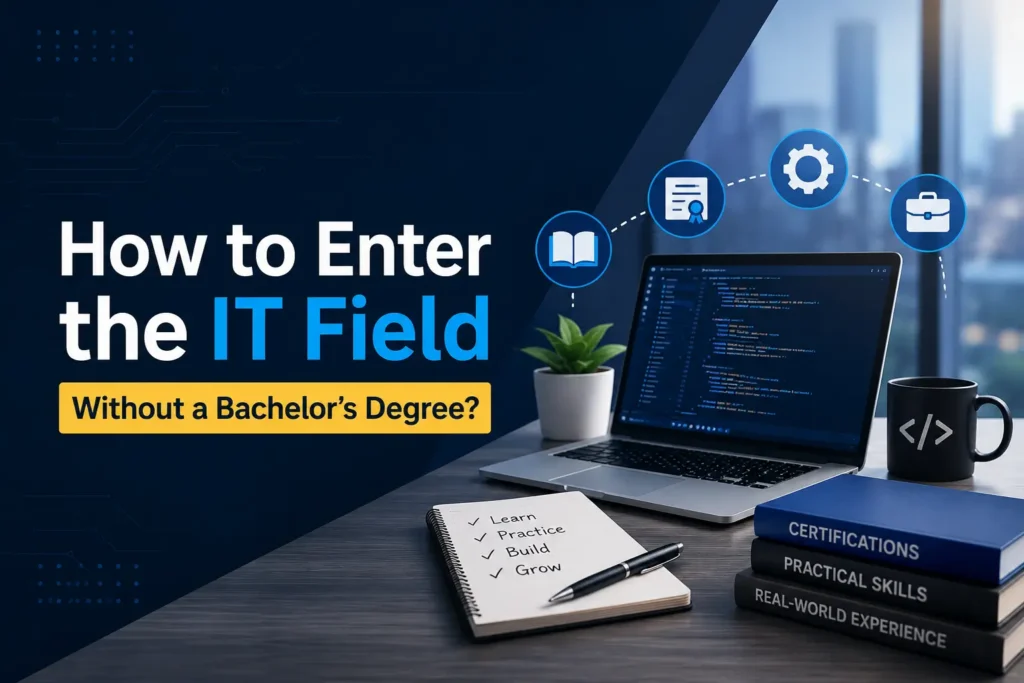
IT is one of the fastest-growing career fields today, with many companies in Nepal and around the world looking for skilled IT professionals. The good thing is you don’t always need a bachelor’s degree to start a career in IT.
Today, many professionals are building successful careers through skills, training, and real-world experience rather than academic qualifications.
If you focus on learning the right skills and getting proper training, you can enter this field even as a beginner.
If you are planning to start your IT career after +2, while studying in college, or even switching from another career field, this guide will help you begin your journey in IT as a beginner.
Can You Really Enter the IT Field Without a Bachelor’s Degree?
Yes, you absolutely can enter the IT field without a bachelor’s degree. Many companies care more about your skills, problem-solving ability, continuous learning mindset, and real projects than your academic background.
Thousands of professionals from Nepal and globally are working in IT sectors without a degree, especially in roles like web development, digital marketing, design, and IT support.
Why Many IT Companies No Longer Require Degrees?
Many IT companies no longer require a bachelor’s degree because in technology, what you can do is more important than what certificate you have.
Today, companies need people who can build websites, develop apps, analyze data, or solve real problems. These skills can be learned through online courses, training programs, and self-practice without going to university.
Another reason is that technology changes very fast. A degree may take 3–4 years, but by that time, tools and programming languages may already have changed. So, companies prefer candidates who are updated and skilled in the latest technologies.
Additionally, there is a high demand for IT professionals worldwide. Because of this, companies are opening doors for self-taught learners, freelancers, and bootcamp graduates.
Instead of degrees, employers now look at portfolios, projects, and real experience. If you can show your work and prove your skills, a degree is often not necessary in the IT field.
How Employers Evaluate Skill-Based Candidates in IT?
Instead of focusing on academic qualifications, employers assess candidates based on practical skills and real-world performance. Here’s how they typically evaluate applicants:
- Portfolio & Projects: Employers look for real projects such as websites, apps, or design work that show your abilities in action.
- Technical Skills: Knowledge of programming languages, tools, and platforms in your field is a key factor in selection.
- Certifications & Online Courses: Certifications from platforms like Google, Coursera, or Udemy help validate your skills.
- Problem-Solving Ability: Companies test how you think, not just what you know, through coding tests or real scenarios.
- Communication & Teamwork: Soft skills are equally important for collaboration in IT teams.
- GitHub or Work Samples: Developers are often judged by their code quality and consistency in repositories.
Popular IT Career Paths for Beginners
Here are some of the most accessible and in-demand IT career paths for beginners:
- Web Development: Involves building websites, web applications, and online platforms using programming and web technologies.
- UI/UX Design: Focuses on designing visually appealing and user-friendly websites and applications by understanding user behavior and experience
- Digital Marketing: Involves promoting products, services, and brands through online channels such as search engines, social media, and websites.
- Graphic Design: Is centered on creating visual content such as logos, posters, social media creatives, and branding materials that communicate messages effectively.
- IT Support: Focuses on helping users solve technical issues related to computers, software, networks, and systems.
- Cybersecurity Basics: Introduces learners to protect computer systems, networks, and data from digital threats.
You can explore our courses to start your IT journey.
Best IT Training Options to Get Started
To start your IT journey, you can join different types of training:
- Short-term IT courses from training institutes
- Bootcamps that focus on practical skills
- Online learning platforms for self-study
- Internship-based training for real experience
These options help you learn faster and become job-ready.
Step-by-Step Guide to Start Your IT Career Without a Bachelor's Degree
1. Choose the IT field you are interested
The first step is to decide what you want to learn in IT. There are many options, so don’t try to learn everything at once. Think about what you enjoy:
- If you like building websites → Web Development
- If you enjoy designing → UI/UX Design or Graphic Design
- If you like online work and marketing → Digital Marketing
- If you like solving technical issues → IT Support
Choosing one clear path helps you focus better and learn faster. Explore our guide on best IT training courses in Nepal to make better choice.
2. Join a good training course
After choosing your field, the next step is to join a structured training program. A good training course helps you learn step by step instead of getting confused with random online videos.
IT training institutes provide practical, job-oriented IT training where students learn through real projects, hands-on practice, and skill-based learning.
They usually focus on areas like web development, design, and other industry-relevant IT skills that help beginners become job-ready.
The main goal of such training is not just theory but helping you build real skills and prepare you for real job requirements without needing a degree.
3. Practice regularly with small projects
Learning alone is not enough; regular practice is essential in building IT skills. Apply what you learn by working on mini projects, completing practice assignments, and experimenting on your own.
These small projects help reinforce concepts, improve problem-solving abilities, and boost confidence.
4. Build a portfolio to show your work
A portfolio is one of the most important assets when starting an IT career without a degree. It proves your skills through real work rather than certifications.
Your portfolio should include completed projects, case studies, before‑and‑after results, and links to platforms like GitHub or design portfolios.
Explore our guide on “How to Build an IT Portfolio as a Beginner in Nepal?”
5. Apply for internships or freelance work
Once you have basic skills and some projects, start applying for internships, freelance opportunities, or entry‑level roles.
This step helps you gain real-world experience, improve skills, and improve your confidence. Even small projects or short internships can accelerate learning and make you more employable in the IT job market.
Common Mistakes Beginners Should Avoid
Many beginners make common mistakes, such as:
- Choosing IT fields only because they are “trending.”
- Expecting instant high-salary jobs
- Ignoring practice and relying only on certificates
- Not building a portfolio
- Jumping into advanced courses too quickly
Additionally, giving up too quickly when things feel difficult is a common barrier. IT learning often involves confusion, errors, and challenges. Beginners who stay patient, ask questions, and keep practicing eventually succeed, while those who quit early miss opportunities.
Being aware of these mistakes early can help you save time, stay motivated, and build a stronger career foundation.
Conclusion
The IT field is full of opportunities for beginners. Getting IT Jobs without a degree is not only possible, but it also happens every day.
If you focus on learning, regular practice, a strong portfolio, building real projects, and patience, you can build a successful career in IT.
Likewise, choosing the right IT learning center is a critical step when starting a career in IT. The quality of training, practical exposure, mentorship, and career support you receive can directly impact your skills and future opportunities.
Therefore, it is important to choose wisely and invest in a learning center that focuses on hands-on training, industry-relevant courses, and real career outcomes.
If you are looking for such an environment, AITC Education provides skill‑focused IT training programs designed to help beginners and aspiring professionals build confidence, practical expertise, and job-ready portfolios.
Frequently Asked Questions
1. Can I get an IT job after +2 without a degree?
Yes, many IT roles are skill-based and accept trained candidates without a bachelor’s degree.
2. Which IT course is best after +2 in Nepal?
Web development, UI/UX design, and digital marketing are popular beginner-friendly options.
3. How long does it take to learn IT skills?
Basic skills can be learned in 3–6 months with consistent practice.
4. Do I need coding for all IT jobs?
No, fields like UI/UX design and digital marketing require minimal or no coding.
5. Is freelancing possible after IT training?
Yes, many beginners start earning through freelancing after building basic skills and a portfolio.