Having a degree alone is no longer enough to secure a good job in the IT field, as graduates are struggling to get jobs. Employers are increasingly looking for candidates who can demonstrate real skills, build projects, and solve practical problems. This shift has made IT training courses more important than ever.
Whether you are a +2 graduate, student, college student, job seeker, or someone planning to switch careers, the right IT training course can give you a clear direction and help you become job-ready.
However, with so many options available, choosing the right course can feel confusing. This guide covers learning pathways, course content, and skill-building, helping you understand which IT training courses in Nepal are best suited for learners ranging from beginners to advanced.
Why IT Training Matters More Than Ever?
Many students in Nepal face a common challenge: they complete academic studies but still feel unprepared for real jobs. This happens because traditional education often emphasizes theory, while the IT industry values practical skills and experience.
At this time, traditional job markets are shrinking, while technology‑driven careers are expanding locally and globally. For Nepalese youth and professionals, IT skills are no longer optional; they are essential for global competitiveness.
As Nepal faces a clear gap between academic education and industrial requirements, practical IT training courses fill this disparity by:
- Teaching tools and technologies used in real projects
- Providing hands-on assignments and case studies
- Helping you build a portfolio
- Improving problem-solving and technical thinking
- Preparing you for internships and entry-level roles
- Supporting Digital Transformation in Nepal
Types of IT Training Courses Based on Skill Level
Before choosing a course, it is crucial to understand where you currently stand. Below is a clear breakdown of IT training courses from beginner to professional level.
1. Beginner- Level
Beginner IT courses are designed for individuals with little or no prior technical knowledge. These courses focus on fundamentals and confidence-building. Common beginner-level IT courses are:
- Web Development (basic frontend)
- Python Programming
- UI/UX Design
- Digital Marketing
- Graphic Design
2. Intermediate-Level
These courses are meant for learners who already understand basic IT concepts and want to specialize in a specific domain. Common intermediate It courses are:
- Full Stack Development
- Mobile App Development
- Data Analytics
- Advanced Digital Marketing
3. Advanced-Level
Advanced IT courses are designed to prepare learners for high‑level roles and global job markets. Some common advanced courses are:
- Full Stack Software Development
- Data Science & Machine Learning
- Cloud Computing & DevOps
- Cybersecurity & Ethical Hacking
- Mobile App Development
- AI and Big Data Technologies
Common Mistakes Students Make While Choosing IT Courses
Choosing the right IT course is a crucial career decision, yet many students in Nepal make avoidable mistakes that lead to a waste of time and money.
Understanding these common errors can help students make informed choices and build a successful IT career. Here are some common mistakes:
- Following trends without understanding the course
- Ignoring personal interest
- Overlooking the course level
- Focusing only on certificates, not skills
- Expecting quick results without practice
- Not completing projects
- Switching courses too frequently
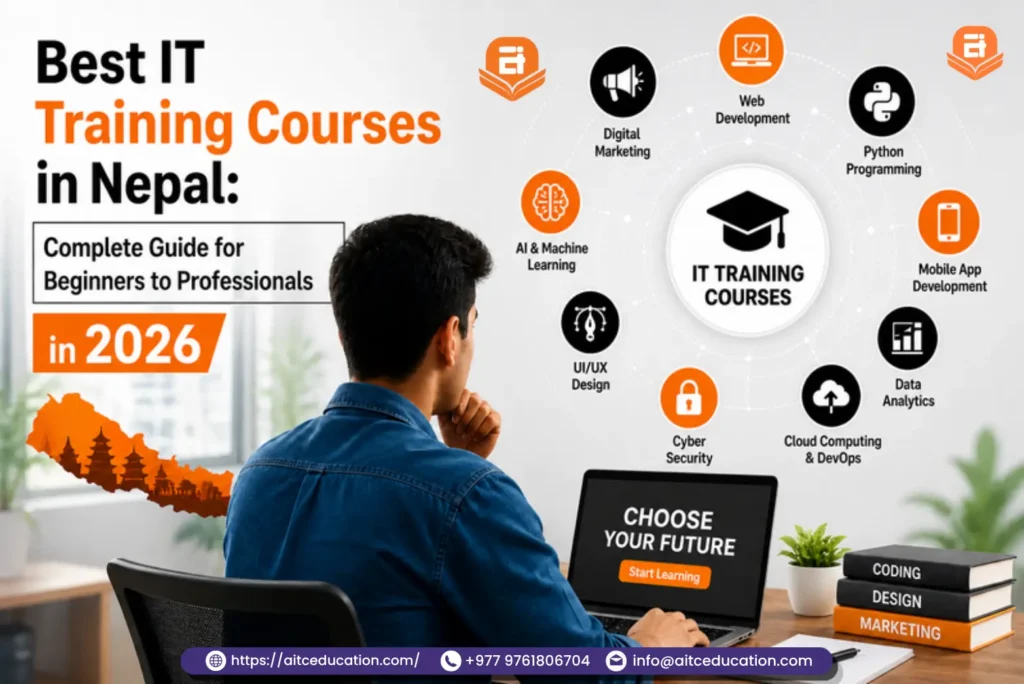
Best 10 IT Training Courses in Nepal (Detailed Guide)
1. Web Development Training
Web development is one of the most practical and widely chosen IT courses in Nepal. This training is ideal for individuals who want to enter the software development field or build web‑based solutions for businesses and clients.
What You’ll Learn:
- Structure of websites using HTML
- Styling with CSS
- Interactive features using JavaScript
- Frontend frameworks like React (basic introduction)
- Backend basics (depending on course level)
- Database integration
By the end of the course, you should be able to build responsive websites and small web applications.
2. Python Programming Training
Python is known for its simplicity and wide range of applications. It is suitable for beginners and those aiming to move into advanced tech fields.
What You’ll Learn:
- Core programming concepts
- Variables, loops, and functions
- File handling
- Basic automation tasks
- Introduction to libraries
Once the training is completed, you will gain a strong programming foundation that can later be applied in web development, data analysis, or automation.
3. UI/UX Design Training
This course is ideal for those who enjoy creativity and problem-solving and is about creating user-friendly and visually attractive digital products like apps and websites.
What You Will Learn:
- Design principles and color theory
- Wireframing and prototyping
- User experience fundamentals
- Tools like Figma
- Real-world design challenges
Following the completion of training, you will be able to design user-friendly interfaces and create complete design portfolios.
4. Digital Marketing Training
As businesses move online, digital marketing skills are becoming essential. It teaches how to promote brands, products, and services through online channels. This training is ideal for students, professionals, and business owners looking to grow online visibility.
What You Will Learn:
- Search engine optimization (SEO)
- Social media strategies
- Content creation
- Paid advertising basics
- Google ads and social media advertising
- Analytics and performance tracking
By the end of this training, you will understand how to promote brands and products online effectively, making you ready to start a career in digital marketing.
5. Data Analytics Training
Data analytics training focuses on transforming raw data into meaningful insights that support business decisions.
What You Will Learn:
- Data handling using Excel or Python
- Data cleaning techniques
- Visualization tools
- Basic statistics
- Working with datasets
Upon successful completion, you will be able to analyze data and present insights clearly.
6. Mobile App Development Training
This course focuses on building applications for the Android and iOS platforms.
What You Will Learn:
- Basics of app development
- UI design for mobile apps
- Frameworks like Flutter or React Native
- App testing and deployment
You will be able to create functional mobile applications after finishing the training curriculum.
7. Cybersecurity Training
Cybersecurity training focuses on protecting systems, networks, and data from cyber threats.
What You Will Learn:
- Basics of network security
- Common cyber threats
- Ethical hacking concepts
- System and network security practices
By the end of this training, you will understand how to identify and prevent security risks.
8. Cloud Computing & DevOps Training
This course teaches how modern applications are hosted, managed, and deployed using cloud platforms.
What You Will Learn:
- Cloud concepts and services (AWS, Azure, or GCP)
- Virtual servers, storage, and networking
- CI/CD pipeline fundamentals
- Docker and container basics
- Automation tools
Upon completion of this training, you will understand how applications run in real environments.
9. Graphic Design Training
This course is suitable for creative individuals interested in visuals.
What You Will Learn:
- Design fundamentals
- Software tools like Photoshop and Illustrator
- Branding and layout design
- Social media creatives
- Portfolio‑focused design projects
You will be able to create professional design materials after completing this course.
10. AI & Machine Learning Training
This is a more advanced and technical training path that introduces learners to intelligent systems that can analyze data, learn patterns, and make predictions.
What You Will Learn:
- Basics of machine learning
- Data processing
- Model-building concepts
- Python for AI
By the time you complete this training, you will understand how intelligent systems are built.
Salary Overview in IT Field in Nepal (Based on Skill Level)
In Nepal’s IT industry, salary is highly influenced by skill level rather than just academic qualifications.
Beginners usually start with entry-level roles where salaries are modest, but they increase steadily as practical experience and technical expertise grow.
IT Training Course | Related Job Roles | Salary Range (NPR) | Career Growth |
Web Development | Frontend Developer, Backend Developer, Web Designer | 25,000 – 120,000+ | High demand globally, freelancing opportunities |
Python Programming | Python Developer, Backend Developer, Automation Engineer | 30,000 – 130,000+ | Strong base for AI, web, and automation careers |
UI/UX Design | UI/UX Designer, Product Designer | 25,000 – 100,000+ | Growing demand in startups & software companies |
Digital Marketing | Digital Marketer, SEO Specialist, Social Media Manager | 20,000 – 90,000+ | High freelance & agency-based growth |
Data Analytics | Data Analyst, Business Analyst | 40,000 – 150,000+ | Strong demand in finance, IT & business sectors |
Mobile App Development | Android Developer, Flutter Developer, iOS Developer | 40,000 – 160,000+ | High global job opportunities |
Cybersecurity | Security Analyst, Ethical Hacker | 60,000 – 200,000+ | Rapidly growing field worldwide |
Cloud Computing & DevOps | DevOps Engineer, Cloud Engineer | 80,000 – 250,000+ | One of the highest-paying IT careers |
Graphic Design | Graphic Designer, Visual Designer | 20,000 – 80,000+ | Freelancing + agency work opportunities |
AI & Machine Learning | AI Engineer, Machine Learning Engineer, Data Scientist | 80,000 – 300,000+ | Future-proof, global high-income career |
How to Get the Most Out of Your Training?
Joining an IT course is only the beginning of your learning journey. Your actual growth and success depend on how seriously and effectively you use the training period.
In Nepal, you can learn these skills from IT learning centers and training institutes, where many institutions are offering structured programs. One of the emerging institutes, such as AITC Education, is now focusing more on job-oriented training rather than just theory, helping students become industry-ready with practical skills.
IT offers training in fields like digital marketing, web development, UI/UX designing, and many in-demand skill-based programs.
To benefit from your training, you must:
- Set clear learning and career goals
- Practice daily, even outside class
- Build your own projects
- Ask questions and stay curious
- Learn beyond the syllabus
- Collaborate with others
- Manage time and stay disciplined
- Plan your next step early
Career Growth in IT Field in Nepal: From Beginner to Skilled Professional
A career in IT does not stay limited to one level; it grows step by step as you gain knowledge, practice, and real-world experience.
A beginner usually starts by learning basic concepts and working on small projects, often in supportive roles like intern or junior trainee.
As skills improve through consistent practice and hands-on experience, they move into intermediate roles where they can independently handle tasks and contribute to real projects.
Eventually, with strong expertise, problem-solving ability, and a solid portfolio, they reach a skilled professional level where they can work as specialists, lead projects, or even work internationally as freelancers or senior developers.
Conclusion
IT training courses play an important role in helping students and professionals in Nepal become job ready.
Instead of focusing only on theory or certificates, these courses provide the practical skills needed to succeed in real-world environments.
The key is to choose a course that matches your interests and skill level, stay consistent, and focus on building real projects. With the right approach, IT training can open doors to multiple opportunities, both locally and globally.
Frequently Asked Questions
1. Which IT training course is best for beginners in Nepal?
Web development, Python programming, UI/UX design, and digital marketing are great starting points.
2. Do I need a technical background to join IT training?
No, many beginner courses are designed for students with no prior experience.
3. How long does it take to complete an IT course?
Most courses take between 3 to 6 months, depending on the level.
4. Are IT training courses enough to get a job?
Courses alone are not enough; you need practical skills and a strong portfolio.
5. Can I learn multiple IT courses at once?
It’s better to focus on one course at a time to build a strong understanding.
6. Is certification important in IT training?
Certification helps, but employers value your skills and projects more.