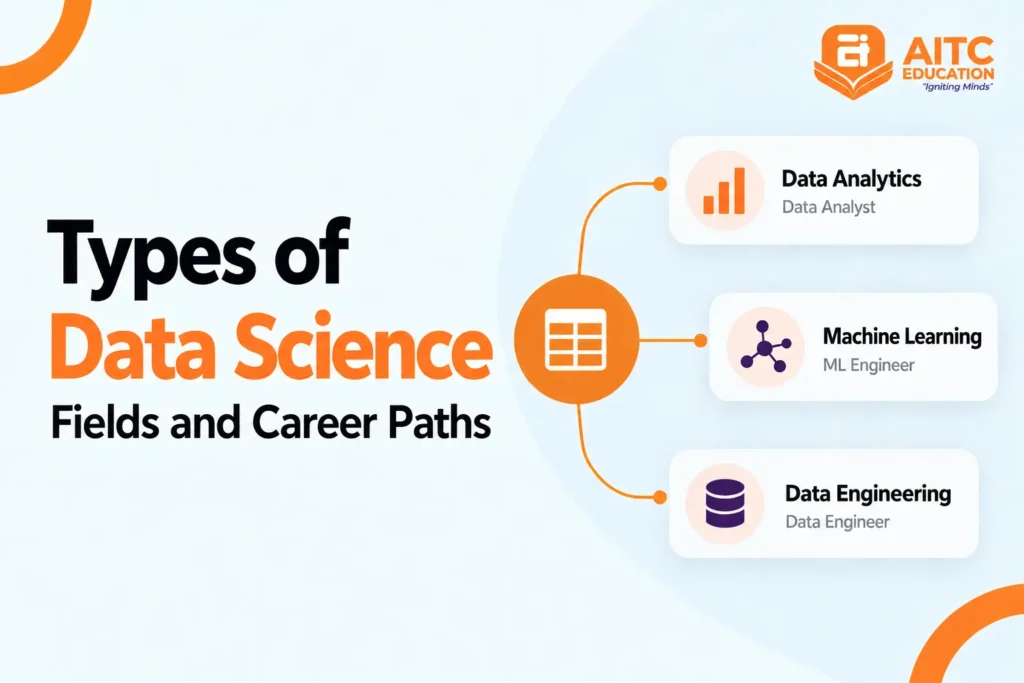
Data science is a broad field that combines data, statistics, programming, and analytical methods to solve problems and support better decisions. As the field has grown, it has developed into several specializations, from predictive analytics and machine learning to natural language processing, data engineering, and business intelligence.
This can make choosing a data science career path confusing, especially for beginners. The term “types of data science” can refer to different fields, methods, or specializations, while job titles such as Data Scientist, Data Analyst, and Data Engineer describe the roles people perform within and around these areas.
Understanding these differences can help you identify which part of data science matches your interests and career goals. In this guide, we’ll explore the major fields of data science, compare related career paths, look at salary differences, and explain how you can move from one specialization to another as your skills develop.
What Does “Type of Data Science” Actually Mean?
A type of data science is a field, methodology, or specialization within data science that focuses on a particular type of problem, data, or analytical technique. Because data science covers many different activities, there is no single official list of “types.”
For example, descriptive analytics examines what has already happened, while predictive analytics uses data to estimate what may happen next. Other specializations, such as machine learning, natural language processing (NLP), and computer vision, focus on specific techniques or types of data.
The term can also be confused with data science job roles. Data Scientist, Data Analyst, and Data Engineer are job titles, not necessarily different types of data science. A professional in one role may work across several fields depending on their responsibilities, industry, and level of specialization.
Understanding this distinction makes it easier to explore data science specializations and career paths. Instead of treating every job title or technique as a separate type, it is more useful to look at the major fields within data science and the roles associated with each one.
What Are the Main Fields of Data Science?
Data science covers a wide range of fields, from analyzing past trends and predicting future outcomes to building intelligent systems and managing large datasets. The main areas below show how data science is applied to different problems and career paths.
1. Descriptive and Diagnostic Analytics
Descriptive analytics focuses on understanding what has happened, while diagnostic analytics looks at why it happened. Businesses use these approaches to examine historical data, identify trends, compare results, and investigate changes in performance.
For example, a company might use descriptive analytics to see that sales decreased in a particular month and diagnostic analytics to determine whether the decrease was related to pricing, customer demand, or another factor. Data Analysts and Business Intelligence Analysts commonly work with these approaches.
2. Predictive Analytics
Predictive analytics uses historical and current data to estimate what is likely to happen in the future. It uses statistical techniques and machine learning models to identify patterns that can help organizations make forecasts.
For example, a retailer could use predictive analytics to estimate future product demand based on previous sales, seasonal trends, and customer behavior. Predictive analytics is commonly used in areas such as finance, marketing, healthcare, and risk management.
3. Prescriptive Analytics
Prescriptive analytics goes a step further by using data and predictive results to recommend what action should be taken. Instead of only asking what happened or what might happen, it focuses on possible decisions and their expected outcomes.
For example, a delivery company could use prescriptive analytics to recommend delivery routes that reduce travel time and operating costs. This type of analysis can involve optimization techniques, simulations, and machine learning.
4. Machine Learning and Deep Learning
Machine learning is a major field of data science focused on building systems that learn patterns from data to make predictions or decisions. Instead of programming every rule manually, professionals train models using existing data.
Deep learning is a specialized area of machine learning that uses neural networks with multiple layers to work with complex patterns. It is widely used for tasks involving images, speech, language, and other large or unstructured datasets.
Common roles in this area include Data Scientist, Machine Learning Engineer, Applied Scientist, and Research Scientist. Python libraries and frameworks such as scikit-learn, TensorFlow, and PyTorch are commonly used to develop machine learning and deep learning models. Learning the right data science tools can help beginners build practical skills across these areas.
5. Natural Language Processing (NLP)
Natural language processing, or NLP, focuses on helping computers process and understand human language. It can be used to analyze written text, classify documents, answer questions, translate languages, or power conversational systems.
For example, businesses can use NLP to analyze customer reviews and identify common complaints or opinions. NLP is also used in applications such as chatbots, search systems, text classification, and language-based AI tools.
6. Computer Vision
Computer vision focuses on enabling computers to analyze and interpret visual information, such as images and videos. It combines data science, machine learning, and image-processing techniques to identify objects, patterns, or other information in visual data.
Applications include quality inspection in manufacturing, medical image analysis, facial recognition, autonomous vehicles, and security systems. Professionals working in this area may specialize in machine learning, deep learning, image processing, or AI engineering.
7. Big Data and Data Engineering
Big data focuses on working with datasets that are too large, fast-moving, or complex for traditional data-processing methods. Data engineering supports this work by building the systems and pipelines needed to collect, store, process, and make large amounts of data available for analysis.
Data Engineers typically work with databases, data pipelines, cloud platforms, and distributed processing technologies such as Apache Spark. Their work provides the reliable data infrastructure that Data Scientists and Analysts need to perform analysis and build models.
8. Data Mining and Data Visualization
Data mining involves discovering useful patterns, relationships, and trends in large datasets. It can help organizations identify customer behavior, detect unusual activity, group similar records, and uncover relationships that may not be immediately obvious.
Data visualization focuses on presenting data in visual forms such as charts, graphs, and dashboards so that people can understand information more easily. Tools such as Tableau, Power BI, and Python visualization libraries are commonly used to communicate findings to technical and non-technical audiences.
9. Business Intelligence and Data Warehousing
Business intelligence (BI) uses data, reporting, dashboards, and analytical tools to help organizations make informed business decisions. It often focuses on turning operational data into information that managers and other decision-makers can use.
Data warehousing supports BI by providing a centralized environment where data from different sources can be stored and organized for reporting and analysis. Professionals in this area may work with SQL, data warehouses, reporting platforms, and BI tools such as Tableau or Power BI.
10. MLOps
MLOps, short for machine learning operations, focuses on managing machine learning models after they have been developed. It combines machine learning with software engineering and operations practices to help teams deploy, monitor, update, and maintain models reliably.
For example, a company may build a machine learning model to detect fraudulent transactions, but the model still needs to be deployed and monitored as new transaction patterns emerge. MLOps helps teams manage this ongoing process and supports more reliable machine learning systems in production.
Data Science vs. Data Analytics vs. Data Engineering
Aspect | Data Science | Data Analytics | Data Engineering |
Main focus | Building models, making predictions, and solving complex problems | Analyzing data to find insights and answer business questions | Building systems to collect, store, process, and deliver data |
Typical tasks | Data analysis, machine learning, model building, prediction | Data cleaning, trend analysis, reporting, dashboards | Data pipelines, database management, data integration |
Common tools | Python, SQL, pandas, and scikit-learn | SQL, Excel, Python, Tableau, Power BI | SQL, Python, Apache Spark, databases, cloud platforms |
Typical roles | Data Scientist, Applied Scientist | Data Analyst, BI Analyst | Data Engineer, Data Architect |
Best suited for | People who enjoy statistics, programming, and machine learning | People who enjoy finding insights and explaining data | People who enjoy programming, databases, and technical systems |
These differences can help you understand which role may fit your interests and strengths. If you are considering a career in the field, exploring data science career paths in Nepal can give you a better idea of the roles, skills, and opportunities available locally.
Data Science Salary in Nepal by Field
Salaries can vary significantly across data science-related fields. Your experience, technical skills, job title, industry, company, and location can all affect how much you earn, so salary ranges should be treated as general benchmarks rather than fixed pay scales.
Field/ Role | Entry-Level Salary | Mid-Level Salary | Senior-Level Salary | Source |
Data Analyst | NPR 30,000-50,000 | NPR 55,000-NPR 90,000 | NPR 100,000-160,000+ | |
Data Scientist | NPR 30,000-60,000 | NPR 60,000-120,000 | NPR 120,000-200,000+ | |
Machine Learning Engineer | NPR 35,000-65,000 | NPR 70,000-160,000 | NPR 150,000-250,000+ |
Salary is only one factor to consider when choosing a data science career path. Your interests, skills, experience, and long-term career goals are also important when deciding which field is right for you.
Should You Specialize in Data Science or Start as a Generalist?
For most beginners, starting as a generalist is a practical approach before specializing in a specific area of data science. A broad foundation helps you understand how data is collected, cleaned, analyzed, visualized, and used to solve problems before you focus deeply on one field.
Approach | What It Means | Advantages | Challenges |
Generalist | Developing skills across several areas of data science | Builds a broad foundation, keeps career options open, helps you understand how different roles work together | Can take longer to develop deep expertise in one area |
Specialist | Focusing deeply on one area, such as machine learning, NLP, or data engineering | Builds specialized expertise, makes it easier to target specific roles, and supports advanced career growth | Requires deeper technical knowledge and can narrow your initial options |
How Can You Move from One Data Science Field to Another?
- Identify your target field: Choose the area you want to move into, such as data analytics, machine learning, data engineering, or NLP.
- Compare your existing skills with the target role: Identify which skills you already have and which ones you need to develop.
- Learn the missing skills: Focus on the tools, methods, and concepts commonly used in your target field rather than trying to learn everything at once.
- Build relevant projects: Create projects that demonstrate the skills required for the new role and add them to your portfolio.
- Look for related opportunities: Internal projects, lateral moves, internships, freelance work, and entry-level positions can help you gain relevant experience.
For example, a Data Analyst with strong SQL and Python skills could move toward data science by developing knowledge of statistics and machine learning. Similarly, a Data Scientist interested in infrastructure could build data engineering skills and transition into a Data Engineering role. If you are entering the field from a different educational background, you can also explore practical ways to start a data science career without a degree.
Conclusion: Choose Your Data Science Path Based on Your Goals
There is no single best path in data science. The right choice depends on your interests, existing skills, and the type of work you want to do.
If you enjoy finding insights and working with business data, data analytics may be a good starting point. If you are interested in statistics, machine learning, and predictive models, data science may be a better fit. If you prefer programming, databases, and building data systems, data engineering could be the right direction.
You also do not need to choose a specialization immediately. Start by building core skills through practical projects or data science with Python training, then specialize as you gain a clearer understanding of your strengths and career goals.
Frequently Asked Questions
What are the main types of data science?
Common areas of data science include analytics, machine learning, NLP, computer vision, big data, data engineering, data mining, business intelligence, and MLOps.
What are the 4 types of analytics in data science?
The four types are descriptive, diagnostic, predictive, and prescriptive analytics.
What is the difference between a data scientist and a data analyst?
A Data Scientist typically builds predictive models and uses machine learning, while a Data Analyst analyzes data to identify trends and answer business questions.
What does a data engineer do?
A Data Engineer builds and maintains systems that collect, store, process, and deliver data for analysis and other applications.
What are the different career paths in data science?
Common paths include Data Analyst, Data Scientist, Data Engineer, Machine Learning Engineer, BI Analyst, NLP Engineer, and Applied Scientist.