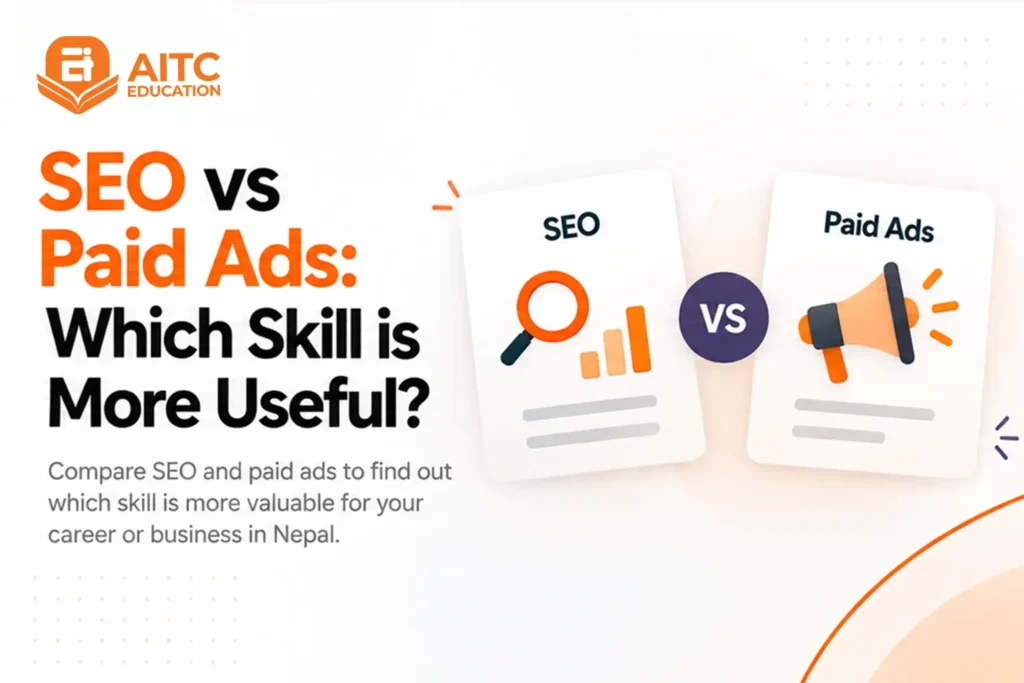
SEO and PPC are two common ways businesses reach people through search engines, but they work in different ways. SEO focuses on improving a website’s visibility in organic search results, while PPC uses paid advertising to reach people who are actively searching for relevant products, services, or information. Both can be valuable parts of a digital marketing strategy, but they require different skills and approaches.
For students in Nepal considering a digital marketing career, choosing between SEO and PPC can be confusing. This guide compares SEO vs. PPC, from the skills and daily work involved to beginner projects, career options, and whether you should learn one or both first.
SEO vs PPC: The Quick Answer
SEO focuses on earning visibility in organic results by improving a website’s content, structure, and overall search experience. PPC focuses on paid search advertising, where businesses pay to show ads to people searching for relevant terms. SEO generally takes longer to build organic visibility, while PPC can start generating paid traffic once a campaign is approved, launched, and funded.
For beginners, neither path is automatically better. SEO may suit students who enjoy research, content, websites, and long-term improvement, while PPC may be a better fit for those who prefer campaign setup, ad copy, audience targeting, budgets, and performance data. You can also learn both over time, especially if you want a broader digital marketing skill set. Google’s comparison of SEO and PPC also explains how the two approaches differ.
What is SEO?
Search Engine Optimization (SEO) is the process of improving a website and its content so that it can appear more prominently in organic search results. Unlike PPC, SEO does not involve paying for each click. Instead, it focuses on helping search engines understand a website and helping users find useful, relevant information. For a close look at how these two approaches compare, see Google’s SEO Starter Guide.
SEO can involve several areas such as keyword research, on-page SEO, technical SEO, content optimization, and internal linking. The goal is to improve a website’s organic visibility while making its content and structure more useful for people searching for relevant information.
What Does an SEO Professional Actually Do?
An SEO professional works on improving a website’s visibility in search engines and monitors how that visibility changes over time. The exact work depends on the business and role, but common tasks include:
- Keyword research: Identify search terms that match what the target audience is looking for.
- Content optimization: Improve existing pages or plan new content around relevant search intent.
- On-Page SEO: Optimize elements such as headings, page titles, descriptions, links, and content structure.
- Technical SEO: Check issues that can affect how search engines crawl, understand, and index a website.
- Off-Page SEO: Build and manage activities such as link building and digital PR that can improve a website’s authority and search visibility.
- Performance analysis: Use tools such as Google Search Console and Google Analytics 4 to understand search traffic and user behavior.
- Competitor research: Review competing websites to identify opportunities for improving content and search visibility.
- Reporting and improvement: Monitor results, identify problems, and make changes based on search performance and user behavior.
For a beginner, SEO can be practiced without working on a large business website. You can learn by researching keywords, optimizing a small website or blog, improving existing pages, and using SEO tools to review the results.
What is PPC?
Pay-per-click (PPC) is a form of paid advertising where businesses pay when someone clicks on an ad. In search advertising, businesses can use platforms such as Google Ads to show ads when people search for items related to their products or services.
Unlike SEO, which focuses on earning organic visibility, PPC allows businesses to pay to show ads in search results and reach specific audiences based on factors such as keywords, location, and other campaign settings. PPC campaigns can also be measured using data such as clicks, conversions, and advertising costs.
PPC is sometimes discussed as part of SEM, although the term “SEM” is used differently across the industry. Some sources use SEM specifically for paid search, while others use it more broadly to include both SEO and paid search.
What Does a PPC Professional Actually Do?
A PPC professional plans, creates, manages, and improves paid advertising campaigns. The exact responsibilities vary by role and platform, but common tasks include:
- Keyword research: Identify search terms that are relevant to the products, services, or goals of a campaign.
- Campaign setup: Create campaigns, ad groups, targeting settings, budgets, and other campaign details.
- Ad copywriting: Write clear and relevant ad text that encourages the right audience to click.
- Audience targeting: Choose who should see the ads based on factors such as search intent, location, or other available targeting options.
- Conversion tracking: Set up and review tracking to understand which ads and campaigns lead to actions such as enquiries, registrations, or purchases.
- Performance analysis: Review metrics such as clicks, conversions, cost per click, and other campaign data.
- Campaign optimization: Adjust keywords, ads, targeting, budgets, and other settings based on performance.
For beginners, PPC can be practiced through small campaign exercises or simulated projects. You can create a campaign plan, research keywords, write sample ads, define a target audience, and build a basic conversion-tracking plan without immediately spending money on advertising.
What Skills Do SEO and PPC Have in Common?
SEO and PPC rely on many of the same core skills, including keyword research, audience understanding, data analysis, writing, testing, and basic digital marketing knowledge.
The main difference is how these skills are applied: SEO uses them to improve organic visibility over time, while PPC uses them to plan, manage, and optimize paid advertising campaigns.
1. Keyword Research
Both SEO and PPC professionals use keyword research to understand what people search for. SEO professionals use keywords to plan and optimize organic content, while PPC professionals use them to build paid search campaigns and target relevant searches.
2. Understanding the Audience
Both fields require an understanding of the target audience. You need to know what people are searching for, what problems they are trying to solve, and what might encourage them to take action.
3. Data Analysis
SEO and PPC both involve reviewing performance data and using it to make decisions. Tools such as Google Analytics 4 can help you understand website activity and conversions, while Google Search Console is particularly useful for monitoring organic search performance.
4. Writing and Communication
Strong writing skills are useful in both fields. SEO professionals may write or optimize website content, titles, and descriptions, while PPC professionals write ad copy that communicates a clear message and encourages the right audience to click.
5. Testing and Improvement
Neither SEO nor PPC is a one-time task. Both require testing different approaches, reviewing the results, and making improvements over time. The specific things you test will differ, but the basic process is similar: try, measure, learn, and improve.
6. Basic Digital Marketing Knowledge
Both professionals benefit from understanding websites, landing pages, conversion paths, and the customer journey. You do not need to master every area of digital marketing before starting, but understanding how your work supports a business goal will make you more effective.
The key difference is where these shared skills are applied. SEO focuses mainly on improving organic visibility and long-term search performance, while PPC focuses on managing paid campaigns and generating targeted traffic through advertising.
Should You Learn SEO or PPC First?
There is no single answer to whether students should learn SEO or PPC first. The better starting point depends on your interests, how you prefer to practice, and the type of digital marketing work you want to do.
Learn SEO First If…
SEO may be a better starting point if you:
- Enjoy writing, research, websites, and content.
- Want to practice without spending money on advertising.
- Prefer working on long-term organic search growth.
- Want to build a portfolio through website and content projects.
- Are interested in how search engines understand and rank content.
If SEO feels like the better fit for you, explore our SEO career roadmap guide or, for structured learning, AITC Education’s SEO Training in Nepal to build practical skills.
Learn PPC First If…
PPC may be a better starting point if you:
- Enjoy numbers, advertising, testing, and campaign performance.
- Want to learn how paid search campaigns are planned and managed.
- Like working with budgets, keywords, ad copy, and conversion data.
- Prefer seeing campaign results and making changes based on performance.
- Are interested in Google Ads or paid media as a career path.
If PPC interests you more, explore AITC Education’s PPC Training in Nepal to learn campaign setup, Google Ads, and performance tracking.
Learn Both If…
Learning both SEO and PPC can make sense if you want a broader digital marketing skill set. The two areas use different approaches, but they overlap in areas such as keyword research, audience understanding, analytics, and conversion-focused thinking.
You do not need to master both at the same time. A practical approach is to start with one, build a few projects, and then add the other once you understand the basics. This can help you develop a stronger understanding of both organic and paid search.
If you are still unsure where to start, consider the type of work you would enjoy doing repeatedly. Choose SEO if you are more interested in content and organic search. Choose PPC if you are more interested in advertising and campaign performance. Learn both if you want broader digital marketing skills.
Advance Digital Marketing Training in Nepal
Already comfortable with the fundamentals of digital marketing and ready to go further? AITC's Advanced Digital Marketing Course — Intensive…

Digital Marketing Training
Looking for digital marketing training in Nepal that goes beyond theory? Digital Marketing Fundamentals is built for students, job seekers,…
Which Is Easier to Practice as a Beginner: SEO or PPC?
SEO is usually easier to practice without spending money. You can learn the basics using your own website, a practice blog, or sample business pages. You can research keywords, improve page content, write title tags and meta descriptions, and review technical SEO issues without running a live campaign.
PPC can be harder to practice independently because real campaign practice usually involves an advertising budget. However, beginners can still learn campaign structure, keyword selection, ad copy, targeting, and conversion tracking through guided exercises or simulated projects.
If your priority is building a portfolio without spending money, SEO may be the easier place to start. If you prefer paid campaigns, testing, numbers, and faster feedback, PPC may be a better fit.
In either field, you can begin developing practical experience through small projects. Here are some beginner-friendly ideas to help you get started.
Beginner SEO Project Ideas
You do not need a real client to start building SEO experience. You can create practice projects around a fictional business, your own website, or a local business example.
- Keyword research project: Build a keyword list for a Nepali business, such as a training institute, hotel, clothing store, or travel company. Group the keywords by search intent and topic.
- On-page SEO project: Choose a sample webpage and improve its title tag, meta description, headings, internal links, and content structure.
- Content optimization project: Take an existing article and improve it around a target keyword while keeping the content useful and natural.
- SEO audit: Review a small website for basic issues such as broken links, missing title tags, poor heading structure, and mobile usability.
- Local SEO project: Create a basic local SEO plan for a business targeting customers in Kathmandu, Pokhara, or another Nepali city.
Beginner PPC Project Ideas
PPC projects can also be created without immediately running a live campaign. Focus on showing that you understand how a campaign would be planned and managed.
- Campaign structure: Create a sample Google Ads campaign for a Nepali business and organize campaigns, ad groups, keywords, and targeting.
- Keyword and match-type plan: Research keywords for a product or service and decide which searches should be targeted or excluded.
- Ad copy project: Write several versions of search ads for the same service, with different headlines and descriptions.
- Landing page plan: Create a landing page outline that matches the searcher’s intent and the ad they clicked.
- Conversion tracking plan: Identify the actions a business should track, such as form submissions, calls, registrations, or purchases.
SEO and PPC Career Paths for Students in Nepal
Students can enter SEO or PPC through internships, trainee positions, junior roles, or broader digital marketing jobs. Career progression is not always fixed, and job titles vary between companies, but both fields offer a path from practical execution to specialist and management roles.
SEO Career Path
A typical SEO career may progress through the following roles:
SEO Intern or Trainee → Junior SEO Executive → SEO Executive or Specialist → Senior SEO Specialist or Strategist → SEO Lead or Manager
At the entry level, you may support keyword research, content optimization, on-page SEO, basic website audits, link building, and performance reporting. As you gain experience, you may take responsibility for SEO strategies, technical issues, content planning, competitor analysis, and organic performance across several websites.
You can also specialize in an area that matches your strengths, such as:
- Content SEO, which focuses on search intent, keyword planning, and content optimization.
- Technical SEO, which focuses on crawling, indexing, site structure, speed, and other website issues.
- Local SEO, which helps businesses improve their visibility in location-based searches.
- E-commerce SEO, which focuses on product pages, category pages, and online store visibility.
With enough experience, SEO professionals may move into strategy, team leadership, consulting, or broader digital marketing roles.
PPC Career Path
A typical PPC career may follow this progression:
PPC Intern or Trainee → Junior PPC Executive → PPC Executive or Specialist → Senior PPC or Paid Media Specialist → PPC Lead or Performance Marketing Manager
Beginners often start by supporting keyword research, campaign setup, ad writing, audience targeting, and reporting. With experience, you may manage advertising budgets, improve conversion tracking, test campaigns, analyze performance, and make decisions based on cost and conversion data.
PPC professionals can later specialize in areas such as:
- Paid search advertising
- Display and remarketing campaigns
- Social media advertising
- E-commerce advertising
- Conversion tracking and campaign analytics
Experienced PPC professionals may progress into paid media strategy, performance marketing, account management, or team leadership.
Careers That Combine SEO and PPC
You do not have to remain limited to one area throughout your career. Because SEO and PPC share skills such as keyword research, analytics, audience understanding, and conversion-focused thinking, experience in one field can make it easier to learn the other.
Learning both can prepare you for broader roles such as search marketing specialist, digital marketing executive, digital marketing strategist, or growth marketer. These positions may involve coordinating organic and paid campaigns rather than working in only one channel.
SEO and PPC professionals can work in agencies, join in-house marketing teams, support clients as freelancers, or pursue remote opportunities. Whichever direction you choose, practical projects and a portfolio that explains what you did, why you did it, and what you learned will help demonstrate your ability to employers or clients.
How AI and Automation Are Changing SEO and PPC Careers?
AI and automation are changing many of the tasks involved in SEO and PPC, but they are not removing the need for digital marketing professionals. Instead, they can make routine tasks faster and give marketers more time to focus on strategy, creativity, and decision-making.
In SEO, AI can help with content ideas, keyword research, content drafts, and data analysis. In PPC, it can support campaign setup, ad variations, bidding, targeting, and performance analysis. However, professionals still need to understand search intent, audiences, campaign goals, and business objectives to decide what should actually be done.
For students, this means learning the fundamentals of SEO or PPC while also becoming comfortable with AI and automation tools.
The goal is not to let AI do the work for you, but to use it to work more efficiently while developing the judgement and marketing skills that tools cannot replace.
Conclusion
Choosing between SEO and PPC does not have to be a permanent decision. Start with the field that matches the kind of work you want to practice, build a few practical projects, and use that experience to decide where you want to go deeper.
If you want broader digital marketing knowledge, you can add the other skill later. For students in Nepal, the most useful starting point is not simply choosing the “better” field, but building skills you can demonstrate through projects, portfolios, internships, and real-world practice.
Frequently Asked Questions
Should students learn SEO or PPC first?
Start with SEO if you enjoy content and websites. Start with PPC if you prefer advertising, numbers, and campaign performance.
Is SEO or PPC easier for beginners?
SEO is often easier to practice without a budget because you can work on websites and content. PPC requires practice with campaign setup and paid advertising tools.
Which career is better: SEO specialist or PPC specialist?
Neither is automatically better. SEO suits people interested in organic search and content, while PPC suits those interested in paid advertising and performance data.
Do SEO and PPC require coding?
No. You can learn both without advanced coding skills. Basic technical knowledge can be helpful for SEO.
Can beginners learn SEO and Google Ads together?
Yes. However, learning one first can make it easier to understand the other.
What is the difference between SEO and PPC?
SEO focuses on organic search visibility, while PPC uses paid advertising to reach targeted audiences through platforms such as Google Ads.
Is SEO better than PPC for a career?
Not necessarily. Both can lead to digital marketing careers. The better choice depends on your interests and the type of work you enjoy.