
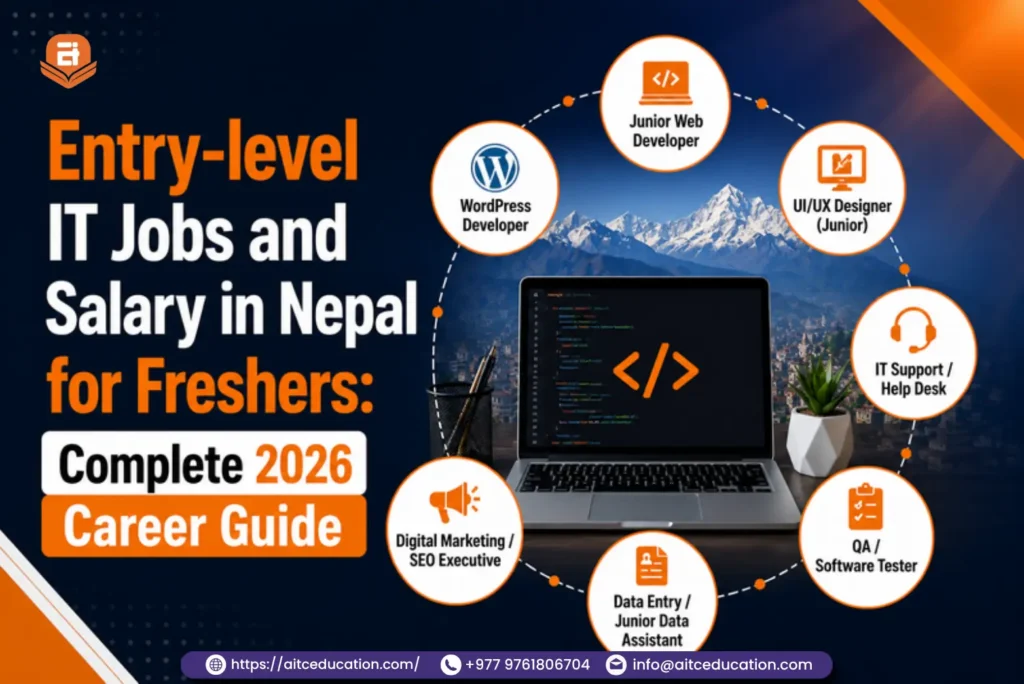
The demand for IT professionals has increased globally including Nepal. Companies in sectors like banking, fintech, startups, outsourcing firms, telecom, and even NGOs are actively hiring technical roles, creating strong IT career opportunities in Nepal for freshers
Along with local opportunities, remote jobs and freelancing have also opened doors for Nepali beginners to work with global clients.
Even though the IT industry offers many career opportunities today, starting the journey is still confusing for many beginners. +2 graduates, freshers with a bachelor’s degree, or professionals who want to switch careers often struggle to understand where to begin.
They are unsure about which field to choose what skills to learn, and what to realistically expect in terms of jobs and salary.
This guide will help you clearly understand the most common entry-level IT jobs available in Nepal and what you can realistically expect as a fresher in 2026.
It also breaks down salary ranges based on skills, experience, and company type so you can set the right expectations.
Why Choose IT as a Career in Nepal?
IT is one of the fastest-growing and highest-paying career fields in Nepal right now.
The growing demand and remote job opportunities with international clients make IT a good career choice for beginners who want long-term growth.
Another advantage is that you don’t always need a degree to start a career in IT. Many entry-level jobs focus more on your practical skills and projects than your formal education.
Key reason to choose IT:
- High job demand both locally and globally
- Remote work and freelancing opportunities
- Fast skill-based learning (3–6 months of training)
- Skill-based entry
- Strong long-term career growth potential
General IT Career Progression for Beginners in Nepal
Career progression shows how your role, skills, and salary improve step by step as you gain experience. IT careers are heavily driven by continuous learning, hands-on projects, problem-solving ability, and real-world work experience rather than just academic qualifications.
Most beginners start at an entry-level position, and within a few years, they can move into higher roles with better responsibilities and a higher salary.
1. Internship Level (Learning Phase):
At this stage, beginners are just starting to understand real work environments and basic tools.
- You learn the fundamentals of your chosen IT field
- You work on small tasks or guided projects
- Focus is mainly on learning, not earning
Salary at this stage usually ranges from NPR 5,000 to 20,000 per month, and in some cases, internships may also be unpaid depending on the company and role.
This stage builds your foundation and prepares you for real job roles.
2. Entry-Level (Fresher Level):
- At this stage, you start your first official job in the IT field after completing training or an internship. This is where you begin applying your skills in real projects with some guidance from senior team members.
- You work as a junior developer, designer, tester, or support staff member
- You handle basic real-world tasks in a professional environment
- You start gaining practical industry experience
Salary at this stage usually ranges from NPR 20,000 to 50,000 per month, depending on your skills, project experience, and the type of company you join.
This stage helps you move from learning to real professional work experience.
3. Mid-Level (Experienced Professional):
At this stage, you have gained a few years of experience and developed strong practical skills in your field.
You can now work more independently and handle complex tasks with less supervision.
- You work on complete project modules or systems
- You may guide juniors or interns in their work
- You solve real technical problems and improve system performance
Salary at this stage usually ranges from NPR 50,000 to 120,000 per month, depending on your specialization, experience, and company type.
This stage represents strong growth in both responsibility and technical expertise.
4. Senior Level (Expert / Leadership Role):
At this stage, you are an experienced professional who takes full responsibility for projects, technical decisions, and sometimes team leadership.
You are expected to handle complex systems and guide overall project direction.
- You lead projects or development teams
- You make important technical and architectural decisions
- You specialize in advanced areas of IT
Salary at this stage usually starts at NPR 120,000 and can go up to 300,000+ per month, depending on expertise, company size, and role.
This stage reflects high-level expertise, leadership, and deep industry experience.
Key Factors Impacting Starting Pay in IT Field
Starting salary in the IT field is not fixed; it varies based on your:
- Skillset & specialization
- Education & credentials
- Practical experience (projects/internships)
- Company type (startups, outsourcing/international firms)
- Job role and responsibility level
- Market demand for specific skills
- Location or remote work opportunities
- Interview performance
- Negotiation skills
In simple terms, better skills + experience = higher starting salary.
Skills Required for Freshers to Get First IT Job
Freshers with basic and practical skills have better chances of getting hired in the IT field than someone with just a degree or certificate.
Pure beginners with no practical experience often struggle in the job market because competition is increasing every year.
Basic skills required:
- Logical thinking and problem-solving ability
- Basic IT knowledge related to your chosen field
- Communication skills
- Willingness to learn continuously
While even small practical experiences like mini projects can make a big difference during hiring, as they showcase the practical skills.
What Companies Expect from Fresh IT Graduates
The growing popularity of IT careers has increased competition, so companies are becoming more selective when hiring freshers. That does not mean they expect perfection, but they do expect basic readiness and practical exposure.
1. Technical Skills
Companies expect freshers to have at least a basic understanding of the IT field they want to enter.
For example, students interested in web development should know the fundamentals of HTML, CSS, and JavaScript, while designers should be familiar with basic design tools.
Freshers are not expected to know everything, but having foundational technical knowledge helps employers understand that you are serious about the field and ready to learn further.
2. Practical Experience
Practical experience is one of the most important things companies look for when hiring beginners.
Instead of only completing theory or watching tutorials, freshers should work on small real-world projects to demonstrate their skills.
Having a portfolio, GitHub account, personal website, or design samples gives employers proof of your abilities.
Moreover, internship experience or practical training is also considered a strong advantage because it shows exposure to real work environments.
3. Soft Skills
Technical knowledge alone is not enough in the IT industry. Companies also value soft skills such as communication, teamwork, professionalism, and willingness to learn.
Freshers should be able to communicate clearly, work with teams, accept feedback, and adapt to new technologies or work environments.
A positive attitude and responsible behavior can leave a strong impression during interviews.
4. Beginner Tools
Freshers should also become familiar with some commonly used beginner tools in the IT industry.
For example, GitHub is widely used for managing coding projects and version control, Figma is important for UI/UX design beginners, and Excel is useful for data-related tasks.
Similarly, basic HTML, CSS, and JavaScript tools help web development beginners understand how websites are built and managed in real projects.
Top Entry-Level IT Jobs in Nepal for Freshers (With Salary & Career Progression)
Entry-level IT jobs in Nepal offer beginners a starting point to enter the tech industry with basic skills or training.
Below are the most common roles, their starting salaries, and how each career grows over time.
1. Junior Web Developer
Entry-level web developers build and maintain basic websites using HTML, CSS, and JavaScript under senior guidance.
Entry-Level Salary: Junior Web Developer salary range around NPR 25,000 – 50,000 per month in Nepal.
Career Progression:
- Junior Web Developer
- Web Developer
- Frontend / Backend Developer
- Full-Stack Developer
- Senior Software Engineer / Tech Lead
This role builds a strong foundation for a long-term career in software development.
2. WordPress Developer
WordPress developers create and manage websites using themes, plugins, and page builders without heavy coding.
Entry-Level Salary: Fresh WordPress developers in Nepal generally earn around NPR 20,000 – 30,000 per month based on practical skills and freelance experience.
Career Progression:
- Junior WordPress Developer
- WordPress Developer
- Web Developer (Custom CMS)
- Full-Stack Developer / Freelance Specialist
This role is ideal for quickly starting a career in website development and freelancing.
Those interested in website development can also read our guide on WordPress careers in Nepal to learn about salaries, job demand, freelancing opportunities, and the skills employers look for.
3. UI/UX Designer (Junior)
UI/UX designers focus on creating user-friendly app and website designs using tools like Figma.
Entry-Level Salary: Junior UI/UX designers in Nepal commonly earn between NPR 25,000 – 50,000 per month, depending on portfolio quality and creativity.
Career Progression:
- Junior UI/UX Designer
- UI/UX Designer
- Senior Designer
- Product Designer
- UX Researcher / Design Lead
This role is perfect for creative individuals interested in building user-friendly digital experiences.
Interested in becoming a designer? Our guide on what is UI/UX design explains the fundamentals, essential skills, tools, and career paths for beginners.
4. IT Support / Help Desk
IT support professionals help companies solve technical issues, maintain systems, and assist users.
Entry-Level Salary: IT support freshers usually earn around NPR 8,000 – 20,000 per month, depending on technical knowledge and company size.
Career Progression:
- IT Support Executive
- System Administrator
- Network Engineer
- IT Manager
- Infrastructure Specialist
This role is a strong starting point for understanding real-world IT systems and operations.
5. QA / Software Tester
QA testers check software and apps for bugs and ensure everything works properly before release.
Entry-Level Salary: Beginner QA testers in Nepal typically earn around NPR 20,000 – 45,000 per month based on testing skills and technical understanding.
Career Progression:
- Junior QA Tester
- QA Engineer
- Automation Tester
- QA Lead
- Software Quality Manager
This role helps build attention to detail and opens doors to advanced software testing careers.
6. Data Entry / Junior Data Assistant
This role involves managing, updating, and organizing company data in systems and spreadsheets.
Entry-Level Salary: Entry-level data assistants in Nepal generally earn around NPR 15,000 – 20,000 per month, depending on workload and company type.
Career Progression:
- Data Entry Operator
- Data Assistant
- Data Analyst
- Business Analyst
- Data Scientist (with advanced skills)
This role is often the first step into the growing field of data and analytics.
7. Digital Marketing / SEO Executive
Digital marketers handle online promotion, social media, and website ranking on search engines.
Entry-Level Salary: Fresh digital marketing and SEO executives usually earn around NPR 20,000 – 45,000 per month based on SEO, content, and marketing skills.
Career Progression:
- Digital Marketing Executive
- SEO Specialist / Social Media Manager
- Digital Marketing Manager
- Growth Marketer / Marketing Head
This role is a great entry point for building careers in online business and marketing. Learn how to start a career in digital marketing in Nepal, or, if SEO interests you, follow our SEO career roadmap for beginners.
8. Cybersecurity / SOC Analyst (Junior)
Cybersecurity beginners monitor systems and help protect companies from cyber threats.
Entry-Level Salary: Junior cybersecurity professionals in Nepal can earn around NPR 30,000 – 60,000 per month due to increasing demand for security skills.
Career Progression:
- Junior SOC Analyst
- Security Analyst
- Cybersecurity Engineer
- Penetration Tester (Ethical Hacker)
- Security Architect
This role is ideal for those interested in protecting systems and building high-demand security skills.
9. Junior DevOps / Cloud Engineer
DevOps engineers help manage deployment, servers, and cloud infrastructure for applications.
Entry-Level Salary: Entry-level DevOps and cloud engineers in Nepal commonly earn around NPR 35,000 – 70,000 per month depending on cloud and automation knowledge.
Career Progression:
- Junior DevOps Engineer
- DevOps Engineer
- Cloud Engineer (AWS/Azure)
- Senior DevOps Specialist
- Cloud Architect
This role offers one of the fastest-growing and highest-paying career paths in IT
How to Start an IT Career in Nepal: Beginner Roadmap
Getting your first IT job may feel difficult at the beginning, but it becomes much easier when you follow a clear and structured approach.
Many freshers struggle not because of a lack of ability, but because they don’t follow a proper path.
By focusing on the right steps, skills, projects, and consistent effort, you can significantly improve your chances of getting hired.
Here are practical steps you should follow:
Step 1: Choose an IT Field
Start by selecting one specific area, such as web development, UI/UX design, digital marketing, data analytics, or IT support.
Avoid trying to learn everything at once, as it creates confusion. Picking one field helps you focus your learning and build relevant skills faster.
Step 2: Complete IT Training (3–6 Months)
Enroll in a structured training program to learn the fundamentals of your chosen field.
Good IT training courses will guide you step by step, teach you practical skills, and introduce you to real tools used in the industry.
This phase helps you move from beginner level to job-ready level.
Step 3: Build 2–3 Real Projects
After learning the basics, start working on small real-world projects. For example:
- A website (for developers)
- App design (for designers)
- Campaign or SEO work (for marketers)
These projects prove your skills to employers and are more valuable than just theoretical knowledge.
Step 4: Create a Portfolio
Organize your work in a portfolio so recruiters can easily see your abilities.
- Use GitHub for coding projects
- Create a personal website or design portfolio
A strong portfolio can significantly increase your chances of getting hired.
Step 5: Apply for Internships First
Internships are the easiest entry point for freshers. Even if the pay is low or unpaid, the experience you gain is extremely valuable.
Many companies hire interns as full-time employees after a few months.
Step 6: Improve Communication Skills
Practice explaining your projects, answering basic questions, and communicating clearly.
Good communication helps you perform better in interviews and work effectively in a team.
Step 7: Apply to Startups and Small Companies
Instead of applying only to big companies, focus on startups and small firms. They are more open to hiring freshers and provide hands-on learning opportunities.
Importance of IT Training and Internship Program for Beginners
IT training is essential for beginners because it bridges the gap between theory and real job requirements. Without structured learning, many freshers struggle to get their first job.
Why training is important:
- Builds a strong technical foundation
- Improves confidence in interviews
- Makes students job-ready
- Helps understand industry workflow
- Helps create projects and a strong portfolio
- Increases chances of getting internships and entry-level jobs
Both online and offline IT training programs are available in Nepal. Structured institutes like AITC Education help beginners build skills step by step and prepare for entry-level jobs.
They focus on practical learning, real projects, and industry-relevant tools, making it easier for students to transition into real job roles.
With guided mentorship and hands-on experience, AITC supports students in becoming confident, job-ready candidates.
Additionally, they help students with internship opportunities and placement support to connect them with real job opportunities.
Best IT Training Paths for Beginners in Nepal
Here are some of the most beginner-friendly and job-oriented IT paths:
- Web Development (HTML, CSS, JavaScript)
- UI/UX Design (Figma and design basics)
- Graphic Design
- Digital Marketing & SEO
- Basic Data Analytics
- WordPress Development
Each path offers different job opportunities based on interest and skills.
Where to Find Entry-Level Vacancies
You can find entry-level IT jobs in Nepal through multiple reliable sources if you know where to find.
Many freshers struggle not because there are no opportunities, but because they are not using the right platforms or methods.
By exploring different job sources and applying consistently, you can increase your chances of getting interviews and job offers.
Here are the most effective places to find IT job opportunities:
- Job Portals (Merojob, Kumari Job): These platforms regularly list verified entry-level IT jobs where freshers can filter roles based on skills, experience, and location.
- Company Career Pages: Many IT companies post direct job openings on their official websites, often giving early access to fresher and internship opportunities.
- LinkedIn Job Listings: LinkedIn helps you find IT jobs posted by companies and recruiters while also allowing you to build a professional profile and connect with employers.
- Social Media Job Groups: Facebook and other social groups frequently share fresher IT jobs, internships, and urgent hiring updates from small companies and startups.
- Recruitment Agencies: Recruitment agencies connect job seekers with companies hiring for entry-level roles, including positions not always publicly advertised.
- Networking and Referrals: Networking with professionals, seniors, and friends can lead to referral opportunities, which often have a higher chance of selection.
Challenges Beginners Might Face
Starting a career in IT comes with real challenges, especially for freshers with little or no experience.
Understanding these challenges helps you prepare mentally and plan your next steps more effectively.
- High competition in IT jobs
- Lack of experience requirement
- Difficulty getting first internship
- Fast-changing technology
- Low starting salary pressure
How to overcome these challenges:
The best way to overcome these challenges is through consistent effort, practical learning, and the right strategy.
Instead of feeling stuck, you can try these things:
- Focus on building real projects instead of only theory
- Start with internships or freelancing to gain experience
- Learn continuously to keep up with new technologies
- Build a strong portfolio (GitHub, personal website, design work)
- Be consistent and apply to multiple companies instead of waiting for one job
Conclusion
IT is one of the most practical and promising career options you can choose in Nepal, but your success depends on how you start.
If you’re a beginner, don’t worry about having everything perfect.
Focus on building real skills, working on small projects, and gaining experience step by step.
Remember, your first job might not pay a high salary but it will give you the foundation you need to grow.
In IT, growth can be surprisingly fast. With consistency, practice, and the right mindset, your skills improve and so does your income.
Every expert was once a beginner; your journey starts with one step, take it today.
Frequently Asked Question
What is entry-level IT salary in Nepal?
Entry-level IT salary usually ranges from NPR 20,000 to 50,000 per month.
Can I start IT after +2 in Nepal?
Yes, you can start IT after +2 with proper training and basic skills.
Do IT jobs require a degree?
Not always. Many entry-level jobs focus on skills and practical experience.
Which IT field is best for beginners?
Web development, UI/UX design, and digital marketing are beginner-friendly.
How long does it take to get an IT job?
Most people take 6–12 months to get their first IT job, depending on how consistently they learn, build projects, and apply for jobs. Some achieve it faster with focused training and practical experience.