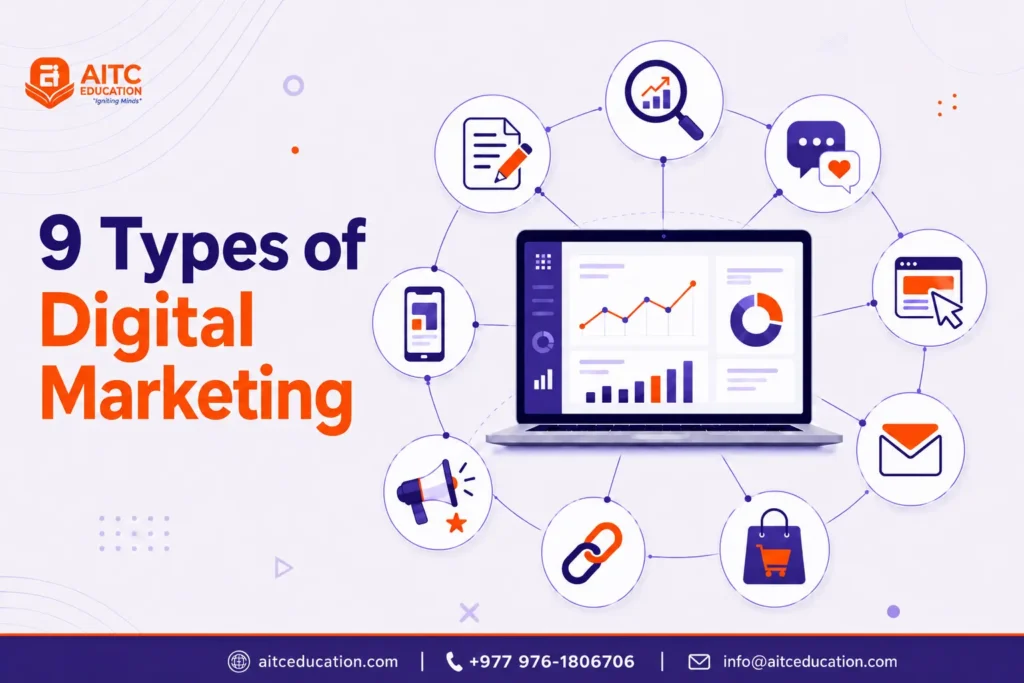
There are different types of digital marketing methods businesses use to reach customers, build brand awareness, generate leads, and increase sales. From search engines and social media to email campaigns and online marketplaces, each digital marketing channel serves a different purpose and helps businesses achieve specific marketing goals.
Understanding these channels is important before choosing a marketing strategy or deciding which digital marketing skills to learn. Whether you’re a student, career switcher, or business owner, this guide explains nine of the most widely used types of digital marketing, how each one works, when to use it, and how they can help you build a digital marketing career in Nepal.
What is Digital Marketing?
Digital marketing is the practice of promoting products, services, or brands through online platforms such as search engines, websites, social media, email, and mobile applications. Unlike traditional marketing, it allows businesses to reach targeted audiences, measure campaign performance, and improve strategies using real-time data.
In Nepal, digital marketing has become increasingly important as more consumers use Google, Facebook, Instagram, TikTok, and online marketplaces to discover products and services. Businesses of all sizes now invest in digital marketing to increase brand awareness, generate leads, and drive online sales.
The growing adoption of digital platforms has also created strong demand for skilled professionals. Whether you want to grow a business or build a career, understanding digital marketing is the first step toward choosing the right specialization and developing practical, job-ready skills.
Search Engine Optimization (SEO)
Search Engine Optimization (SEO) is the process of improving a website so it appears higher in search engine results when people search for relevant information, products, or services. Unlike paid advertising, SEO focuses on improving a website’s visibility in organic search results, helping businesses attract relevant traffic over the long term.
When done correctly, SEO helps businesses reach people who are already interested in what they offer. Instead of interrupting potential customers with ads, it increases the chances of being found when they are actively searching for solutions.
How SEO Works
Search engines like Google use algorithms to decide which webpages are most relevant and useful for a user’s search query. SEO works by helping search engines understand your website while improving the overall experience for visitors.
Factors such as relevant content, keyword optimization, website speed, mobile responsiveness, and quality backlinks all influence how well a page ranks. Although results usually take time, consistent SEO efforts can generate steady traffic and qualified leads over the long term.
On-Page SEO
On-Page SEO focuses on optimizing the content and structure of individual webpages. This includes using relevant keywords naturally, writing clear headings, optimizing title tags and meta descriptions, adding descriptive image alt text, and creating valuable content that answers users’ questions.
A well-optimized page is easier for both search engines and visitors to understand. High-quality content that addresses search intent also encourages users to stay longer on the website, which can improve overall performance.
Off-Page & Technical SEO
Off-page SEO involves activities outside your website that improve its credibility, such as earning backlinks from reputable websites and building your online reputation. These signals help search engines determine whether your content is trustworthy and authoritative.
Technical SEO focuses on the performance and structure of your website. Improving page speed, fixing broken links, ensuring mobile friendliness, and making your website easy for search engines to crawl all contribute to better visibility in search results.
Content Marketing
Content marketing is the process of creating and sharing valuable content that informs, educates, or entertains your target audience. Instead of focusing on direct sales, it helps businesses build trust, answer customer questions, and establish long-term relationships.
By consistently providing useful information, businesses can build trust, encourage engagement, and gradually turn readers into customers. This makes content marketing one of the most effective long-term digital marketing strategies.
Common Types of Content Marketing
Content marketing comes in many formats, allowing businesses to connect with audiences in different ways. Popular examples include blog articles, videos, infographics, case studies, e-books, podcasts, email newsletters, and guides.
The best format depends on your audience and business goals. For example, educational blogs can answer frequently asked questions, while short-form videos and infographics are often used to simplify complex topics and increase engagement on social media.
How Content Marketing Supports SEO and Social Media
Content marketing works closely with other digital marketing channels, especially SEO and social media marketing. Well-written articles that target relevant keywords can improve search engine rankings, while valuable content gives businesses something meaningful to share across their social media platforms.
Instead of creating separate content for every platform, businesses can repurpose one piece of content into multiple formats. A single blog post can become social media posts, short videos, email newsletters, or downloadable guides, helping brands reach more people while maintaining a consistent message.
For Nepali businesses, content marketing is an effective way to demonstrate expertise, build credibility, and attract potential customers without relying solely on paid advertising. If you’d like to learn how content marketing fits into a complete digital strategy, explore AITC Education’s Digital Marketing Training, where you’ll gain practical experience in content creation, SEO, social media, and other essential marketing skills.
Social Media Marketing (SMM)
Social media marketing is the practice of using social media platforms to promote a brand, connect with customers, and achieve marketing goals. It helps businesses increase visibility, engage with their audience, and drive traffic to their websites or online stores.
In Nepal, platforms such as Facebook, Instagram, TikTok, LinkedIn, and YouTube have become essential marketing channels. Businesses use these platforms to increase brand visibility, engage with their audience, promote products, and build lasting customer relationships.
Organic Social Media Marketing
Organic social media marketing focuses on growing an audience without paying for advertisements. Businesses create posts, reels, stories, videos, and other content to educate, entertain, or inform their followers while encouraging engagement through comments, shares, and messages.
Consistency is one of the most important factors in organic growth. Regularly publishing valuable content helps businesses build trust, strengthen customer relationships, and create a loyal online community over time.
Paid Social Media Marketing
Paid social media marketing involves running advertisements to reach a larger or more targeted audience. Platforms like Facebook and Instagram allow businesses to target users based on factors such as age, location, interests, behavior, and purchasing habits.
Unlike organic content, paid campaigns can deliver faster results and are often used to promote products, generate leads, increase website traffic, or boost sales. Many businesses combine organic and paid strategies to maximize their reach and marketing performance.
For businesses in Nepal, social media has become one of the most effective ways to connect with local customers while expanding their online presence. If you want to learn how to create engaging content, manage campaigns, and run effective advertisements, explore AITC Education’s Social Media Marketing Training, where you’ll gain practical skills through hands-on projects.
Pay-Per-Click (PPC) Advertising
PPC advertising is a digital marketing strategy where businesses pay a fee each time someone clicks on their advertisement. Instead of waiting to gain visibility through organic methods, PPC helps businesses appear in front of potential customers almost immediately.
The two most popular PPC platforms are Google Ads and Meta Ads. Google Ads displays advertisements on Google Search and partner websites, making it ideal for reaching people actively searching for products or services. Meta Ads, on the other hand, help businesses reach users on Facebook, Instagram, and Messenger based on their interests, behavior, and demographics.
PPC is often the best choice when businesses need quick results or want to promote time-sensitive campaigns, such as product launches, seasonal offers, or limited-time discounts. While SEO focuses on building long-term organic visibility, PPC can generate traffic, leads, and sales much faster.
Many successful businesses use both strategies together. They invest in SEO for sustainable long-term growth while using PPC advertising to capture immediate opportunities and reach highly targeted audiences.
For businesses and aspiring marketers in Nepal, understanding PPC is an important skill as more companies invest in paid digital advertising. If you’d like to learn how to create campaigns, target the right audience, and measure advertising performance, explore AITC Education’s PPC Training and gain hands-on experience with industry-standard tools.
Email Marketing
Email marketing is the practice of sending targeted messages to people who have already shown interest in your business, such as subscribers, customers, or website visitors. Despite being one of the oldest digital marketing channels, it continues to deliver one of the highest returns on investment (ROI) because businesses communicate directly with an audience that has already chosen to hear form them.
Unlike social media, where algorithms control who sees your content, email allows brands to reach subscribers directly. This makes it especially useful for building relationships, sharing updates, and encouraging repeat purchases.
Businesses commonly use email marketing for lead nurturing, customer retention, and promotional campaigns. For example, an e-commerce store may send discount offers, a training institute may share course updates, and a software company may send educational content that helps potential customers make informed decisions.
Email marketing also supports other digital marketing channels. Someone who discovers a business through SEO, social media, or PPC advertising can later join an email list and continue receiving valuable content, offers, and reminders over time.
For Nepali businesses, email marketing is a cost-effective way to stay connected with customers without relying entirely on paid advertising. If you’d like to learn how to build subscriber lists, create campaigns, automate emails, and measure performance, explore AITC Education’s Email Marketing Training and gain practical experience with real campaign workflows.
E-Commerce Marketing
E-commerce marketing is the process of promoting products and increasing sales through online stores and digital marketplaces. It combines multiple digital marketing channels, such as SEO, social media, PPC advertising, and email marketing, to attract customers and encourage them to complete a purchase.
In Nepal, e-commerce marketing has become increasingly important as more businesses sell through platforms like Daraz, Facebook Marketplace, and their own online stores. As online shopping continues to grow, businesses need effective strategies to stand out from competitors and reach the right customers.
One important aspect of e-commerce marketing is product listing optimization. Writing clear product titles, using relevant keywords, uploading high-quality images, and providing accurate descriptions can improve visibility on marketplace search results and help customers make informed purchasing decisions.
Businesses also use marketplace advertising to promote products to shoppers who are already looking to buy. Sponsored product ads on marketplaces and paid campaigns on platforms like Facebook and Instagram help increase product visibility and generate more qualified traffic.
Another effective strategy is retargeting, which allows businesses to reconnect with people who have previously visited their website or viewed a product without making a purchase. Showing relevant advertisements to these potential customers often increases the likelihood of converting interest into sales.
For online sellers in Nepal, combining product optimization, marketplace advertising, and retargeting can significantly improve both visibility and revenue. If you’d like to learn how to build and promote successful online stores, explore AITC Education’s E-Commerce Marketing Training, where you’ll gain practical skills in marketplace selling, online advertising, and digital sales strategies.
Affiliate Marketing
Affiliate marketing is a performance-based marketing strategy where individuals or businesses earn a commission by promoting another company’s products or services. Instead of creating their own products, affiliates recommend products through blogs, websites, YouTube videos, or social media and receive a percentage of each successful sale or lead generated through their unique referral link.
In practice, a business provides an affiliate link, the affiliate shares it with their audience, and a commission is paid whenever someone completes a purchase or performs a specific action through that link.
Affiliate marketing is popular because it offers a low-cost way for businesses to reach new customers while giving content creators an opportunity to earn income. Bloggers, influencers, and website owners often include affiliate links in product reviews, tutorials, buying guides, or educational content that helps readers make informed decisions.
However, it’s important to have realistic expectations. Affiliate marketing rarely generates significant income overnight, especially for beginners. Success usually depends on building an engaged audience, creating valuable content, and consistently recommending products that are relevant and trustworthy.
For aspiring digital marketers, understanding affiliate marketing provides valuable insight into online sales, audience building, and content-driven promotion. Even if you don’t pursue it as a primary channel, knowing how affiliate partnerships work helps you recognize opportunities and understand how many online creators and businesses earn revenue today,
Influencer Marketing
Influencer marketing is a strategy where businesses collaborate with content creators to recommend or promote their products or services. Instead of relying only on traditional advertisements, brands use influencers to create authentic content that builds trust and encourages people to explore or purchase their offerings.
Influencers are generally grouped into micro and macro categories based on the size of their audience. Micro influencers usually have smaller but highly engaged communities, making them a good choice for businesses targeting niche audiences, while macro influencers have a much larger reach and are often used to increase brand awareness on a broader scale.
In Nepal, influencer marketing has grown rapidly alongside the popularity of platforms such as Facebook, Instagram, TikTok, and YouTube. Many local businesses now collaborate with creators to promote restaurants, fashion brands, beauty products, educational institutions, travel services, and online stores.
Choosing the right influencer is often more important than choosing the one with the largest following. Businesses that partner with creators whose audience matches their target market are more likely to build credibility, generate engagement, and achieve better marketing results.
As Nepal’s creator economy continues to grow, influencer marketing is becoming an important part of many digital marketing strategies. Understanding how brands collaborate with creators can help businesses promote their products more efficiently while giving aspiring marketers another valuable skill to add to their digital marketing knowledge.
Mobile Marketing
Mobile marketing focuses on reaching customers through smartphones and tablets using channels such as SMS, mobile applications, push notifications, and mobile-friendly advertisements. As mobile internet usage continues to grow, it has become an essential part of many digital marketing strategies.
Many businesses use SMS marketing to share promotional offers, appointment reminders, delivery updates, and important announcements. Mobile apps also allow businesses to send push notifications that encourage users to return, complete purchases, or explore new products and services.
Another important aspect of mobile marketing is creating advertisements and websites that work well on mobile devices. Fast-loading, mobile-friendly websites and responsive ads improve user experience and increase the chances of conversions.
In Nepal, where smartphones are the primary way many people access the internet, businesses that optimize their marketing for mobile devices can reach customers more effectively. Whether combined with social media, PPC advertising, or email marketing, mobile marketing helps brands connect with audiences wherever they are.
Which Type of Digital Marketing Should You Learn or Use First?
There isn’t a single “best” type of digital marketing for everyone. The right choice depends on your goals, whether you’re trying to grow a business, build a career, or specialize in a particular skill.
Instead of learning every digital marketing channel at once, start with the one that aligns most closely with what you want to achieve. The table below can help you choose the best starting point.
Your Goal | Best-Fit Channel |
Improve Google rankings and attract organic traffic | SEO |
Build an audience and increase brand engagement | Social Media Marketing |
Generate immediate website traffic or leads | PPC Advertising |
Retain customers and promote offers | Email Marketing |
Grow an online store or marketplace business | E-Commerce Marketing |
Start a career in digital marketing | Digital Marketing |
No matter which channel you start with, building practical skills through real projects is more valuable than trying to master every area at once. As you gain experience, you’ll naturally understand how different digital marketing channels work together to achieve better results.
How to Build a Career in Digital Marketing in Nepal
Building a career in digital marketing doesn’t require mastering every channel from the beginning. Most professionals start with one specialization, build practical experience, and gradually expand their skills over time.
Hands-on experience is just as important as theoretical knowledge. Working on personal projects, creating sample campaigns, optimizing websites, or managing social media pages helps you build a portfolio that demonstrates your skills to potential employers.
As you gain experience, continue learning complementary skills such as SEO, content marketing, PPC advertising, email marketing, and analytics. Understanding how these channels work together makes you a more versatile digital marketer and increases your career opportunities.
The demand for skilled digital marketers continues to grow in Nepal as businesses invest more in their online presence. Whether you want to work for a company, join a digital marketing agency, or become a freelancer, practical skills and real-world experience can help you stand out in a competitive job market.
If you’re ready to begin your journey, explore our guide on How to Start a Digital Marketing Career in Nepal for a step-by-step roadmap that walks you through building skills, gaining experience, and landing your first role.
Conclusion
Digital marketing offers a wide range of opportunities, but you don’t need to master every channel to get started. Choosing one area that matches your goals, whether it’s SEO, social media marketing, PPC, email marketing, or e-commerce marketing, will help you build practical skills more effectively than trying to learn everything at once.
As your knowledge and experience grow, you can gradually expand into other digital marketing channels and develop a well-rounded skill set. If you’re ready to begin your journey, explore AITC Education’s digital marketing courses and gain hands-on experience through real-world projects that prepare you for business success or a rewarding digital marketing career in Nepal.
Frequently Asked Questions
What are the most common types of digital marketing?
Some of the most common types of digital marketing are SEO, content marketing, social media marketing, PPC advertising, email marketing, e-commerce marketing, affiliate marketing, influencer marketing, and mobile marketing.
Which type of digital marketing is best for beginners in Nepal?
SEO, social media marketing, and content marketing are excellent starting points because they build practical skills that are in high demand.
Do I need to learn all types of digital marketing?
No. Start with one specialization and expand your skills as you gain experience.
Which digital marketing skill pays the most in Nepal?
SEO, PPC advertising, and performance marketing are among the highest-paying digital marketing skills, especially for experienced professionals.